AI vs. Human Work for Students: Tasks, Evidence and Time
AI can create a quick first draft, but speed is not evidence that the result is correct. Match each student task to the right kind of assistance.
Why there is no honest universal AI-versus-human winner
A model can produce twenty practice-question ideas in seconds, while a student may need longer to write them. That speed difference says little about whether the questions match the course, whether the answer key is correct or whether a teacher permits the assistance. Conversely, a student who knows their own experiment, class discussion and assignment rubric may have crucial context a general-purpose model does not. Comparing AI and humans without defining the task, available evidence and success criterion creates a misleading ranking. This guide treats better and worse as decisions about specific workflows, not as laboratory results or claims that Lynara tested named models against people. Think in stages: generate, verify, decide and submit. A model may accelerate generation, while human responsibility is necessary for checking claims and making an authorized final choice. UNESCO's AI competency framework for students emphasizes critical judgment, human agency and responsible applications. Those ideas are useful when deciding what to delegate rather than assuming every task should be automated.
Often useful: brainstorming alternatives within a known brief
If an assignment permits generative help, an AI assistant can quickly offer alternative essay questions, possible poster headings or ways to arrange a presentation. It is particularly useful when the student already knows the rubric and needs a starting set of options. The output can be varied and cheap to revise, but it may contain topics outside the syllabus or ideas that are too broad to research. An effective prompt includes subject, grade level, maximum length, forbidden topics and a request for several distinct approaches. The student must still decide which option is workable. A good topic requires real evidence, sufficient time and permission to use the intended methods. A model's preference for a catchy title does not prove that credible sources exist. The best division of labor is often: let the assistant suggest a shortlist, have the student reject options that violate the constraints, and use the teacher's requirements to finalize one. This is different from allowing a model to invent a completed research project and pretending its observations occurred.
Often useful: formatting, reorganizing and checklist creation
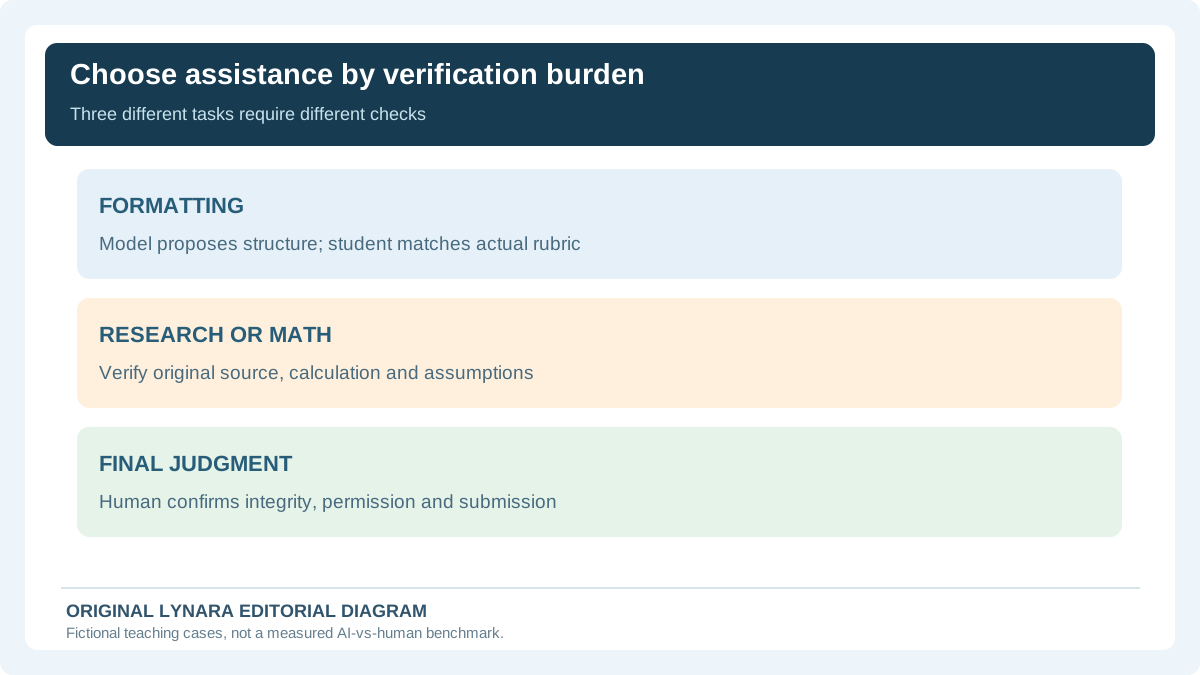
When the source facts are already verified, a model can assist with turning a long task description into a checklist or offering different ways to organize notes. It may suggest headings for a report, create a revision queue or rephrase a confusing explanation. These are potentially time-saving tasks because the student can compare the transformed output with a known source. The ability to check against something real is an advantage: if a required task was omitted, the mismatch is visible. However, a long generated checklist can also add unwanted steps. It may misread dates, reorder dependencies or invent an unstated requirement. Keep the original assignment nearby and compare every major item. For study-note compression, our source-checked PDF notes guide explains how to preserve exceptions and numbers. The specific purpose of this article is deciding whether AI should be used for a task in the first place, not repeating that summary workflow.
Weak without verification: finding authentic research sources
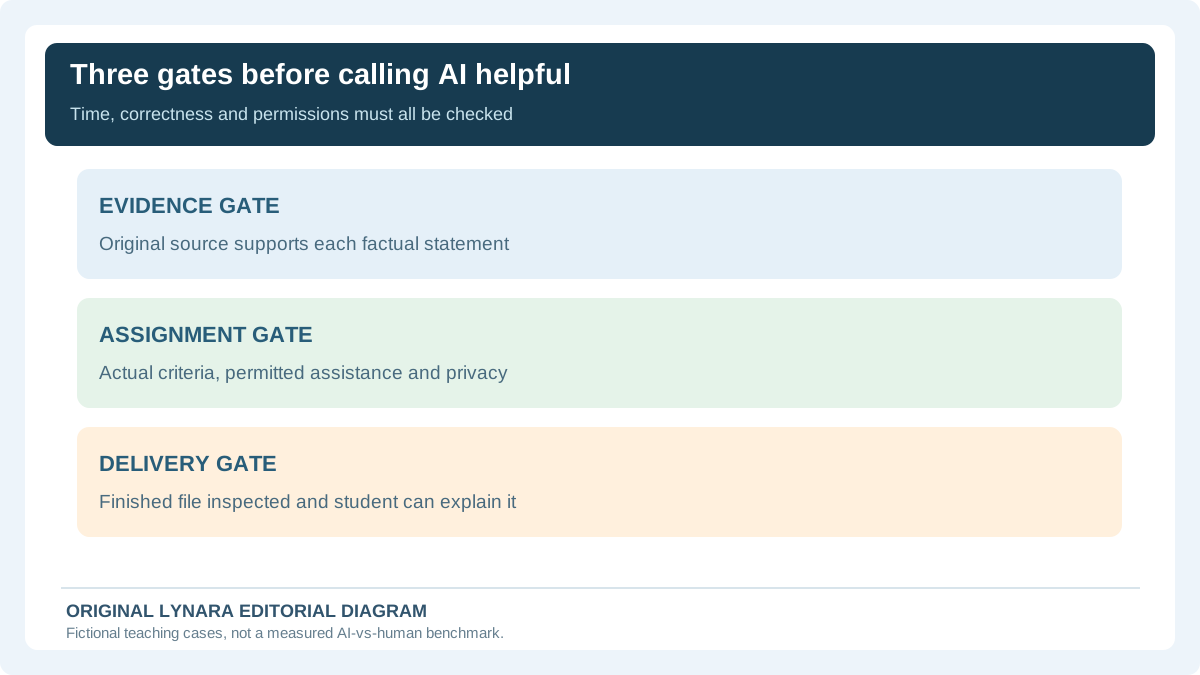
A conversational model may produce article titles, authors, DOIs and publication years that look authoritative but are not real. Even when a publication exists, the assistant can misstate its methods or claim it proves something stronger than the results support. Students should therefore avoid assigning a model sole responsibility for collecting citations or deciding which references are suitable. Searching real scholarly databases, opening the original record and reading the method are necessary steps when an academic claim depends on the source. A useful division is to ask AI what evidence would be relevant, then independently locate publications and check the claim-to-source link. Our source evaluation guide focuses on that deeper process. An AI-produced bibliography is not proof that the author did research. A human student's comparative advantage is not that every person remembers every publication correctly, but that they can inspect documents, notice missing support and be accountable for a traceable choice.
Weak without checks: mathematical and statistical conclusions
An AI explanation can be educational but may contain calculation errors or misunderstand the conditions. A student should check the actual input, mathematical operations and final constraints. Consider the illustrative equation 4(x − 2) = 20. Expanding gives 4x − 8 = 20, then 4x = 28 and x = 7. Substitution confirms 4(7 − 2) = 20. A model that answers x = 5 has not passed the test merely because it explains itself confidently. A person who also guesses x = 5 would fail by the same criterion. The important distinction is verifiability, not species. Straight arithmetic can be checked with a deterministic calculator, and unusual operations or domain restrictions may require independent reasoning. For a detailed treatment of equation recognition, extraneous roots and checking two simultaneous equations, use our step-by-step AI math solver guide. Here, the decision rule is that the fastest answer is not complete until an appropriate independent check has been performed.
Weak when context is missing: rubrics and classroom expectations
A model usually cannot know an instructor's private priorities, corrections made in class or restrictions on generative content unless they have been supplied and accurately understood. A generic suggestion to write five paragraphs can conflict with an assignment requiring a short annotated bibliography or a specific source comparison. Teachers may assess process, originality or evidence quality in ways that do not appear in a broad online writing template. The student has to interpret the actual instructions and may need to ask a clarifying question. Instead of requesting the whole assignment be done automatically, the student can ask an allowed assistant to map their draft against rubric items that they provide. The student then verifies whether each suggested change makes sense. If the rubric is unclear, instructor guidance has priority. There is no hidden AI trick that guarantees a higher grade without knowing what the evaluator requires. A polished model response that ignores the real submission format can waste more time than a plain human outline that meets every requirement.
Different strengths: visual design versus factual diagrams
AI image tools can help create mood boards, illustration styles and visual alternatives quickly. They may be helpful for a fictional classroom poster or a slide background. But a realistic image of a laboratory apparatus or a biological process is not evidence that the apparatus exists or that the scientific labels are correct. Generated diagrams can introduce impossible parts, inconsistent proportions or invented text. A student should obtain factual content from course material and verified references. The human review stage matters because the student is responsible for what the illustration communicates. For a conceptual diagram, make sure arrows, annotations and legend entries are accurate and accessible. If the assignment requires a real photograph, map or document, generated artwork is often the wrong medium altogether. Our educational AI image prompting guide explains how to separate visual drafts from correct labels. The comparison is between types of output, not a claim that human artists are always accurate or models are always inaccurate.
A task matrix with criteria instead of slogans
A practical student decision matrix has four columns: task, possible AI contribution, human verification and stop condition. For a presentation outline, AI may offer a structure; the student checks assignment coverage, sources and speaking time; stop if the generated structure misses mandatory sections. For math homework, AI may explain a step; the student substitutes results into the original question; stop if the answer violates the given restrictions. For a research reference, AI may suggest a search term; the student finds and reads the actual paper; stop if the citation cannot be verified. The local AI claim verification tracker provides a place to label claims as unverified, supported or contradicted, but it does not fetch scholarly evidence or certify citations. For a lab reflection, the assistant may help organize wording, but it cannot replace measurements actually taken. For a creative story, a model can suggest plots while the student chooses original themes and follows the assignment's collaboration rules. The goal of the matrix is repeatability. It prevents a tempting but vague claim that AI is better at thinking or humans are better at creativity, both of which depend heavily on how the task and result are defined.
An illustrative time-and-quality comparison
Imagine a student needs to turn verified notes into a five-slide outline. In one fictional workflow, they spend twenty-five minutes structuring the talk manually. In another, they use five minutes to prompt an AI, fifteen minutes to check each suggested claim against the notes and ten minutes to revise the order. The AI workflow takes thirty minutes, five longer than manual drafting. In a third fictional case, the prompt and checking take five plus eight plus six minutes, or nineteen minutes, saving six. These deliberately invented numbers show that AI does not automatically save time. The outcome depends on the quality of the input material, how much the tool invents and how hard the result is to review. Do not use these invented workflows as a benchmark of actual human and AI performance. A useful personal experiment is to record total time, correction effort and rubric coverage on a permitted task. Count all verification, not just the initial generation. Sometimes a familiar spreadsheet, reference book or student-written outline is the faster and more reliable solution.
Academic integrity, privacy and final responsibility
A teacher might allow brainstorming but not AI-produced final prose. Another might permit AI-assisted drafting with disclosure. Those rules change what constitutes a suitable workflow. Do not conceal generative assistance or upload classmates' work, private grades or restricted assessment material into a personal AI service without authorization. UNESCO's guidance for generative AI in education emphasizes privacy, safety and a human-centered approach. Keep an audit trail when appropriate: initial prompt, original notes, major corrections and the sources used to verify claims. This helps the student explain the result and prevents a confident generated paragraph from replacing an actual demonstration of learning. The most reliable rule is task specific. Delegate reversible, inspectable drafting assistance when permitted; keep evidence evaluation, factual sign-off, original experiences and responsibility with the student. To make your choice actionable, build a permission-aware assignment workflow that distinguishes manual work, permitted AI planning and teacher-approved drafting. A model is neither a universal shortcut nor a universally useless tool.
Run a paired task comparison that measures the finished product
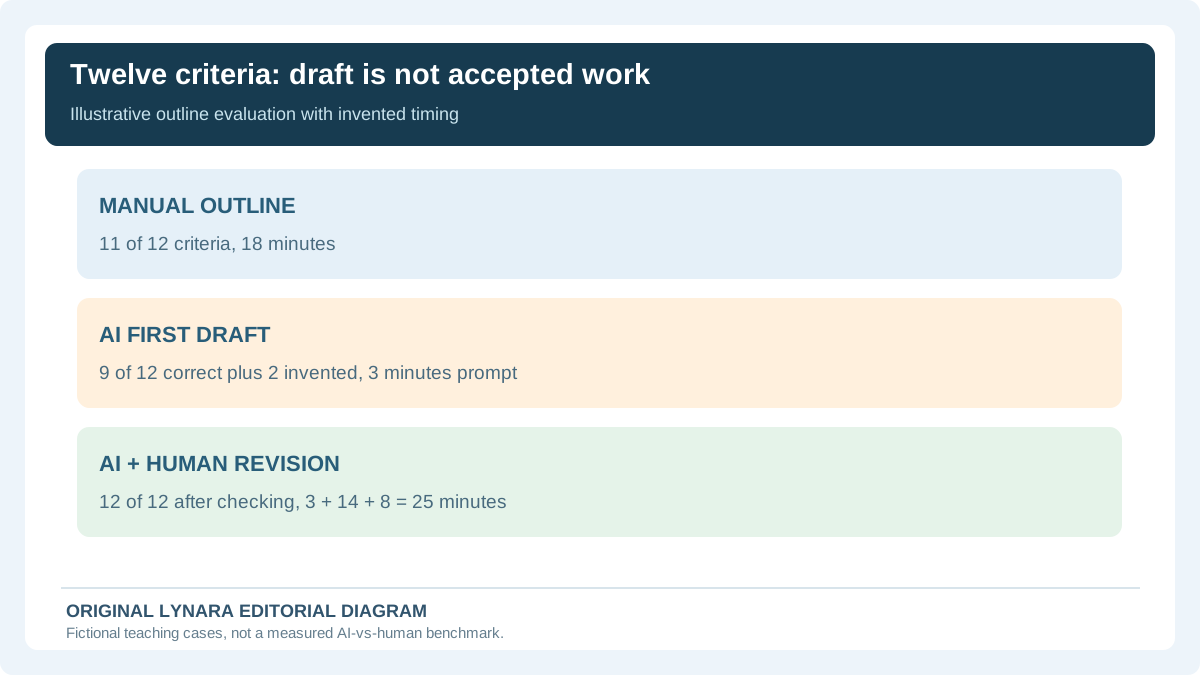
A student wants to decide whether AI helps organize a genuine twelve-criterion assignment brief. Instead of comparing a three-minute prompt with a completed hand-written plan, use the same evidence and the same rubric on both routes. The illustrative manual outline takes eighteen minutes and correctly covers eleven of twelve criteria. The invented AI draft takes three minutes but includes only nine correct criteria and two extra, unsupported requirements. A human spends fourteen minutes identifying missing and invented criteria and eight minutes finishing the revised outline, making 3 + 14 + 8 = 25 minutes in total. The fully reviewed version covers twelve criteria, but it takes seven minutes longer than the first manual version. Neither example is a real AI benchmark.
| Workflow | Verified criteria | Time | Caveat |
|---|---|---|---|
| Manual outline | 11 of 12 | 18 min | Needs one correction |
| AI initial draft | 9 of 12; two invented | 3 min | Not submission-ready |
| AI and human review | 12 of 12 | 25 min | Depends on real verification |
This comparison shows why a productivity claim needs at least two outcome measures: total time to a reviewable product and accurate coverage of the actual instructions. Do not calculate a percent productivity gain by comparing a rejected first draft with an accepted answer. The UNESCO AI Competency Framework for Students explicitly includes human-centered judgment and accountability. The UNESCO education guidance also emphasizes human oversight, privacy and educational appropriateness. Neither publication evaluates the fabricated twelve-criterion scenario or promises particular gains.
Build a shortlist of tasks by their correction cost. Reformatting an already verified outline may be quick to check. Research-paper citations need the actual publication opened and read. A mathematics solution needs independent algebra and the correct interpretation of its assumptions. Sensitive files require authorization before sharing, regardless of how well the model handles them. A claim such as “AI is better at citations” is too vague: a bibliography can be beautifully formatted while citing a nonexistent source.
Before accepting assistance, ask whether the work demonstrates your own understanding. The claim verification tracker can help record source checks, and the assignment checklist tool can organize permitted steps. Neither authenticates a citation automatically or transfers academic responsibility from the student to a model.
Evidence and limitations
Task comparisons are reasoned decision frameworks, not original performance benchmarks. All hypothetical results and time budgets are labeled; users must verify their assignment rules and original evidence. See editorial standards.
Score rubric coverage before calling a draft faster
Imagine an assignment with 12 explicitly listed rubric criteria. A fictional manual outline covers 11 correctly in 18 minutes. A fictional AI-assisted first draft covers nine correctly, omits three and invents two requirements not present in the rubric. After checking the original assignment, the student removes both invented items and adds the three missing criteria. The revised outline can cover 12 of 12, but that outcome depends on human verification, not on the first AI draft being accurate.
| Workflow | Correct criteria | Total time |
|---|---|---|
| Manual outline | 11 of 12 | 18 minutes |
| AI first draft | 9 of 12; 2 invented | 3-minute prompt, not final |
| AI plus human verification | 12 of 12 after correction | 3 + 14 + 8 = 25 minutes |
| Time difference | Not a quality score | 25 − 18 = 7 minutes longer |
Both workflows may still need a final source and originality review. The comparison is not a claim that people are universally faster or AI universally worse; it illustrates why measuring prompt time alone is misleading. If AI is permitted, use the Assignment AI Workflow Builder to separate permitted assistance from work the student must complete. Keep the original rubric visible and verify each claim against it before submission.