AI Math Solvers: Verify Steps, Domains and Answers
An AI solver can save time when you know how to verify what it read and how it reached an answer.
Different math helpers solve different problems
A photograph-based math application, a symbolic algebra engine and a general conversational assistant can produce similar-looking answers through different workflows. A photo solver begins by recognizing what is on the page. A symbolic engine interprets a mathematical expression and applies formal operations. A conversational assistant can explain the concept in ordinary language, create parallel problems and respond to questions about confusion. None of these strengths means that every result should be accepted automatically. A misread exponent or an omitted condition can turn a correct solution method into an answer to the wrong problem. Begin by identifying the nature of the task: is the difficulty entering the equation, finding the next transformation, interpreting a graph or checking a numerical result? Then choose the tool suited to that difficulty. This article is about a verification workflow, not an unsupported ranking of how often named products get questions right.
Photomath: verify that the photographed equation is correct
Photomath is known for accepting photographed or entered mathematical problems and showing solution steps for supported topics. Its official information is available at Photomath. The first important action after scanning is not reading the answer: it is comparing the displayed equation with the original. A minus sign can be mistaken for a plus, a subscript for a normal digit, or a denominator for part of a neighboring expression. If the transcription is wrong, the subsequent algebra may be internally coherent but irrelevant. Correct the input before evaluating the result. Use the steps to identify the operation that caused difficulty in your own attempt. If an app shows a transformation you cannot explain, try to reproduce it on paper and consult the source lesson. Plan availability and supported features can vary; check the current official help instead of assuming every step is included with every account.
Symbolab and WolframAlpha: compare symbolic output with the task
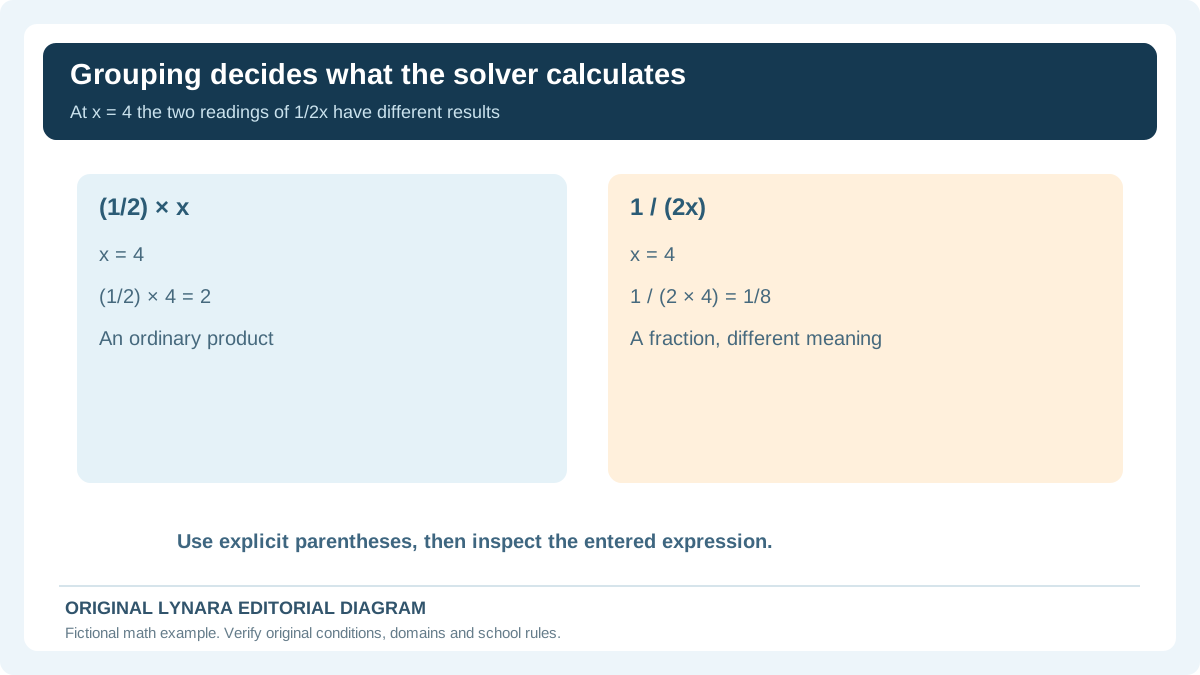
Symbolab and WolframAlpha offer mathematical computation and symbolic approaches to supported problems. Their official services are Symbolab and WolframAlpha. They can be useful when you need to confirm an algebraic transformation, a derivative or a numerical evaluation, but the input format remains crucial. Parentheses, implied multiplication, ranges and units can change the meaning of a query. For example, 1/2x can be read differently if the intended grouping is not explicit; entering (1/2)×x or 1/(2x) removes ambiguity. Check the format of the answer, too. A symbolic expression may be exact, while a displayed decimal is rounded. A result that resembles the teacher's expected value can still omit a required explanation or proof. Treat the output as a verification aid, not a substitute for satisfying the assignment instructions.
Check every linear-equation step with our local tool
Before submitting a solution, use the Linear Equation Step Checker to paste each equation on a new line. It computes exact rational solution sets and identifies where two consecutive lines stop being equivalent. It handles one variable x, addition, subtraction, constant multiplication and division, and parentheses; it cannot validate algebraic explanations, systems, nonlinear problems, word-problem units or instructor rules. Your problem stays in the browser, with no AI upload.
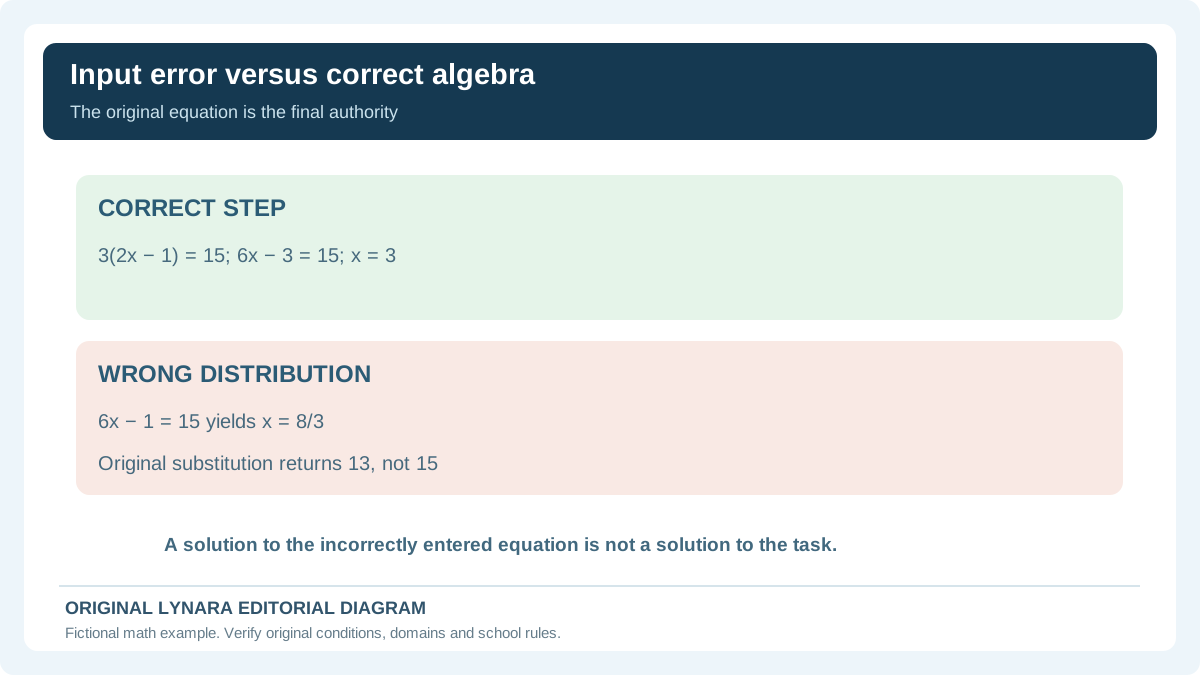
Try 3(2x−1)=15 → 6x−3=15 → 6x=18 → x=3, then deliberately change the distribution to 6x−1=15 to see the different solution set flagged. The OpenStax linear-equation strategy reinforces the important final check: substitute any proposed answer into the original equation.
A complete worked linear equation
Suppose the homework equation is 3(2x − 1) = 15. A disciplined student first expands the bracket to get 6x − 3 = 15. Adding three to both sides produces 6x = 18. Dividing by six gives x = 3. To verify the result independently, substitute it back into the original expression: 3(2×3 − 1) = 3×5 = 15. The equation holds. An AI assistant is useful if it identifies that the student expanded the bracket incorrectly or forgot to apply the coefficient to both terms. The key is seeing the precise cause of the mistake. Change only the constant to create a transfer test: 3(2x − 1) = 9 gives 6x = 12 and x = 2. A student who understands the operation can solve the new version without copying x = 3. The time saved should come from correcting the technique, not from storing isolated answers.
Check systems of equations with both original conditions
Consider two simultaneous equations: 2x + y = 11 and x − y = 1. The second equation implies y = x − 1. Substitute into the first: 2x + (x − 1) = 11, so 3x − 1 = 11, then 3x = 12 and x = 4. Thus y = 3. Verification requires both original equations: 2×4 + 3 = 11, and 4 − 3 = 1. A solver that presents only x = 4 is not enough if the assignment asks for the ordered pair or an explanation. This example also illustrates why a familiar-looking single answer can hide an incomplete solution. Ask the assistant to show how it substituted the relationship and then explain the process without looking at its response. A general-purpose AI may present several valid methods, but only the original simultaneous conditions establish whether the proposed pair is a solution.
Extraneous answers and restrictions that algebra cannot ignore
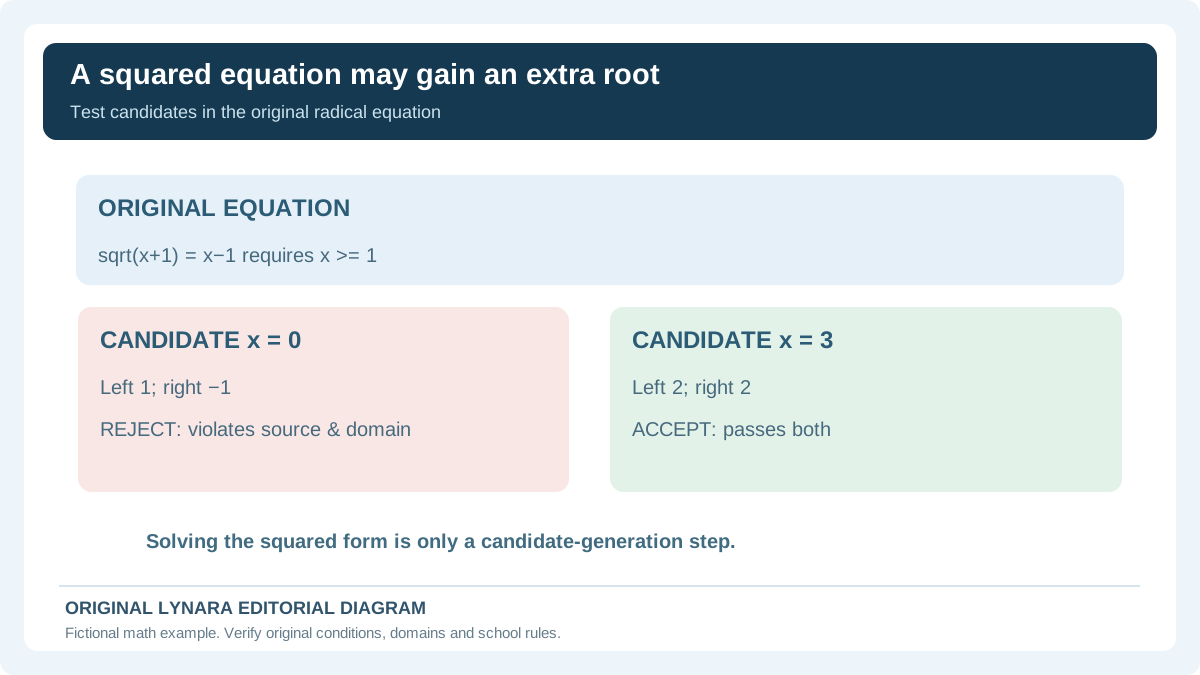
Some mathematical procedures can introduce candidate answers that do not satisfy the original problem. Squaring both sides of an equation is a classic example. Consider the equation square root of (x + 1) = x − 1. The right side must be nonnegative, so x is at least one. Squaring both sides gives x + 1 = (x − 1) squared = x squared − 2x + 1. Rearranging yields x squared − 3x = 0 and candidate roots x = 0 or x = 3. But x = 0 fails the original equation and also the nonnegative-right-side condition. Only x = 3 passes: square root of four equals two, and 3 − 1 equals two. A solver that ends with both candidates has not completed the verification. Always return to the original equation when a transformation may lose information or introduce extraneous solutions. Fractions, logarithms and domains can have similar restrictions.
Word problems need variable meaning and units
A word problem is not simply an equation waiting to be scanned. The student must decide which quantities are known, what the variable represents and what restrictions apply. If a task describes the number of tickets purchased, a negative or non-integer answer may be mathematically possible for a loosely entered equation but impossible in the real situation. Ask the assistant to list assumptions and units before doing the arithmetic. For measurements, note whether lengths use feet, inches or meters and convert consistently. A model that confuses square feet and cubic feet can produce an appealing but meaningless final number. Independent checking means asking whether the answer fits both the mathematical conditions and the context. When the task is a grade calculation, our grade calculators can help verify the correct weighted arithmetic, but only after you confirm that the weights and grading rules match the course.
Use hints to solve faster across an entire problem set
Imagine a student has ten questions and repeatedly makes mistakes with brackets. Getting ten final answers could finish the worksheet while leaving the underlying weakness unchanged. A more efficient workflow is to attempt two questions, identify the expansion error, ask an assistant for a one-step hint and then solve a new question independently. If the error disappears, the remaining questions may require less assistance. If it persists, work on the specific concept instead of asking for a longer generic explanation. This strategy can save time over a week even if the first difficult problem takes longer. Keep a small error log with the incorrect step and corrected rule. For a homework assignment that explicitly allows tools, the student may use a calculator to check results. If the assignment restricts automated help, the instructor's rule governs. The objective is competent independent work, not concealing outside assistance.
How to decide whether a result is trustworthy
Before submitting any answer produced with AI assistance, check four things: the original problem was interpreted correctly; intermediate transformations are mathematically valid; the candidate result satisfies all original conditions; and the final answer has the required units, precision and explanation. For advanced topics, also check which branch, domain or convention the solver assumed. If two services disagree, do not vote for the more attractive result. Reinspect the input and prove the answer by substitution, differentiation or another appropriate method. No external tool can guarantee that a response matches a teacher's private expectations. Keep academic integrity and privacy in view, especially when a screenshot includes classmates' names or a restricted test. AI math help becomes genuinely useful when the student can defend every answer it helped them check.
Use a four-gate worksheet before accepting a result
A solver can perform accurate algebra on an incorrectly scanned expression. Before submitting an answer, use four different checks instead of repeating the last line from the model: the entered equation must match the source; every transformation must preserve the relevant solution conditions; every candidate must satisfy the original equation; and the final format, units and explanation must fit the actual assignment. This is a general checking process, not a benchmark ranking of Photomath, Symbolab, WolframAlpha or chat assistants.
| Verification gate | Example evidence | Decision |
|---|---|---|
| Original expression | The page states 3(2x − 1) = 15, not 6x − 1 = 15 | HOLD if scanning changes a sign or bracket |
| Equivalent transformations | Distribute to 6x − 3 = 15; then isolate 6x = 18 | HOLD if an unexplained step changes meaning |
| Substitution | x = 3 gives 3(2×3 − 1) = 15 | GO for this algebraic value if all other rules fit |
| Domain and notation | A radical requires valid inputs and a nonnegative right side | Reject extraneous candidates |
A common error is expanding 3(2x − 1) as 6x − 1. Solving this new, incorrect equation produces x = 8/3. But substituting eight thirds into the original gives 3(2×8/3 − 1) = 13, not 15. That is a reason to stop and repair the distribution step, not a reason to ask three tools to confirm the wrong input. The OpenStax linear-equation method closes with checking the proposed solution in the original expression.
Detect extraneous roots and ambiguous typed input
Consider √(x+1) = x−1. The right side must be nonnegative, so x≥1. Squaring both sides yields x+1 = x²−2x+1, so x²−3x=0 and the candidate answers are 0 and 3. At x=0, the original equation claims √1 = −1, which is false. At x=3, √4 = 2 and 3−1 = 2, which is true. A complete solution says that 0 is extraneous and 3 is valid. Squaring gave candidates, not permission to ignore the original domain.
Ambiguous grouping is a different hazard. At x=4, (1/2)×x = 2, whereas 1/(2x) = 1/8. If you enter '1/2x' without parentheses, different systems or people may interpret it differently. State the intended grouping explicitly, then compare the tool's parsed expression with the assigned problem. When units or restrictions matter, write them before generating a solution; a numerically correct result can still be impossible for a real-world counting problem.
When the homework requires the student to show reasoning, record the precise operation they learned and then attempt a new problem without the AI explanation visible. Our local Linear Equation Step Checker handles a bounded set of one-variable operations; it does not certify radical-domain restrictions, a complete proof or academic integrity. If two solver results disagree, inspect the input and work, not the popularity of the service. Ask an instructor when the allowed tools or mathematical conventions are unclear.
Editorial limitations
The algebra and verification cases here are illustrative, not evidence that a particular AI solver was independently benchmarked or that a student will earn a given grade. Check each transformation against the original problem, especially signs, exponents, denominators and substituted answers. Follow the teacher's permitted-assistance rules before using an external solver. Our editorial policy explains the limits of these examples.