How to Evaluate Academic Sources: An Evidence Checklist
A trustworthy-looking title and a working DOI do not prove that a paper supports your claim. Learn to check the actual evidence before writing.
Begin with the question your assignment asks
A research source is useful only in relation to a particular question. An article about student satisfaction with a study application does not necessarily provide evidence that the application improves examination performance. A survey of one school's graduates may not support a claim about all university students. Before searching for a citation, translate the assignment into a question with a population, subject, outcome and relevant context. Then decide what type of evidence could answer it. A textbook may be suitable for a stable definition; a primary experiment may be needed for an empirical claim; an official statistical release may be more appropriate for a numerical trend. This step keeps a student from choosing sources because their abstracts contain impressive keywords. An AI search assistant may suggest candidates, but the student should decide in advance what kind of publication and evidence would be persuasive. This article is about judging source quality, not formatting a bibliography.
A professional-looking website is not enough
Ask who created the material, what expertise they have for this subject, which organization published it and when. Next, look for an accessible description of the method, data or sources behind the conclusion. University branding can be useful context but does not prove that every page is a peer-reviewed study. A polished commercial report can contain valuable information while also serving a marketing purpose. The Cornell University Library guide on critically analyzing sources recommends checking author qualifications, publication context and the work's evidence. Use these checks together rather than reducing source evaluation to a formula in which a .edu domain always wins. A recent blog post by a knowledgeable author may explain a topic well but still be the wrong authority for an assignment that asks for original experimental results.
Follow a citation to the actual publication
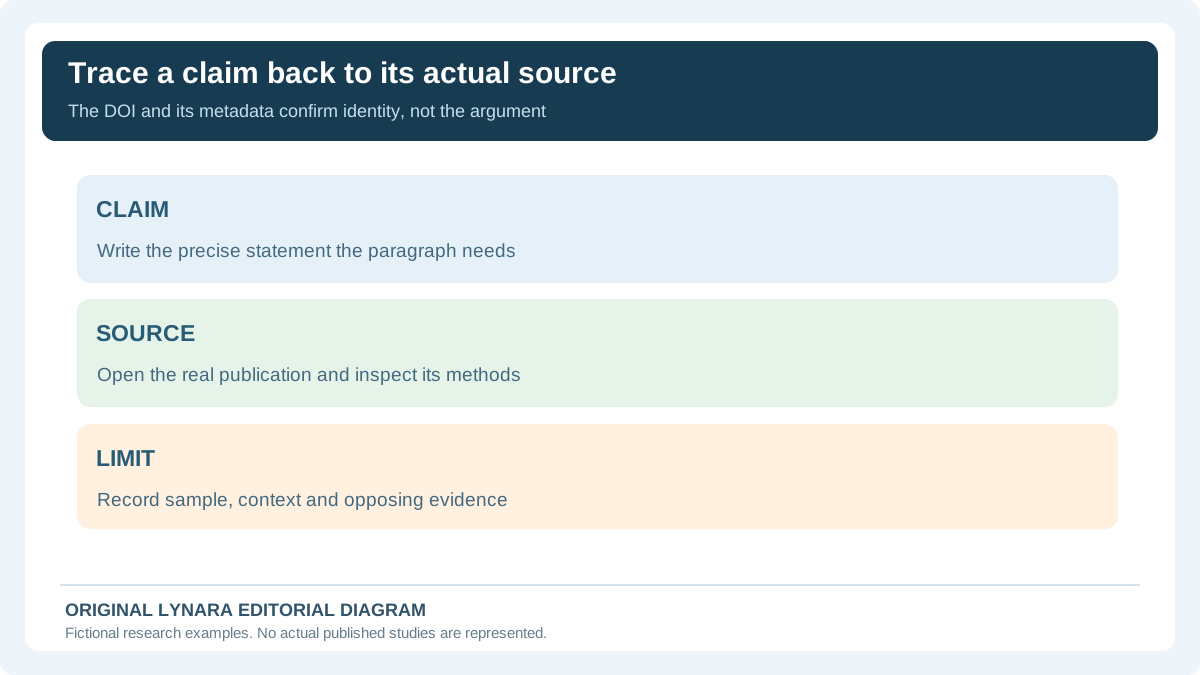
An AI assistant can generate a plausible author, title, journal and DOI even when no such paper exists. Copying that reference into a bibliography is not verification. Search the exact title, inspect the publisher or database record, check the authors and publication year, and follow the DOI to the identified work. DOI infrastructure helps identify and locate registered objects, but an identifier does not certify scientific validity, peer review or relevance. The Crossref service is one resource for checking registered scholarly metadata. If a title and DOI resolve to different works, stop and correct the reference instead of choosing whichever version the AI provided most confidently. Our citation tools format verified source details; they do not decide whether a publication exists or demonstrates a claim. Keep existence, bibliographic accuracy and evidential support as separate checks.
Read the method rather than accepting the abstract
An abstract tells you how authors describe their work. The method tells you what actually happened. Identify whether the work reports an experiment, observational study, survey, synthesis, case study or expert commentary. Check the sample, selection process, measured outcomes and time period. A survey might ask participants if they felt more productive, whereas a controlled assessment could measure performance under stated conditions. Those are different outcomes. A claim about causes requires stronger justification than a simple association. Look for missing groups, substantial dropout, unclear definitions and assumptions that the analysis cannot support. Some projects will require statistical knowledge beyond introductory coursework; ask a teacher or librarian for help identifying appropriate study designs. The goal is not to dismiss every small study. It is to understand what each study can and cannot reasonably tell you. Even high-quality research has boundaries.
A worked evidence matrix with three fictional sources
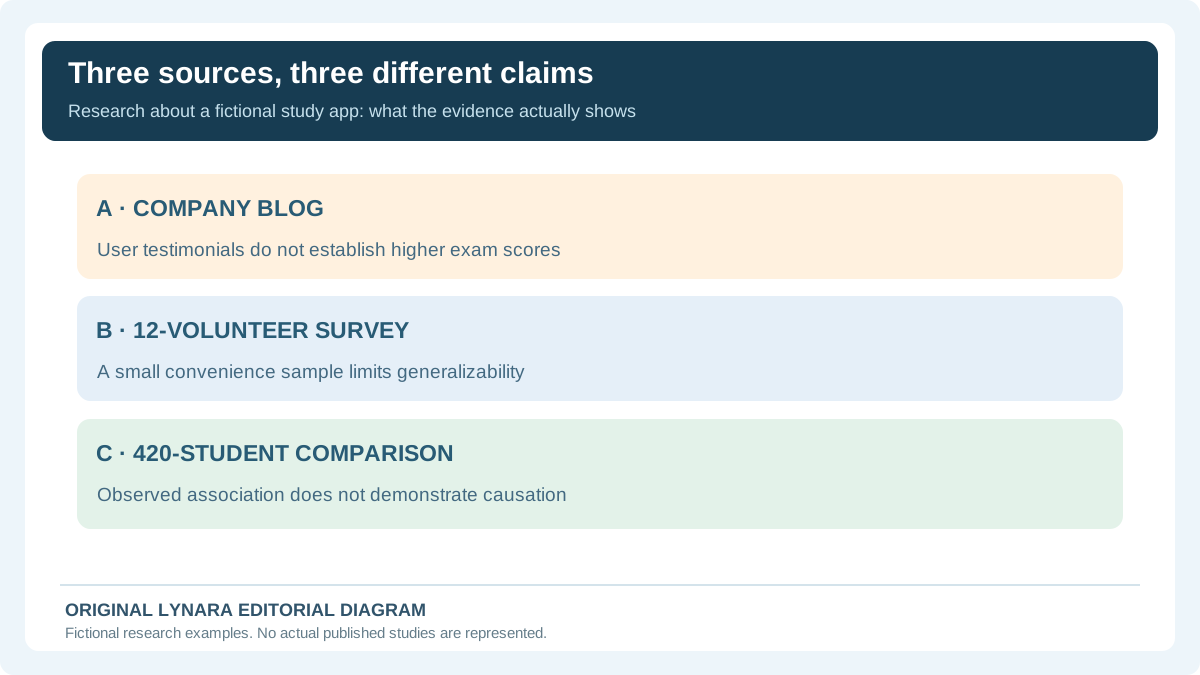
Imagine the essay question is whether a new study-planning app improves exam outcomes. Source A is an invented company blog claiming that users feel organized after seven days. Source B is an invented survey of twelve volunteers at one college who reported liking the app. Source C is an invented comparative study that follows 420 students and records examination results alongside usage patterns. None of these sources is a real publication: the examples illustrate how to classify evidence, not papers to cite. In a three-column evidence matrix, record the actual claim, how it was measured and its limitation. Source A may support what the company says about user experience but not a causal performance effect. Source B is narrow and self-reported. Source C has a larger sample and measured results, but if students chose whether to use the app, pre-existing motivation could explain part of the difference. A larger sample alone does not remove confounding. The correct essay may conclude that evidence differs by outcome rather than declaring that one source proves everything.
Distinguish correlation from causation in the actual wording
Suppose a paper reports that students who studied with a planning app scored higher on average than those who did not. Without knowing how the groups were selected and what else differed, the safe description is that app use and score were associated in the observed data. The statement that the app caused the gain is stronger and requires additional assumptions or evidence. A similar distinction appears in news about education, health, economics and technology. Look for randomized assignment, controlled conditions, alternative explanations and whether the measured difference is large enough to matter. The actual reported design matters more than a headline or social-media summary. When paraphrasing, preserve qualifiers such as in this sample, after adjustment and during the study period. Removing these words can transform a reasonable finding into an unsupported universal claim. Research writing improves when it respects uncertainty.
Currency and relevance depend on the subject
Recent evidence matters for changing software capabilities, current legislation and education policy. A ten-year-old application comparison could describe features that no longer exist. Historical scholarship and foundational mathematical work, however, do not become automatically useless on an arbitrary anniversary. The relevant question is whether later evidence, changes in the subject or the assignment's scope require newer material. Check publication dates and whether an important piece has been corrected or retracted. Also distinguish the date a website was updated from the date its underlying data were collected. If an AI search summary provides a 2026 headline based on a 2018 dataset, that age should remain visible in the essay. Consult original publications and subject experts where necessary. Source quality is not reducible to a recent date plus a prestigious-looking logo.
Build a claim-to-source table before drafting paragraphs
Take each claim planned for the essay and create a small row: claim, supporting publication, relevant result or passage, page or section, method limitations and whether another source disagrees. If two articles provide contrasting results, do not hide one because the other supports the preferred thesis. Check whether they studied different populations or used different outcomes. A research synthesis is not simply a stack of quotations. It should explain relationships between sources and why the evidence supports a bounded conclusion. When information remains uncertain, acknowledge it rather than filling the gap with an invented AI citation. Use our Literature Review Evidence Matrix to compare actual sources, research methods and limitations in one local worksheet. A student can use a model to question whether a planned claim overstates a result, but the model should be directed to the supplied evidence and checked independently. The finished paragraph needs traceable support that an instructor can find.
Before submitting, verify every cited claim again
Reopen the source, confirm that its authors and dates match the bibliography, and check that a claim's wording does not overreach the methods or results. Confirm where quotes begin and end and apply the assignment's required citation style. If a research paper requires disclosure of AI assistance, accurately describe the tool's role in brainstorming, organizing or reviewing work rather than attributing independent experiments to it. If an article has no accessible method or authoritative publication record, decide whether it belongs as background context or should be replaced with stronger evidence. The difference matters especially when a polished AI-produced reference list has made weak evidence look more credible than it is. A student who can explain why each source was selected and what it cannot prove has done more meaningful research than one who supplies a longer bibliography without checking a single underlying paper.
A three-source claim audit that prevents stronger conclusions than the data support
Suppose a student asks whether a fictional revision app improves examination performance. They find three fictional leads: a company blog where users say they feel organized, a twelve-person voluntary survey recording self-reported satisfaction at one school, and an observational comparison involving 420 learners. Each can help frame a question, but none automatically proves that the app caused higher grades. The blog may be useful background on the product's intended use; the survey describes people who chose to respond; the larger comparison must be checked for differences in prior achievement, study time, access to tutoring and group selection.
A larger sample size alone does not fix confounding. Even if a summary says app users scored better, it may reflect students who were already more motivated. Ask the study authors what they measured, when, whether groups were assigned randomly, whether important baseline differences were handled and how missing data affected the result. The example's twelve and 420 are fictional sample sizes, not real published outcomes or measured AI effects. The editorial question is what a specific piece of evidence permits you to say, not which number looks more impressive.
Use the exact matrix recovered from the previous editorial preparation branch to classify the three source types. It names what they describe, what they cannot establish and what evidence would be needed next. When building a real academic paper, replace every invented row with an opened original source and a precise page, figure or table. Keep each source's limitations attached to the claim it supports; do not hide them in a generic disclaimer at the end.
Verify the publication identity before evaluating a claim
Cornell University Library's critical appraisal guidance recommends examining the author, publication date, publisher, intended audience, reasoning and source coverage. Those criteria are useful, but a university web address or peer-review claim does not mean every conclusion is automatically correct. The actual study design and the wording of its findings still matter. MIT Libraries' source evaluation guide also distinguishes verified research from vendor white papers and encourages checking original evidence by reading laterally.
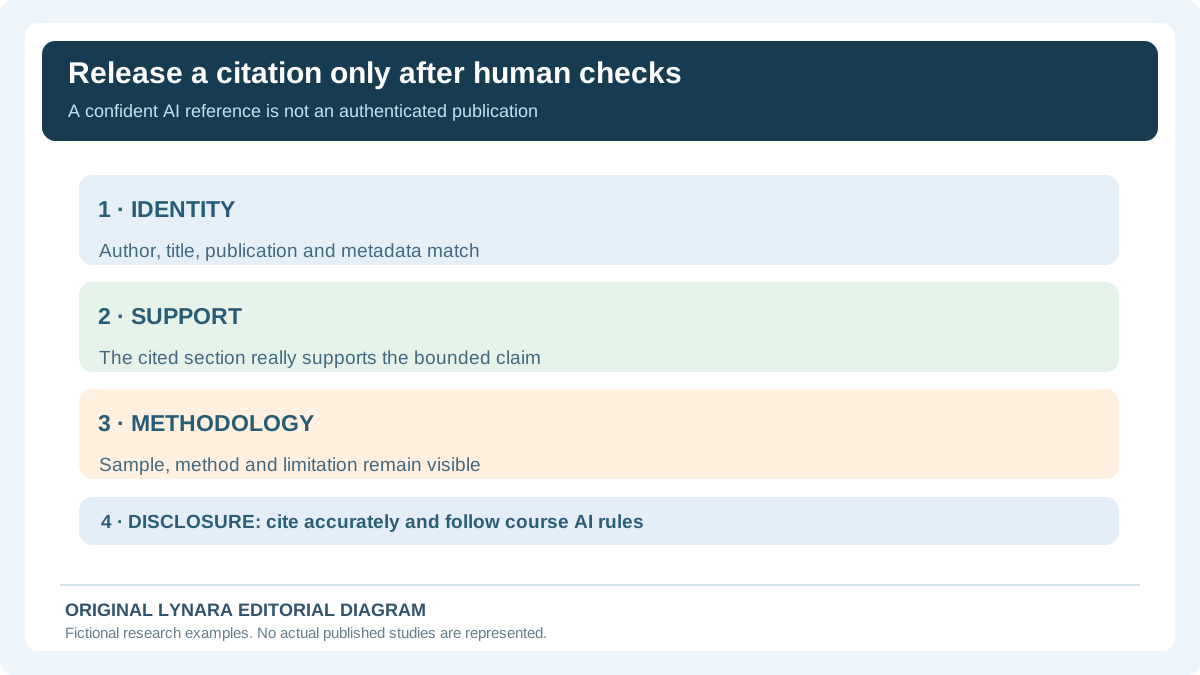
A DOI can help identify a work, but it is not a quality certification. Crossref's documentation describes how DOI resolution confirms registered metadata and links to a landing page. It does not claim to certify the accuracy, causality or appropriateness of a specific article. Match the author, year, title and publication record, then open the actual article, inspect its methods and verify that the relevant result exists.
Use a release decision: GO when the source exists, the cited material really supports the narrowly worded statement and the methodological limitations remain visible; REVISE if the source shows association but the paragraph says causation; HOLD if the publication cannot be found or the required pages were never inspected. Lynara's Literature Review Evidence Matrix helps organize that reasoning, not automatically authenticate a DOI or decide the correctness of a claim.
Editorial approach
These are research and safety workflows, not claims of personally conducted source experiments, legal advice or universal service policies. Check the original publications and official privacy guidance cited in the text, and follow the school's own requirements. See our editorial policy.
Compare fictional sources in a claim-first evidence table
The three teaching sources described above are deliberately fictional. The table demonstrates what a student should record before treating a source as support for a claim; it is not a bibliography and must not be cited as published research.
| Teaching source | Evidence actually described | Claim it cannot establish | Next verification |
|---|---|---|---|
| A: company blog | Promotional report of users feeling organized | Improved examination scores | Find independently measured outcomes |
| B: twelve-volunteer survey | Self-reported satisfaction at one college | Generalizable causal improvement | Check recruitment, response rate and survey wording |
| C: 420-student comparison | Observed app use alongside exam results | That app use caused any score difference | Check group selection, baseline differences and outcome definitions |
When using real sources, replace every fictional row with a verified publication and the precise page or table supporting the claim. The Literature Review Evidence Matrix helps record the comparisons; marking a row as checked does not authenticate it. A claim without a verifiable source should remain unresolved rather than being supported by a plausible-sounding AI citation.