Assignment Rubric to Checklist: Verify AI Work Before Submission
Build a plan that preserves the actual rubric and makes the final human checks explicit.
Interactive companion
Create a task-specific plan, verification checklist and permission-aware prompt locally, with no coursework upload or hidden AI generation.
Read the original assignment before generating anything
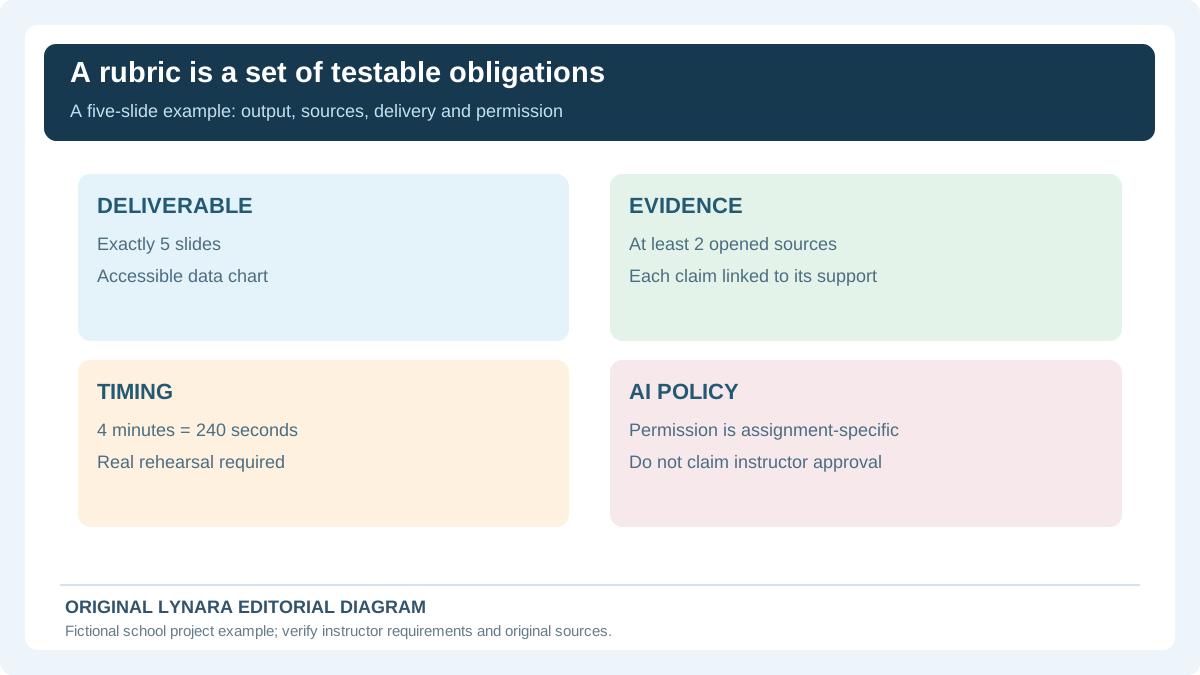
A student may paste a homework prompt into a chatbot and ask it to do everything in one pass. That can produce a polished answer quickly, but it can also omit the class's real requirements. Begin with the actual assignment: what must be submitted, in what format, how it will be assessed, when it is due and which kinds of AI help are permitted. If the assignment is only available through a school portal, avoid copying private account data or restricted class information into an unrelated service. Take short notes about requirements instead. A rubric is not the same as a topic. A presentation about local environmental problems might need exactly five slides, two traceable sources, a specified speaking time and an accessible visual explanation. A model can write about the environment while missing all four requirements. The first task is extraction: create a clear list of deliverables, constraints and assessment criteria. Only then decide which pieces of work might benefit from optional AI help.
Separate the deliverable from its success criteria
The deliverable describes what the teacher should receive: a report, slideshow, annotated diagram, mathematical solution, interview summary or group presentation. The success criteria describe qualities the result must demonstrate. A three-page report might be required to use primary sources, explain an opposing argument and distinguish observed results from opinions. A formatted document that meets the page count but does not support its claims is not complete. Build two columns. In the first, list the tangible output and technical requirements. In the second, list the evidence needed to prove each criterion has been met. For example, source credibility can be checked by opening each original article; timing can be checked through a rehearsal; arithmetic can be checked with substitution or an appropriate calculator. These checks are human actions with observable results. A generative assistant can suggest an organization for the table, but the student must verify that no rubric item disappeared in the summary.
Check the allowed role of AI before drafting a prompt
School rules differ. UNESCO's guidance on generative AI in education emphasizes human-centered use, data protection and appropriate institutional safeguards; it does not supersede a teacher's assignment policy. Some teachers permit idea generation and outlines but require students to write the final text themselves. Others allow drafting with disclosure and independent verification. Some assignments forbid AI assistance entirely. The right workflow is not a universal one-click setting that magically authorizes any use. Ask which rule applies and record it. If the teacher has explicitly prohibited generative help, complete the assignment through ordinary permitted methods instead of asking another service to disguise AI involvement. Lynara's AI Assignment Workflow Builder has separate modes for no AI, planning-only and drafting explicitly permitted. If no AI help is allowed, it generates a manual task checklist but no prompt to send to a model. Planning-only mode tells the external assistant not to write a submission-ready answer. Even drafting-permitted mode asks for factual and source verification. These settings describe a student's understanding of their policy; they cannot enforce or interpret institutional rules on the student's behalf.
Work backward from the submission deadline
A deadline is useful only when the stages of work fit before it. Imagine a six-day assignment requiring a short presentation and two original sources. Day one could establish the topic, rubric and source requirements; day two locate the actual publications; day three draft an outline; day four create and check slides; day five rehearse and revise; and day six test the exported file and submit. This is an illustrative order, not a mandatory daily schedule for everyone. The dependencies matter more than the decorative calendar. A student cannot responsibly finalize a data slide before checking the dataset, and they should not wait until submission time to discover that a quoted source never existed. If less time is available, reduce optional activities or request clarification rather than making up evidence. An AI planner can propose a sequence, but the student needs to confirm real availability and the assignment's actual demands. The result should be an achievable set of next actions rather than an unrealistic promise to complete everything instantly.
A worked example: five slides and two sources
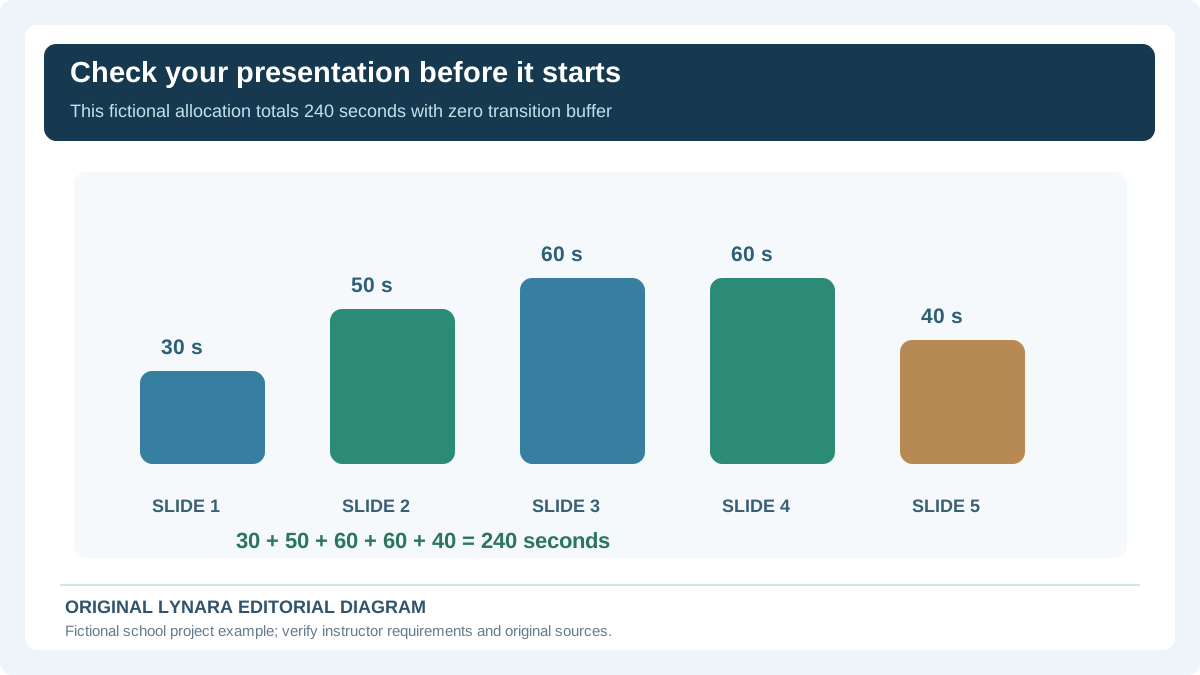
Suppose the assignment says: prepare five slides about a local environmental problem, explain one cause and one potential remedy, use two reliable sources and speak for four minutes. The student selects Presentation, planning-only AI, two required sources and citations required in the builder. The output provides a slide storyboard request, a source-checking reminder and a rehearsal step. It does not generate authentic environmental evidence, a final slide deck or a verified bibliography. That difference is essential. An illustrative outline might use slide one for the question, slide two for the identified cause, slide three for relevant evidence, slide four for a possible response with limitations and slide five for the conclusion and source directions. Whether this arrangement meets the teacher's directions must still be checked against the real rubric. For timing, four minutes is 240 seconds; allocating fifty seconds to each of five slides would take 250 seconds and exceed the limit. A revised allocation of 30, 50, 60, 60 and 40 seconds totals 240. These numbers are a practice calculation, not a guarantee of speaking speed.
Source numbers are requirements, not model-generated citations
If a rubric requires two sources, writing the number two into a prompt does not create two trustworthy publications. An AI assistant may suggest database searches, types of evidence or candidate titles, but the student should open the underlying publications and confirm their real authors, dates, claims and limitations. Where possible, keep notes on which paragraph or figure supports which slide. Do not paste a fabricated DOI or URL into the final bibliography because the model used formal-looking language. Our academic source evaluation guide focuses on the strength and suitability of evidence. Our citation generators can format known metadata; they do not prove that a reference exists. For a lesson that uses a published dataset, record the correct vintage and table rather than calling a recent access date the observation year. The builder therefore adds a human source-verification step instead of pretending to be a research engine.
Math work needs a different quality gate from an essay
A rubric for a problem set may require reasoning, correct operations, units and answers that satisfy the original conditions. An essay may require a claim, counterargument and evidence. A group assignment has additional obligations about contribution and shared handoffs. Giving all three the same generic checklist would not be useful. The builder changes the checks based on the task category to preserve some of these differences. For example, consider 2(x + 5) = 18. Expanding produces 2x + 10 = 18, so x = 4. Substitution verifies 2(4 + 5) = 18. The numerical answer alone is not enough if the instructor requires the working. When a model displays an unexplained or inconsistent step, the student should not simply copy it. Our math-solver verification guide discusses tools and domain restrictions in greater depth. The assignment builder is a workflow organizer, not a symbolic algebra engine.
A useful AI prompt sets limits on what can be claimed
When drafting assistance is permitted, a helpful prompt includes the user-provided brief, the output format, requested type of help, real source requirements and an explicit instruction not to fabricate references or describe research that has not been performed. This will not eliminate all model mistakes, but it makes the expected boundary visible. Asking the system to state missing information is better than encouraging it to fill every uncertainty with a confident guess. The local workflow tool assembles a bounded prompt from the student's entered goals and selected permission. It does not send text to a model; the user decides whether a permitted separate service should receive it. Review the generated text before copying it, particularly if the original description includes private information or an instruction that cannot be shared. A prompt is a starting instruction, not evidence that the model followed it or that the final work meets school rules.
How to perform a final rubric audit
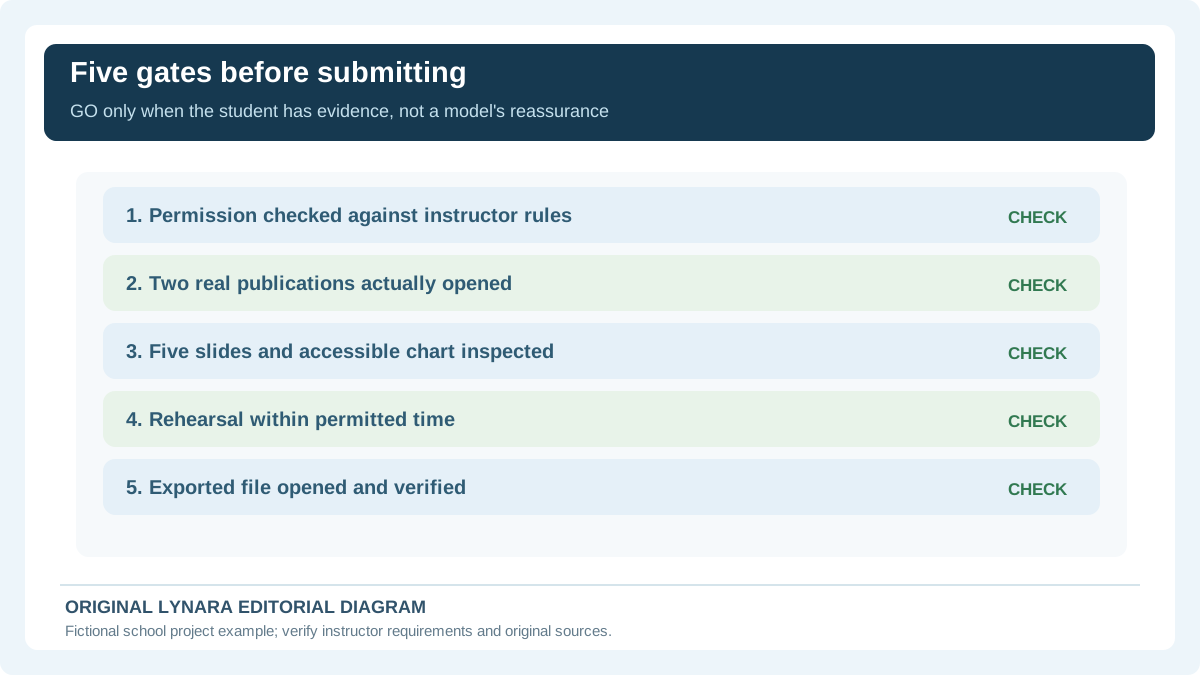
At the end, revisit each requirement without looking only at the polished surface. Does the requested file exist? Is the argument clear? Are every needed source and quotation traceable? Are calculations independently reproducible? Are images accurately labeled and accessible? Does the exported file open? Were collaboration and AI-disclosure obligations respected? A checklist is complete when each item has an answer based on the actual work, not when a model writes a convincing sentence saying it has been checked. Some problems must be resolved by asking the instructor. A rubric can be ambiguous, a citation style may be department-specific and a project might require approval before contacting human participants. A model cannot override those instructions. If an item is uncertain, note the uncertainty and request clarification rather than declaring it complete. A good final review can be short, but it should include the criteria that distinguish a genuine finished assignment from an attractive first draft.
Use the planner as support, not as a substitute for studying
One practical sequence is to read the original brief, write a privacy-safe summary, set the confirmed AI permission, select the task type and required sources, and generate an initial plan with the AI Assignment Workflow Builder. Review its steps against the rubric. Use any generated prompt only where permitted. Carry out the real research, writing, calculation or practice, and verify the result independently. This method differs from our AI-versus-human task comparison, which helps decide whether AI belongs in a workflow at all, and our group project guide, which assigns responsibility across multiple people. Here the main job is turning one assignment into a complete, auditable set of actions. Good AI use reduces avoidable organizational effort without obscuring the student's own learning or the instructor's standards.
A requirement-to-evidence checklist that can stop a bad submission
Imagine a fictional four-minute presentation about a local environmental issue. The instructions demand exactly five slides, two sources that actually exist, a graph that other students can understand and a conclusion that states limitations. AI permission is governed by the real instructor. Instead of trusting a generated summary to say the assignment is finished, make every requirement point to evidence you have personally inspected. Open the exported file and count the slides; open each article and check its authors and findings; rehearse the spoken presentation with a timer.
| Requirement | Proof to inspect | Release decision |
|---|---|---|
| Five slides | Count the actual exported slide pages | HOLD if a slide is missing or extra |
| Two reliable sources | Open both original publications and check the relevant claim | HOLD if a citation is fabricated or unsupported |
| Accessible chart | Check axis labels, denominator and text explanation | HOLD if it misleads or cannot be understood |
| Four-minute limit | Rehearse with a timer, including any required spoken citations | HOLD if the permitted duration is exceeded |
| AI use allowed | Read course policy and instructor's actual directions | HOLD and ask if permission is unresolved |
The distinction between a requirement and its proof is useful in essays, science labs and oral reports too. A three-page essay can meet a length rule while offering no evidence for the central claim. A diagram can have an alt attribute but still fail to communicate the necessary idea. A mathematical answer may be correct yet lack the requested working. For each category, make the final check observable rather than relying on the model to pronounce it complete.
A realistic four-minute rehearsal and correction
Four minutes equals 240 seconds. Giving each of five slides fifty seconds would take 250 seconds, exceeding the limit by ten. A sample alternative is 30 + 50 + 60 + 60 + 40 = 240 seconds. Yet this leaves no buffer for transitions. A better real rehearsal may target slightly less than the maximum and include any introduction, handoff and acknowledgments the instructor requires. The allocation is a teaching calculation, not a guaranteed speaking-speed prediction.
Decide where the substantive evidence belongs rather than dividing the time equally by habit. The introduction might need only thirty seconds, while a chart interpretation requires sixty. The limitation statement needs space because it shows how far the evidence supports the conclusion. Ask classmates, when permitted, to check whether they can follow the argument without seeing all the speaker notes. Use the result to adjust the presentation, not to claim a predicted grade.
Before using a model, check your own school's rules. Marquette University's student checklist is a useful example of permission, source and disclosure checks, but it is not a policy for every university. UNESCO's education guidance supports a human-centered approach. If the brief prohibits AI-written work, do not submit such text. If instructions are ambiguous, ask the teacher rather than taking a chatbot's assurance as permission.
The local assignment builder can help organize user-entered requirements but does not read the learning management system, check the exported deck or grant academic permission. Complete the final GO/HOLD matrix using the real files, sources and course rules yourself.
Editorial scope
This page describes a reproducible planning workflow with hypothetical examples; it cannot verify a teacher's rules, perform research or promise a grade improvement. See Lynara's editorial policy.