AI Group Project Planning: Task Owners and Deadlines
An AI planner can draft the task board, but it cannot make classmates deliver work or guarantee that the final research is correct.
Agree on one deliverable before asking AI to organize the group
Four students receive an assignment to prepare a fifteen-minute presentation based on credible sources. One person imagines a slideshow, another wants a written report and a third thinks the group only needs to find five links. Without agreement on the deliverable, an AI-generated calendar is merely an organized version of confusion. The group must first read the actual task and write down required outputs, format, deadline, rubric and evidence standard. Note who is allowed to upload assignment material to external services. A useful first AI request, if permitted, asks for a checklist extracted from the verified brief. The students then compare every line with the original. If the model invents a required survey or omits an oral presentation, correct the checklist before using it. For an individual rubric, the local assignment-to-checklist planner helps identify permission limits and evidence steps before the group assigns owners; it does not assign responsibility or manage a shared team. AI can rearrange information faster than a group meeting, but accountability starts with the shared understanding of the teacher's instructions. This guide addresses cooperation and handoffs, not the broader question of whether AI or humans are universally better at thinking.
Turn a shared deadline into genuine dependencies
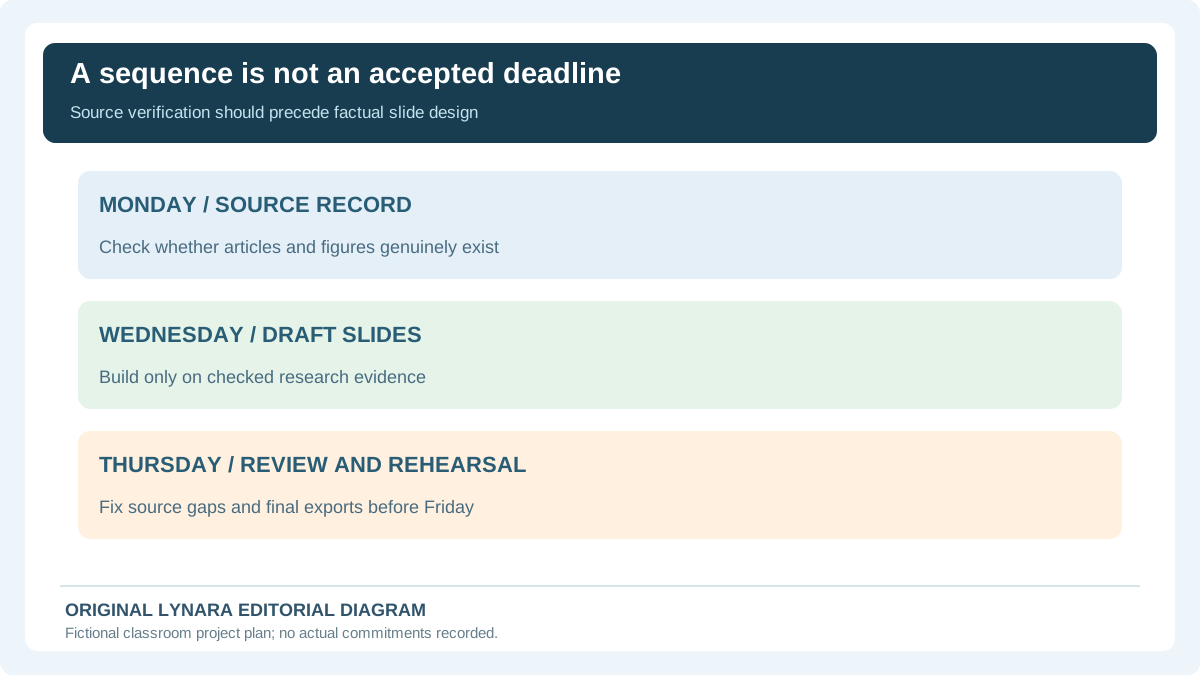
A task board should distinguish finding sources from evaluating them, writing the argument, building slides and rehearsing the presentation. These are dependencies: a student cannot responsibly finalize a statistics slide before verifying the data, and an editor cannot check the finished argument before the draft exists. Ask an AI planner to propose a sequence with review time, but mark its dates as suggestions until the group confirms each person's availability. For example, a fictional project due Friday at 5 p.m. could set Monday as the source-selection checkpoint, Tuesday for an outline with verified evidence, Wednesday for draft slides, Thursday for a full group rehearsal and Friday morning for file checks. A school event may change these milestones. Avoid setting deadlines exactly at the final submission time; a delayed group member then leaves no space for recovery. The goal is to make waiting dependencies visible, not to create an impressive but unrealistic schedule.
Assign an owner and reviewer for every substantive task
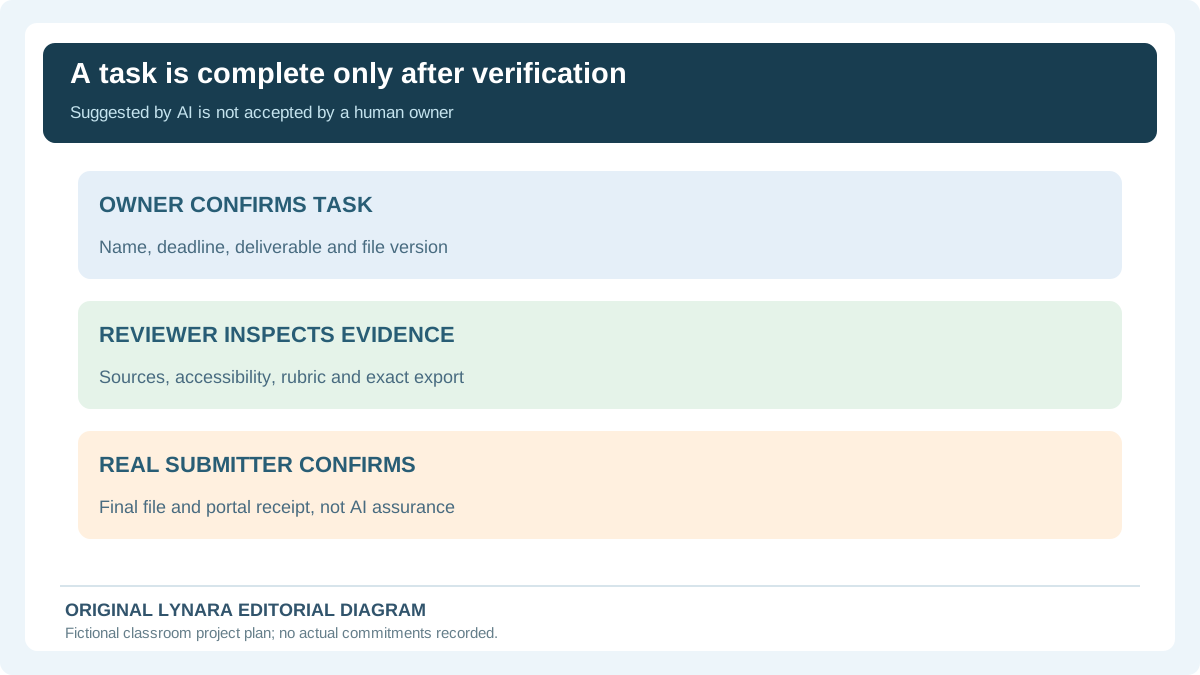
A recurring group-work problem is the statement that everyone will research or everyone will edit. With no clear owner, the work may remain unfinished until the last day. Use a simple table with task, owner, reviewer, due date and status. Owners produce the first version. Reviewers check it against sources, rubric and format. This is not a command hierarchy; roles can rotate so everyone contributes meaningfully. The right distribution depends on skill, accessibility, workload and instructor requirements. Imagine four team members, called A, B, C and D. A gathers authorized research sources, B builds a provisional argument, C drafts visual materials and D coordinates the rehearsal and submission checks. A's source work needs review by B; B's argument needs evidence checking by A; C's slides need review for accuracy; D should not approve the final product alone. AI may draft this ownership table, but only the people involved can confirm that they accepted the roles and can meet the deadlines. A generated assignment of names is not a commitment.
Meeting agendas: where summarization can be useful
AI can turn a list of agreed open questions into a short meeting agenda. For example, a ten-minute check-in could spend two minutes on completed work, three minutes on blockers, three minutes on decisions and two minutes on next steps. That totals ten minutes. The organizer could ask an assistant to produce the agenda from the shared task board, but it should not invent who made promises or quietly rewrite decisions. After the meeting, a human checks the summary and asks participants to correct any ambiguity. Recording or transcribing real classmates can create privacy and consent issues. Do not upload audio, faces or names to a model merely because a meeting-summary feature exists. A manual anonymized decision log may be more appropriate. The Lynara student privacy checklist explains why using the minimum necessary information is safer. A useful group note says what was decided, who owns the next action and when it is due. It does not need to reproduce every casual comment.
Research checks remain distinct from presentation polishing
One group member may ask AI to generate a bibliography while another builds polished slides. The finished deck can look convincing even when a cited paper is fabricated. To avoid this, keep an evidence register separate from the design file. Each key claim should have an original publication or authorized source, a short explanation of what it supports and the person who verified it. Assign at least one other member to spot-check the most important figures and quotations. A citation tool may format verified metadata, but it cannot prove a study supports a claim. Use our academic source evaluation workflow and the citation tools at the appropriate stages. AI can help identify questions to research, suggest alternative outline structures and detect inconsistent terminology. It should not produce fake survey results, pretend interviews took place or replace a real document with a plausible imitation. Human sign-off is necessary because the final group shares responsibility for the accuracy of what it submits.
Worked example: a realistic four-person task board
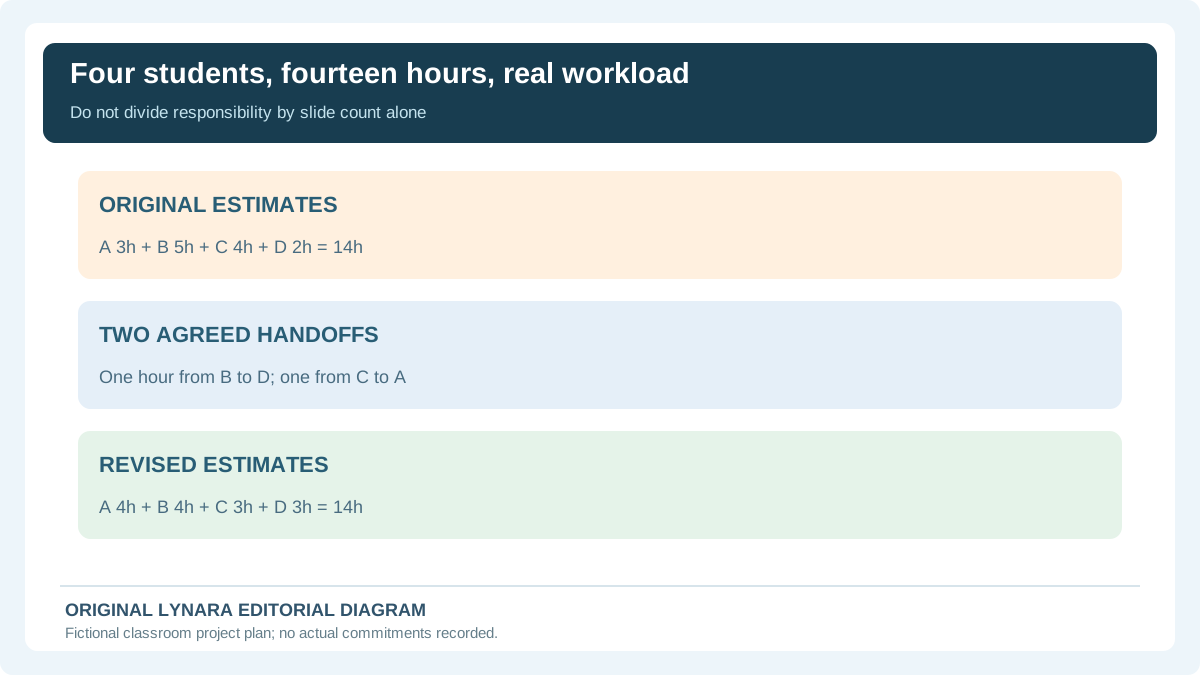
Imagine a twelve-slide presentation with four main sections. Team A takes slides one through three, Team B four through six, Team C seven through nine and Team D ten through twelve. Dividing three slides each looks equal, but it ignores that the research-heavy middle section may require more effort than the introduction or conclusion. A better task board estimates the work behind each section: source retrieval, verification, explanation, graphic preparation and rehearsal. Responsibility should be assigned to deliverables rather than equal slide counts alone. Suppose the hypothetical expected workloads are three, five, four and two hours. Their total is fourteen hours, with five hours assigned to B and only two to D. The group can balance the plan by moving one hour of citation verification to D and another hour of slide design from C to A. The revised hypothetical distribution becomes four, four, three and three hours, still fourteen total. These invented numbers demonstrate how a task board can expose imbalance. They do not measure actual student productivity. Let AI suggest redistributions, then have teammates agree to realistic commitments.
Use clear handoffs rather than endless group chat
A message saying my section is done is ambiguous. Is the source verified? Is the slide file in the shared location? Are the charts accessible? Does the teammate need to review anything? A useful handoff includes the file location, version, completed checklist, outstanding questions and named reviewer. The reviewer either approves the task or returns a specific correction request. This avoids multiple people silently editing conflicting copies while everyone assumes someone else has checked the result. An AI assistant may reformat a verbose handoff into a concise note, but the person handing off the work should confirm that the summary matches reality. Keep one authoritative task board and decide who can modify the final submission. Version conflicts and missing file permissions can waste more time than the actual design. A simple document with clear status fields can outperform a sophisticated automated workflow that the group does not consistently use. Do not create unnecessary accounts simply to follow a trend for AI project management.
Resolve disagreements using the rubric and evidence
Suppose one student wants a dramatic slide claiming a technology improves grades by forty percent, while another cannot find the source. This is not merely a design preference. The group should inspect the evidence and decide whether the statement is accurate, correctly qualified or should be removed. An assistant can propose less overstated wording, but it cannot make an unsupported percentage true. The teacher's rubric and the original publication provide stronger grounds for resolution than a model's confident preference. For ordinary stylistic disagreements, decide in advance who has final editing responsibility or use an agreed review rule. If a member misses a deadline, discuss the actual obstacle and reassign work transparently rather than having the assistant invent a message accusing them of bad faith. Fair collaboration includes appropriate recognition of contributions, accessibility and clear communication. A project can be completed efficiently without making every human interaction dependent on automated text generation.
A practical checklist for the last forty-eight hours
Two days before submission, freeze the central argument and confirm that source claims are traceable. Ask each owner to update the status of their assigned items and each reviewer to sign off on key facts. Open the deck from the actual shared link and test whether graphics, videos, fonts and citations survive export. Rehearse with a timer and leave room for transitions and questions. Do not generate new factual sections at the last minute merely because a model offers them quickly. On the final day, check the filename, recipient or submission portal, deadline and format. Ensure the student responsible for submission has access and that the group retains its final version. If the instructor requires a statement describing AI use, prepare an accurate record: agenda drafting, task-board reorganization or editorial suggestions, rather than pretending that the model conducted interviews or verified sources. The purpose of the final checklist is to remove avoidable logistical failures, not to cover up unfinished academic work.
What AI should and should not own in a student team
AI can be useful for reversible coordination tasks such as suggesting milestones, formatting a task board, creating a meeting-agenda draft and pointing out missing rubric items. It should not be treated as a teammate who took part in actual meetings, accepted responsibility or produced genuine observations. An assistant also cannot guarantee that all team members are satisfied, that the cited sources are authentic or that a teacher will approve the work. Those obligations belong to real participants. UNESCO's student AI framework highlights human agency, ethical practice and critical review. Apply that principle in a practical way: use AI when its output can be checked cheaply, keep one source of truth for project status, and retain human ownership of evidence, collaboration and final submission. For broader comparisons of suitable and unsuitable tasks, read our AI-versus-human task guide. The group-work article deliberately goes deeper into ownership and handoffs instead of reprinting a general AI strengths list.
Assign a real owner and reviewer to each task
In our Assignment AI Workflow Builder, choose the group-project option to create a local task-owner and reviewer checklist under the instructor's declared AI permissions. The worksheet does not contact classmates, assign responsibilities in real accounts or verify consent.
A real handoff is more useful than a perfect-looking AI plan
Imagine a fictional four-student team preparing twelve slides for a fifteen-minute presentation due Friday. Splitting exactly three slides per person appears equitable, but the actual work is not equal when some slides require original source verification, numerical interpretation or image accessibility checks. A realistic planning estimate may give A three hours, B five, C four and D two, totaling fourteen hours. After the team agrees to transfer one hour of source checking from B to D and one hour of graphics work from C to A, the revised responsibilities are four, four, three and three hours—still fourteen in total. These are estimated hours, not measured productivity or permissions imposed by the model.
| Deliverable | Owner | Independent reviewer | Evidence needed |
|---|---|---|---|
| Reference list | Student A | Student B | Real source pages opened and claims mapped |
| Central argument | Student B | Student D | Rubric alignment and checked statements |
| Visual slides | Student C | Student A | Readable exported slides with real captions |
| Rehearsal and submission | Student D | Student C | Actual timing, file version and portal receipt |
Keep the three stages distinct: a person proposes work, the owner explicitly accepts it, and a reviewer approves the deliverable after inspection. A chatbot can draft a weekly task board or meeting agenda, but cannot prove that an unavailable classmate has accepted a role. Do not record fictional timestamps, completed tasks or classroom interviews in a real handoff. The UNESCO AI competency framework for students emphasizes a human-centered mindset and critical judgment; it does not relieve a team of human responsibility for original evidence and fair participation.
Reserve time before the actual school deadline for errors in file export, format, sources and accessibility. On Thursday, test the slides from the shared link, review all chart numbers and rehearse aloud. On Friday, the designated submitter should check the final filename, actual portal submission status and any required honest disclosure of AI assistance. Lynara's Assignment AI Workflow Builder can help students draft a local checklist, but it neither contacts classmates nor verifies final delivery.
Editorial approach
Group workloads and timelines are explicitly illustrative; no model performance test or real team observation is claimed. Academic and privacy policies must govern any AI assistance.