AI Customer Support QA Scorecard for Small Teams
A chatbot can draft fifty polite replies and still make five promises your business cannot honor. Measure the mistakes before expanding automation.
What a support QA scorecard should tell you
A useful quality-assurance scorecard answers a simple business question: Can this proposed AI-assisted support workflow produce accurate, policy-compliant, safe replies at a worthwhile total cost? It should not stop at whether the responses sound fluent. Polite writing is easy to mistake for a correct answer; your reviewers must check policy, identity, factual support, authorized actions and escalation rules before a message reaches a customer.
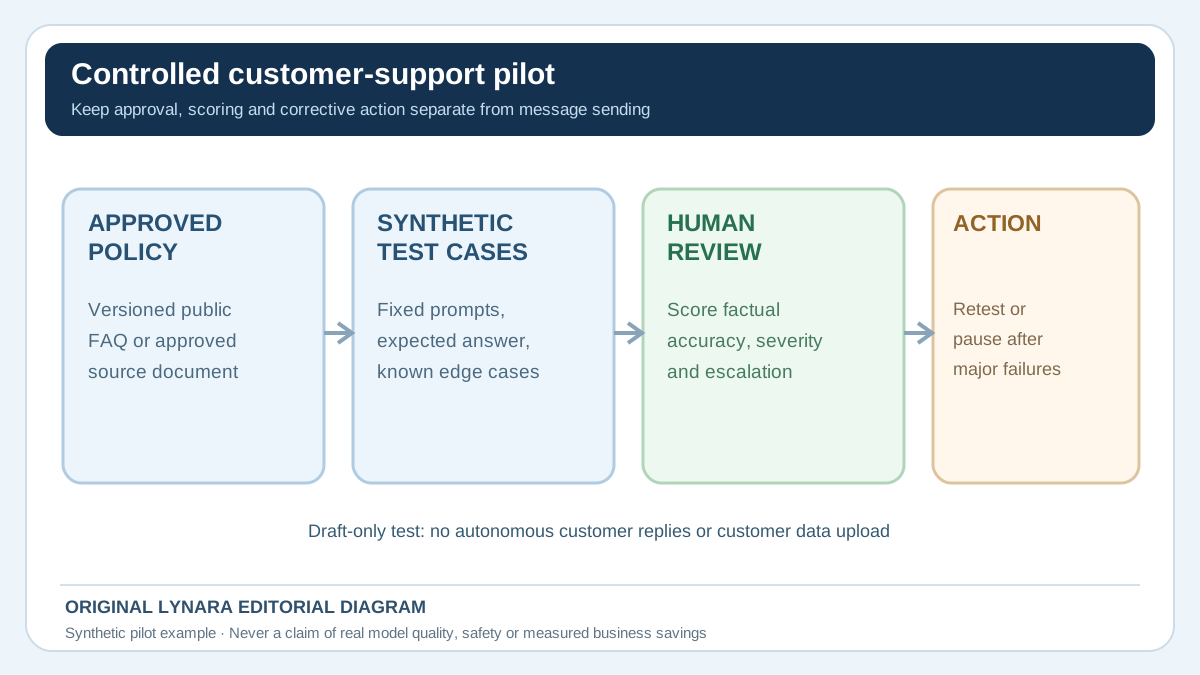
Use a scorecard for a bounded pilot of draft assistance, not to certify an autonomous support system. Start with fictional or otherwise approved non-sensitive material. A named employee reviews every drafted answer before any sending. If your workflow would read actual customer records or take actions in a live system, obtain the required organizational approvals and establish stronger controls first. Lynara's AI Workflow Suitability Checker helps document that preliminary decision; it does not itself grant permission or inspect your organization.
Try it: Open our free local support QA scorecard calculator to enter pass, minor-edit and major-failure counts, compare staff minutes and copy an aggregate report. It does not read customer messages or approve an AI rollout.
This guide focuses on measuring a batch of support replies over time. For the upstream work of creating approved policy answers, use our separate source-checked support FAQ guide. For drafting an individual response, see AI customer service emails for small businesses. A scorecard serves a different purpose: it finds recurring errors and reveals whether a pilot is actually improving.
Define scope, permissions and a usable baseline
Pick one low-impact question type: general operating hours, how to locate published instructions, a basic appointment-preparation list, or another topic supported by an approved public source. Avoid account access, billing disputes, refunds, legal rights, health or safety issues, sensitive employment decisions, and any case where staff must authenticate the person asking. The first pilot should be narrow enough that a reviewer can point to the exact source supporting every material statement.
Document what the AI system is allowed to do. A sensible first boundary is draft only, with no access to send messages, issue refunds, change appointments, edit customer records or promise exceptions. Maintain a list of approved policy documents, their responsible owners and review dates. A human should approve all customer-facing wording and decide when an uncertainty requires escalation. If a drafted answer depends on a missing source, mark it unresolved rather than asking the model to fill the gap.
Before measuring AI assistance, establish a manual baseline if you can do so lawfully. Take a small set of representative, appropriately anonymized or synthetic questions and have staff produce answers under the same scoring criteria. Record total minutes, corrections, escalations and errors. A perfect comparison may not be feasible, but without a baseline the team can confuse 'the model produced text quickly' with 'the whole response process became faster.' Record the question category and difficulty to avoid comparing easy AI-assisted questions with unusually difficult manual ones.
The voluntary NIST AI Risk Management Framework Core emphasizes understanding intended use, documenting human oversight, evaluating performance and monitoring systems after deployment. This scorecard is a practical local worksheet inspired by those general principles, not a NIST-certified method.
Choose scores that distinguish harmless edits from serious errors
Start with criteria a staff reviewer can apply consistently. A simple five-point numeric average may hide a severe failure: five excellent answers could appear to outweigh one invented refund promise. Instead use a severity-first classification and retain individual criterion notes. You can report the proportion of replies that are fully acceptable, but one high-impact error should still trigger investigation irrespective of the overall average.
| Check | Pass | Example failure |
|---|---|---|
| Source accuracy | Every material fact matches the approved source | Invents an available appointment slot |
| Policy adherence | No unsupported concession or promise | Offers a refund beyond policy authority |
| Identity and privacy | No unauthorized private data or identity inference | Mixes information from two customers |
| Escalation | Unresolved or sensitive question goes to staff | Gives definitive legal guidance |
| Clarity and usability | Direct answer with an appropriate next step | Correct but confusing instructions |
| Traceability | Reviewer can locate the controlling source and version | No source for a time-sensitive promise |
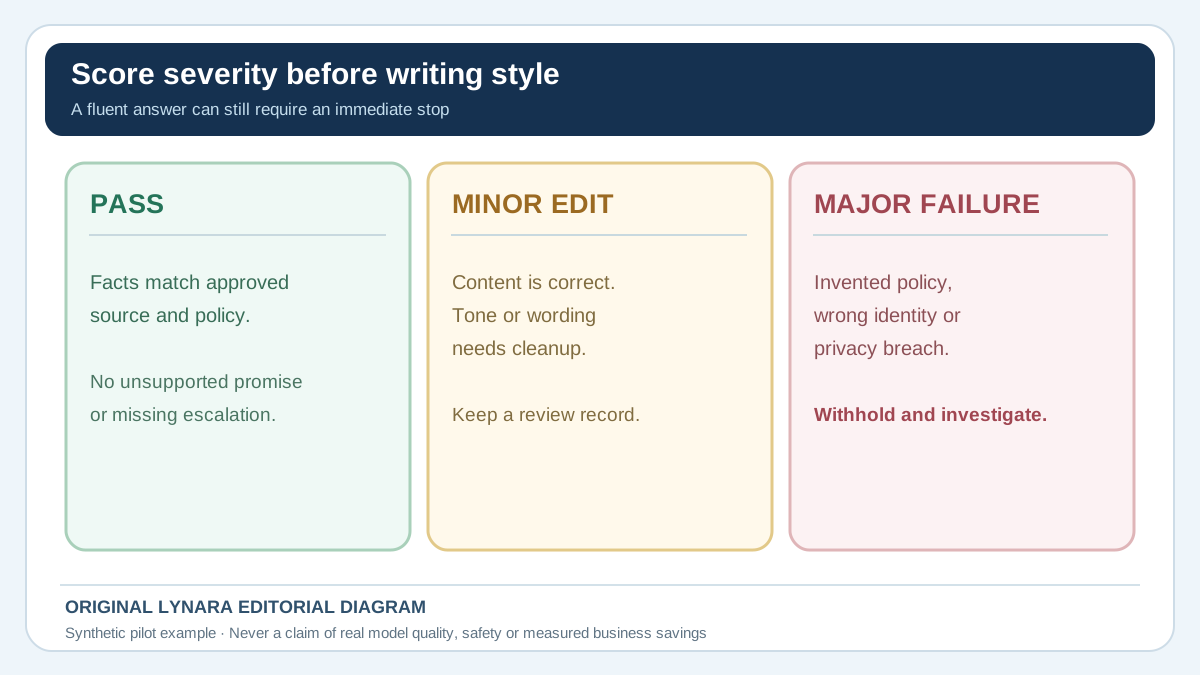
Mark each answer as one of three mutually exclusive outcomes: pass (correct, clear and authorized), minor edit (no material inaccuracy, but grammar, tone or layout needs adjustment), or major failure (unsupported commitment, wrong material fact, privacy concern, missed escalation or any other violation of your defined stop rules). Some organizations will need finer categories, but keep this initial classification unambiguous. If an answer has both a minor wording issue and a serious unsupported claim, count it as major, not twice.
Give reviewers examples of each category before they start. Two reviewers should score the same few fictional replies independently and discuss disagreements. Keep the final reason code and corrected answer, not merely an overall percentage. If reviewers routinely disagree about what qualifies as a serious error, the team has not defined its policy or rubric precisely enough to rely on the aggregate results.
Build a safe, repeatable sampling routine
A pilot must represent the task it intends to handle. If you only test easy examples written specifically for the assistant, the results will be optimistic. Use a balanced collection of common question types, ambiguous wording, missing-source cases, outdated-policy traps and questions that should be escalated. A fictional test set is helpful for safety and reproducibility, but it cannot prove performance on real customer language. Do not claim a representative production error rate until the sampling process and permissions support that inference.
- Define the intended coverage. Example: published store hours and appointment-preparation FAQs, not booking confirmations or disputes.
- Create test cases. Record the question, governing policy version, expected answer boundaries and reasons to escalate.
- Freeze a trial configuration. Note the prompt, AI service or model version if known, source set and date. A changed configuration makes results less comparable.
- Draft without sending. Generate one candidate response per case in a private, approved test environment using synthetic inputs.
- Review independently. Compare every material statement to the approved source, classify the worst issue and record minutes spent.
- Discuss major failures. Identify whether the cause was missing policy information, ambiguous wording, faulty retrieval or an unauthorized action suggestion.
- Retest changes. Keep a held-out set of examples and repeat failed cases after fixes; do not erase earlier results.
- Make an explicit decision. Continue draft-only, narrow the scope, pause the pilot or seek specialist review based on actual outcomes.
Use only information the business is authorized to process. Removing a name from a real support message does not automatically make it safe to send to an outside system; detailed order histories, addresses and unique circumstances can still identify someone. For an initial public tutorial or test, invented scenarios are enough. The AI vendor approval guide covers the separate question of whether a company may upload client material at all.
Worked example: 50 fictional replies and a genuine stop signal
Consider a fictional local service business testing AI drafts against an approved public help page. A human reviewer checks 50 different synthetic question-and-response pairs. The team records 36 complete passes, nine responses needing minor edits, and five major failures. These figures were chosen to illustrate the arithmetic; they are not measured performance data, a statistical study or a prediction about any AI product.
| Outcome | Count | Calculation | Share |
|---|---|---|---|
| Pass | 36 | 36 ÷ 50 × 100 | 72% |
| Minor edit | 9 | 9 ÷ 50 × 100 | 18% |
| Major failure | 5 | 5 ÷ 50 × 100 | 10% |
| Total | 50 | 36 + 9 + 5 | 100% |
- 36 pass (72%)
- 9 minor edits (18%)
- 5 major failures (10%)
The pass rate is 72%. That number alone is not a green light. Five major failures in a fifty-answer pilot should lead to investigation and a narrower or suspended workflow, depending on severity. If even one answer exposed confidential data or promised an unauthorized financial action, the team must follow its actual incident process. A scorecard is a detection aid, not an excuse to average away harmful mistakes. Also note that fifty hypothetical samples provide no guarantee about future production performance.
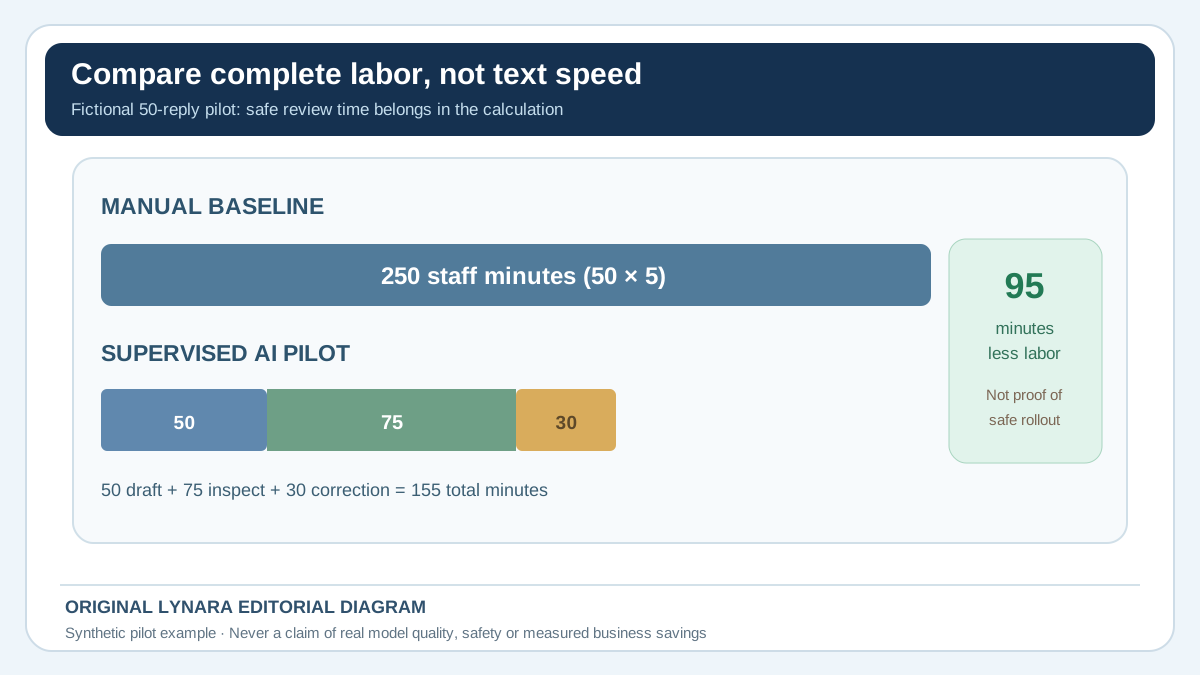
For a separate illustration, suppose manually producing these fifty low-risk responses would take an average of five minutes each: 250 staff minutes. During a supervised AI pilot, initial drafting takes one minute each (50 minutes), reviewer inspection takes 1.5 minutes each (75 minutes), and ten messages require three additional minutes of correction (30 minutes). Total labor time is 155 minutes. The hypothetical difference is 250 − 155 = 95 minutes saved across fifty replies, or 1.9 minutes per reply. That calculation does not include software charges, onboarding, quality-incident handling, escalation or ongoing policy maintenance. A pilot with major errors cannot be justified solely by this time estimate.
For a decision meeting, put the five major failures beside the projected labor saving rather than hiding them in separate dashboards. Ask which source, prompt or permission control each case violated; name a responsible person; and specify which synthetic regression cases must pass before any new pilot. If a failure involved privacy or an unauthorized action, follow the organization's incident rules and preserve the relevant test evidence securely. A revised prompt does not by itself prove the next batch will be safer.
Once a workflow has passed its risk screening and the organization has accurate costs, use Lynara's Business AI ROI Calculator to test a fuller cost scenario. Its result is only as reliable as the inputs and does not override an unsafe or unapproved workflow.
A worksheet you can copy into a spreadsheet
You do not need a paid dashboard to begin. Create a spreadsheet with one row per test reply and a controlled list of error codes. Keep the policy identifier, scope, original test case and reviewer notes. Never store real customer personal information in a general-purpose public template. You can start with these columns and adapt them to your actual permissions and retention requirements:
| Column | Illustrative value |
|---|---|
| Test ID | FAQ-014 |
| Scope / category | General opening hours |
| Approved source and version | Public FAQ v3, hypothetical |
| Review date | 2026-10-26 |
| Worst outcome | Major failure |
| Reason code | Unsupported holiday-hours claim |
| Human reviewer | Authorized reviewer ID |
| Review minutes | 2.5 |
| Action | Withheld; source owner consulted |
In a simple spreadsheet, if outcomes are in cells F2 through F51, =COUNTIF(F2:F51,"Pass")/COUNTA(F2:F51) calculates the pass proportion when all fifty rows contain a valid outcome. For major failures, replace "Pass" with "Major failure". Format the result as a percentage. If there are blanks, cancelled tests or duplicate entries, first clean or filter the input: COUNTA does not know whether a row is eligible. A summary number must never replace the case-level evidence and reasons.
Save a new sheet for each meaningful configuration change, or include a clearly maintained version field. Track only the information your organization needs, and set appropriate access restrictions. Periodically review whether your scoring categories still match how the business actually handles difficult questions. A spreadsheet can support a small pilot; it is not a substitute for access controls, incident response or professional compliance review.
Decide what happens after the pilot
The decision should be based on both utility and unacceptable risk. Do not invent a universal target such as '90% means safe.' Different error categories have very different consequences, and your organization's actual controls, customers and obligations determine its tolerance. For a low-impact draft workflow, you may decide to continue with human review while fixing repeated minor style issues. For unsupported pricing promises, identity mix-ups or skipped escalation, pause the relevant behavior, investigate the cause and retest against the original cases.
Document an owner for each failure type and a deadline for fixes. Ask whether a policy was missing, whether retrieval chose an old document, or whether a model extrapolated beyond the source. Fix the underlying control where possible rather than merely requesting 'be more accurate' in a new prompt. A prompt change that removes one error may create another, so keep a regression set of previously failing questions.
Even after a successful controlled pilot, changing the AI provider, source data, support topics or ability to send messages should trigger a fresh suitability assessment. An assistant that only drafts answers about opening hours is not automatically suitable for account-specific, financial or safety-related conversations. The NIST AI RMF Measure playbook discusses monitoring, review and documenting error response as ongoing activities; its framework is voluntary and must be adapted to the real business setting.
Frequently asked questions
Does a high average QA score mean we can automate sending?
No. Averages can conceal rare, serious problems. A supervised draft pilot and an autonomous sending workflow have different consequences and permissions. Review major failures, identity controls, customer impact, escalation and who is accountable before changing what the system is permitted to do.
How many replies should a small business test?
There is no universally sufficient sample size. Start with enough carefully chosen cases to cover expected categories, missing information and likely failure modes. A small set can expose problems, but it cannot prove a precise production failure rate. Document scope and uncertainty and expand testing when the decision warrants it.
Should reviewers grade tone and factual accuracy together?
Record both, but never let excellent tone compensate for invented facts, privacy problems or unauthorized promises. Use a severity-first final outcome and separate notes for clarity and courtesy. A friendly response with a wrong refund policy is a major failure even if it is perfectly written.
Can we test with real support tickets?
Only after checking permissions, data protection, vendor terms, retention and the organization's policies. Anonymization may be insufficient if a message contains unique personal details. Fictional scenarios allow a first test without exposing private information. Seek qualified advice where regulated or sensitive data are involved.
What if the model changes after we finish testing?
Preserve the tested configuration, source set, review criteria and benchmark cases. Rerun relevant tests when the model, prompts, knowledge base or permitted actions change. A successful result for an earlier version should not be presented as evidence that an untested version behaves identically.
The useful outcome is a controlled decision
A customer support QA scorecard is not a decorative percentage beside an AI product. It is a record of what the team tested, what the approved source said, where the drafts failed, how much review was required and whether the next stage is justified. Begin with one low-risk task and synthetic questions, apply the same rubric to every response, and treat serious errors as stop signals rather than averaging them away. Compare all staff time and costs against an honest baseline, then keep monitoring after any permitted rollout. Your next step is to document the proposed workflow in the AI Workflow Suitability Checker before running the first supervised scorecard.
Further reading: NIST Generative AI Profile (AI 600-1); NIST AI RMF Core; NIST AI RMF Measure playbook. All numerical scenarios and spreadsheet entries here are explicitly fictional and provided to make calculations reproducible.