Approve an AI Vendor Before Uploading Client Data
A useful demo is not permission to upload a customer's contract. Decide what the provider may receive before your team starts experimenting with real files.
The decision happens before the first upload
A consulting firm wants an AI service to summarize customer meeting notes. A designer wants to ask a chatbot questions about a client's brand strategy. A bookkeeper is offered a tool that can categorize invoices. All three projects might be useful. None should begin with a staff member dropping a confidential file into an unapproved personal account simply because the interface looks familiar and the first demo worked well. The central question is not whether an AI system can produce a good summary. It is whether this company is authorized to share this information with that specific service under understood conditions.
This article focuses on the business supplier decision: approved use case, provider due diligence, internal owner, written terms, access controls and safe pilot boundaries. Our earlier small-business AI automation checklist addresses whether a particular workflow should be automated at all. This is the next, narrower problem: how to screen an actual external vendor before anyone uploads real client material.
Draw the data flow on a single page
Write down who supplies the file, which employee uploads it, which account or product receives it, whether the service forwards it to a different model or subcontractor, what output comes back and where the result will be stored. This often exposes assumptions a sales demonstration never discusses. A provider might host an interface while another service processes prompts. A browser extension could read page content beyond the exact document the employee intends to summarize. A shared team workspace may retain uploaded files after the original staff member leaves.
Use one concrete scenario rather than approving “AI” in the abstract. For example: Account manager uploads a signed client service agreement to extract renewal dates. That is substantially different from copywriter asks for five headline ideas using a fictional product brief. List data categories: public, internal, contractually confidential, customer personal information, financial records, employee information or trade secrets. This classification is a local working model, not a substitute for legal requirements or contractual obligations. When in doubt about permission, do not upload real records.
Ask what the vendor actually does with inputs
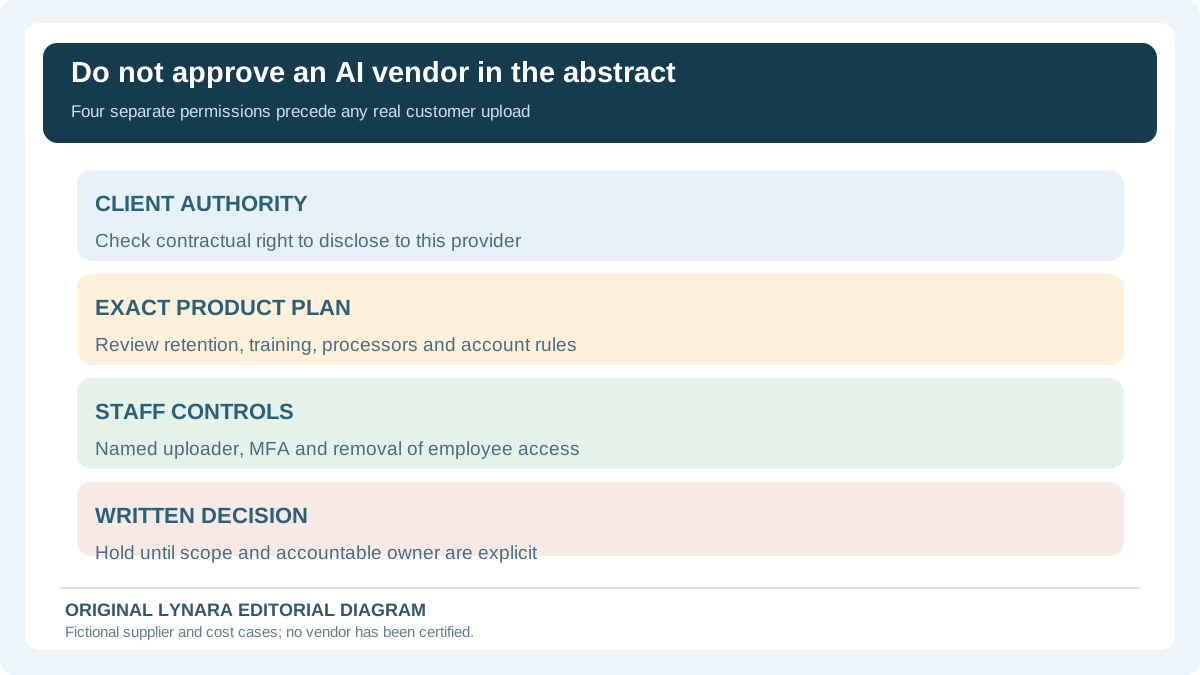
Marketing phrases such as “enterprise-grade,” “secure” and “private” are not enough to answer a procurement question. Request product-specific documentation about whether prompts and uploaded files are retained, for how long, whether they may be used for model training or service improvement, whether administrators can view them, and how data is removed. Ask which settings apply to the exact plan your company would buy. Terms for a free consumer account may differ from terms for a contracted business workspace. Do not assume a product name alone identifies the contractual controls.
Check who can access the data, how team accounts are provisioned, whether multifactor authentication is supported, and what happens when an employee leaves. Ask about incident notification, backups, subprocessors and whether a documented deletion request actually covers all the relevant copies or has stated exceptions. These are questions for the vendor to answer in writing; this article does not claim that every service provides every feature. NIST's Generative AI Profile discusses third-party AI data privacy, information security and procurement due diligence as risk-management considerations.
Review the contractual boundary, not just the toggle
A setting that says “do not train on my content” might be valuable, but it does not answer every question about retention, access, onward processing or the company's right to disclose a client's file. Identify the relevant terms of service, any business agreement, data-processing terms where applicable, confidentiality clauses and what the provider says it will do if service conditions change. If a client contract restricts sharing with third parties, a vendor's reassuring privacy page does not automatically override that restriction. Someone with authority over the client relationship should review and approve the proposed use.
For sensitive processing, get qualified privacy or legal advice appropriate to the jurisdiction and industry. A generic checklist cannot decide whether a particular provider is a processor, whether a transfer is permissible or which notices and agreements are legally required. The NIST Privacy Framework discusses expressing requirements to external service providers and reflecting them in formal agreements. Think of the documents as evidence to examine, not paperwork to collect without reading.
Make a small decision table with an owner
A useful screening sheet can have eight columns: use case, input category, client permission, provider/product plan, written retention answer, access controls, unresolved questions and named approver. The approver should be a real person with appropriate authority, not a shared email address that nobody monitors. A team that makes its go/no-go decision explicit is less likely to mistake an enthusiastic employee trial for company approval. Keep the date and version of the source documents: supplier statements and service settings can change.
Try a fictional three-provider comparison. Provider A offers an impressive demo but will not clarify retention or downstream processing: status hold. Provider B supplies relevant written terms, documents access controls and is compatible with the proposed client permissions: status eligible for a synthetic-data pilot, not automatic permission for confidential data. Provider C is a free personal account with unclear business-use controls: status no real client uploads. These outcomes follow from the hypothetical evidence in the example; they are not ratings of real vendors or a universal legal rule.
Match access to the smallest practical audience
Even after a provider is selected, do not give every employee every uploaded document by default. Separate roles such as account owner, billing administrator, approved uploader, reviewer and read-only viewer where the product supports them. Put offboarding into the process so access can be removed promptly when somebody changes teams. Prefer individually attributable accounts over shared credentials. If a service cannot show who uploaded a file or who can retrieve it later, that limitation belongs in the approval decision.
Cybersecurity basics matter as much as model behavior. The FTC's small-business cybersecurity guidance discusses vendor-related security expectations and security provisions in contracts. Its advice is broader than AI, which is precisely the point: a generative system is still an outside technology service that might handle sensitive business information. A strong AI prompt cannot compensate for a compromised team account.
Run the first pilot with invented or sanitized material
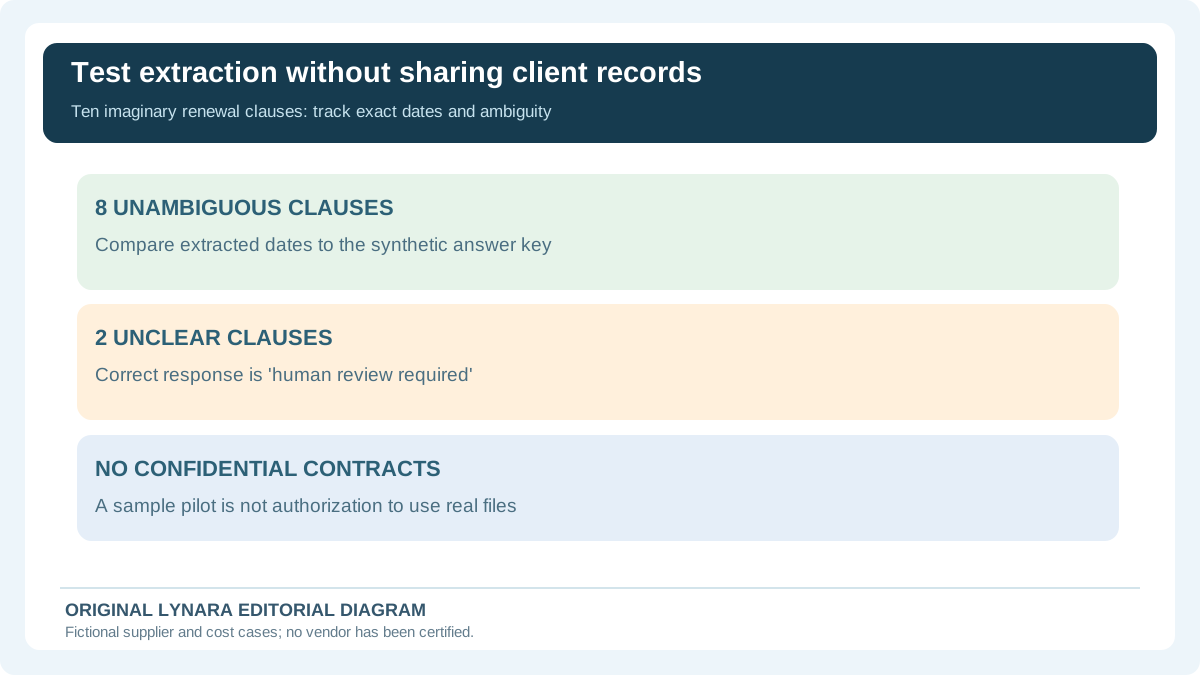
Start with a synthetic contract, dummy invoice or invented support-ticket collection that resembles the workflow but contains no real client's identity or secrets. Give the reviewers a known answer key before uploading anything. If you are testing extraction of renewal dates, write ten fictional clauses with known dates, optional extensions and a few ambiguous sentences. See whether the proposed service preserves those distinctions, flags unknowns and provides traceable references to the sample text. A persuasive response without an evidence trail should not be treated as verified extraction.
Only after the data-flow, vendor review and workflow tests are satisfactory should an authorized person consider whether a more realistic pilot is permissible. Do not disguise a full confidential data upload as “testing” just because it uses only ten files. The AI Workflow Suitability Checker can help frame reversibility, error impact and human-review questions; it is not connected to the vendor's privacy settings and cannot approve contracts on your behalf. Keep authorization separate from model performance.
Measure the real benefit after subtracting controls
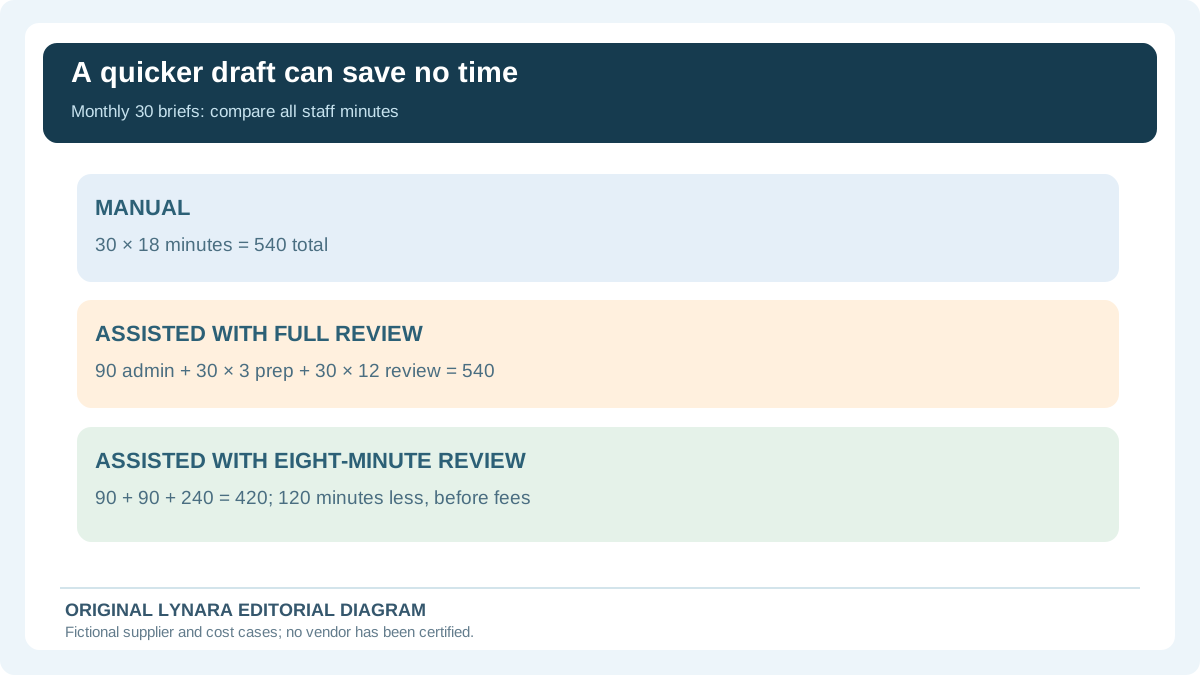
Suppose a fictional agency handles 30 client briefs a month. Manually extracting each brief's key dates and actions takes an illustrative 18 minutes, or 540 minutes monthly. The AI-assisted process takes 90 minutes of monthly administration, 3 minutes per brief to prepare and upload approved material, and 12 minutes per brief for full human review. That totals 90 + (30 × 3) + (30 × 12) = 540 minutes. In this example the supposedly faster AI workflow saves no time. A narrower, lower-risk use case may make more sense.
If review can legitimately fall to eight minutes per brief without losing quality, the new illustrative total becomes 90 + 90 + 240 = 420 minutes, saving two hours per month before vendor fees, onboarding and monitoring. These are scenario numbers, not measured benchmarks. Use the Business AI ROI Calculator to test real assumptions once a workflow is authorized and reliably evaluated. A supplier should not be approved because a spreadsheet assumes away the time required for safety checks.
Keep an approval record that can be revisited
A simple review record might say: Approved for synthetic training materials only; not approved for client contracts; owner: operations manager; review again before a plan change. This is more actionable than “AI tool approved.” Record the permitted input types, prohibited uses, account plan, authorized team, documentation reviewed, test findings, approval date and what event triggers reassessment. A new feature, change in subcontractors, revised contract terms or security incident could all require a fresh decision.
Also define the response if a real file was uploaded without permission. Preserve the facts, notify the designated responsible person and follow the organization's incident-handling process rather than deleting evidence in a panic or promising a client that the provider has erased all copies without confirmation. If an employee reports a mistake early, the process should make it possible to act. A vendor assessment is valuable only when people know where it lives and who can update it.
When not to approve the use case
Stop if the company cannot identify what data is being disclosed, cannot establish that it has authority to share it, cannot get a satisfactory answer about vendor processing, or cannot ensure an acceptable level of access and review. Stop if the system's errors would lead directly to client harm or contractual decisions without human checks. Sometimes the useful alternative is drafting with fictional examples, local manual summaries, a less sensitive dataset or an existing approved business tool. The project does not fail merely because one vendor is unsuitable.
A small company does not need a huge governance department to make a disciplined decision. It does need someone empowered to say no, a few documents that answer the relevant questions and a pilot that does not put real clients at risk. This is where AI procurement differs from choosing the prettiest interface: the company must be able to explain what it shared, with whom, under which conditions and why.
Keep trial evidence beside the approval record
After the proposed data use is explicitly approved, use the AI Software Trial Scorecard to compare two tools on the same task set. It separates accepted-output rates, total review-inclusive time and subscription-only cost. It does not replace approval or claim a vendor has been verified.
Use separate approval statuses for a demonstration and real documents
A small consulting agency may need only an automated summary of contract renewal dates. First, write a synthetic agreement containing ten invented renewal clauses: eight clear dates and two intentionally ambiguous extensions. Preserve an answer key drafted by a person before trying a service. If the service extracts the eight explicit dates but invents confident dates for the two ambiguous clauses, it has failed a critical behavior for this use case. A good result identifies uncertainty and cites the relevant clause. This cannot be counted as permission to start uploading live clients' agreements.
| Gate | Required actual evidence | Decision when unknown |
|---|---|---|
| Right to disclose | Client agreement and named account owner approve the exact sharing scope | HOLD real-file uploads |
| Plan-specific retention | Written provider terms about storage, training and downstream processors | HOLD real-file uploads |
| Employee access | Individual account roles, authentication and departure controls | HOLD until controlled |
| Synthetic test | Answer key, reviewer and ten invented clauses | May proceed only within a separately permitted dummy-data pilot |
Keep the approved use case, document type and service account in the record. 'Approved for synthetic training material' must never be shortened to 'vendor approved.' A provider might change its subprocessors, data retention, product plan or defaults; a significant change can require a new decision. The NIST AI RMF Playbook describes governance, mapping, measurement and risk management. It is voluntary guidance, not a license to process client data or an independent security certification.
Calculate full operating time before representing the vendor as financially worthwhile. In the fictional thirty-brief month, manual processing takes 30 × 18 = 540 minutes. Ninety minutes of governance, thirty times three minutes of preparation, and thirty times twelve minutes of reviewing the generated results also total 540. The software has saved no staff time even if the drafts appear immediately. If genuine review time falls to eight minutes without reducing accuracy, the assisted path becomes 420 minutes, a conditional two-hour difference before any vendor expense. A contractual, privacy or security barrier cannot be outweighed by a time saving.
If a real file is uploaded accidentally, follow the organization's incident response process, notify authorized staff and preserve relevant information. Do not promise deletion from every provider backup unless you have written confirmation that covers the relevant systems. Use the AI Software Trial Scorecard to document synthetic comparisons, while obtaining actual approval for every sensitive deployment separately.
Editorial method and limits
The vendors, examples, task times and savings calculations are fictional teaching scenarios; Lynara has not independently assessed named AI providers in this guide. NIST and FTC sources explain broader risk-management principles, but they do not certify a vendor or determine your company's legal position. Business agreements, client instructions, local laws and the exact product plan all require separate review. This procurement checklist is distinct from our student file-upload privacy guide, which addresses course and school records rather than company vendor approval. See our methodology for evidence and example policy.
A sign-off matrix that prevents accidental approval
Use a short evidence gate rather than a single green checkmark for “vendor approved.” The decision belongs to a named company owner and applies to a specific account plan and data type. An unanswered question is a hold, not permission to upload a smaller number of real files.
| Gate | Evidence to keep | Stop condition |
|---|---|---|
| Right to share | Use-case owner and client-data classification | Client permission or contractual authority is unresolved. |
| Provider processing | Plan-specific retention, training and subprocessor terms with review date | Material data flows or retention remain unclear. |
| Access and deletion | Named administrators, offboarding method and documented deletion limits | Uncontrolled shared access or unsupported deletion claims. |
| Pilot boundaries | Approved synthetic dataset, answer key, reviewer and expiry date | A real client file appears before separate authorization. |
Write the result as “synthetic pilot only until [review date]” or “hold: no uploads”, not simply “AI approved.” Recheck if the plan, subprocessors, retention terms or client instructions change. The AI Workflow Suitability Checker helps prioritize risk questions but cannot verify contracts, grant consent or authorize data transfer. The source documents and approver's record remain the controlling evidence.