Small-Business AI Automation Checklist: Safe Pilot and ROI
Decide which AI tasks should remain drafts, which require specialist oversight and how to test a low-impact workflow without inventing approval.
Automation should begin with permission, not just technical capability
A small business may have many repetitive tasks that appear suitable for AI: preparing customer emails, summarizing meetings, checking spreadsheets or compiling routine reports. The fact that a model can produce a plausible draft does not establish that it should receive the underlying data or be trusted to act. First determine which information the system will handle, what a mistaken answer could cause, whether someone can verify the official source and who has authority to accept the result. Our AI Workflow Suitability Checker helps document those conditions. It is a local educational screening form, not an information-security certification.
Separate writing a draft from taking an action
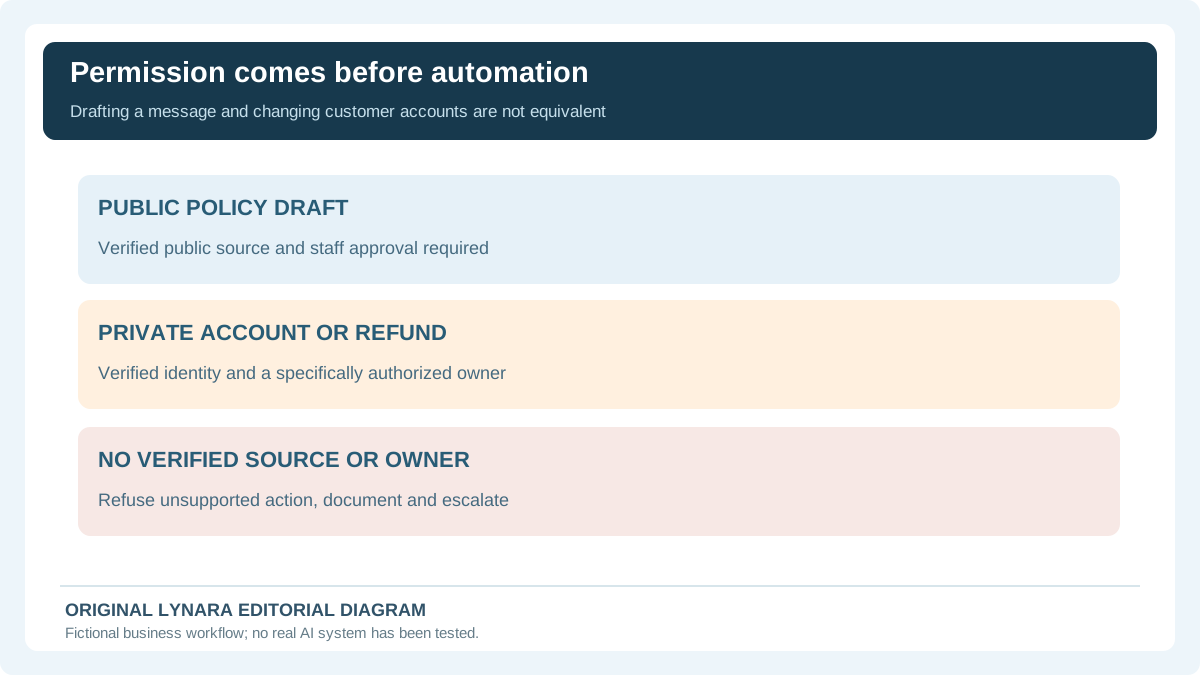
An internal draft of a customer service response can be reversible. Sending that response to hundreds of customers is a live business action that may create financial or legal obligations. Updating an invoice, changing payment details or approving a refund can be more consequential still. Distinguish the model's job from the human's job: “prepare a response for review” is not the same authorization as “contact the customer and update their account.” A company that cannot identify who approves messages or record changes should keep AI assistance within a drafting sandbox until an authorized workflow is designed.
Map data sensitivity before choosing a tool
Public product specifications are different from internal management notes, employee compensation data and identifiable customer records. A confidential input does not become harmless simply because the final answer is a short summary. Check whether the provider, account configuration, retention conditions and intended use are approved by the organization. In a demonstration, use invented records rather than copying production data. If the tool has not been approved for a restricted category, the right next step is to stop and request appropriate review, even if the automated task might otherwise save significant time.
Ask what happens when the assistant is wrong
For a low-impact planning outline, a mistake may cost a few minutes to correct. For a client contract, medical recommendation, safety procedure or employment decision, the consequences can be substantially higher. A useful risk question is whether the output can be checked before anyone acts on it, and whether the responsible reviewer has the information and expertise needed to detect an error. This is why the suitability checker deliberately flags high-consequence decisions for specialist assessment rather than handing out a reassuring numerical “safety percentage.” A scoring gadget cannot prove permissions or compliance.
Worked comparison: fictional shop FAQ drafts
Imagine a fictional bicycle-repair shop that wants to draft general answers to questions about opening hours. It already has a verified current public hours page and a trained employee reviews every draft before anything is sent. The assistant uses only those public facts and has no access to customer accounts. This can be a reasonable candidate for a small supervised pilot, provided the organization also approves the software. The result of the suitability checklist should be treated as permission to examine the idea, not proof that future replies will be correct or that the technology is financially worthwhile.
Worked comparison: automatic refunds
Now consider the same fictional shop using an AI assistant to decide whether a customer qualifies for a refund and to issue it automatically. This process affects payments, policy interpretation and private customer account information. If there is no human approval step or authorized integration, it is not appropriate to treat it like the public-hours drafting exercise. The screening tool marks an unreviewed live action as a stop condition. A specialist may design an approved, controlled system later, but the existence of an AI response does not authorize the action.
Meeting notes need both consent and decision review
A manager might use AI to summarize a regular internal stand-up. If the conversation includes employee performance, client complaints or confidential business plans, the data category changes materially. Recording may require consent and approved storage practices, depending on the location and circumstances. The reviewer must also distinguish suggestions from confirmed decisions. Our meeting-notes and SOP guide illustrates how a missing negative word or invented due date can change the meaning of a record. An automatically created summary is still a draft until the right person checks it.
Human review must be an actual workflow
“Human in the loop” is meaningless if no one has time, context or authority to check the result. Identify the reviewer and define what they inspect: current source policy, customer identity, numerical totals, contractual restrictions or other appropriate criteria. Estimate the time needed to conduct that check. An assistant that saves ten drafting minutes but requires fifteen review minutes adds work, however attractive its demo looks. Review should be tracked as part of the process rather than omitted from a productivity claim.
A trusted source matters more than polished prose
An assistant asked to answer a policy question may rely on an old website, a cached FAQ or fabricated context. Define the single authoritative source and its owner before automating a reply. Include a clear fallback for questions that the source does not answer. If no one can confirm where a business policy comes from, the checker returns a review state rather than treating the system as ready. Any attempt to produce an answer anyway should remain visibly provisional. The source owner must be able to update instructions and withdraw obsolete claims.
Governance is not just a checklist score
The NIST AI Risk Management Framework describes voluntary guidance for governing, mapping, measuring and managing risks associated with AI systems. It does not certify our calculator or substitute for an organization's security review and local legal requirements. A business should consider retention, security, access, human oversight, failure reporting and changes to model behavior. If an automation can affect other people, it needs a responsible owner and a documented escalation procedure.
Calculate potential ROI after a task clears screening
A safe process may still be too expensive. The Business AI ROI Calculator compares task frequency, time saved after human review, adoption and software plus setup costs. For example, a hypothetical workflow saving 13 net minutes across 65 monthly adopted tasks has about 14.08 hours of potential staff capacity value. That is not automatically cash savings or new sales. Keep financial arithmetic separate from authorization. A positive estimated value cannot transform a restricted data flow or unapproved automatic action into an acceptable deployment.
A four-stage trial that preserves control
First map the intended task, information and consequence. Second create approved sample inputs and a checked source of truth. Third operate only in a narrow supervised trial, collecting review time, corrections, exceptions and any effects on customers or staff. Fourth decide whether the benefit survives the actual cost and whether the controls have remained appropriate. A trial that needs substantial human checking can still be useful for learning, but it may not deserve a company-wide subscription. Report failures and limits alongside improvements instead of treating the original hypothesis as a success target.
A small pilot scorecard can expose hidden review work
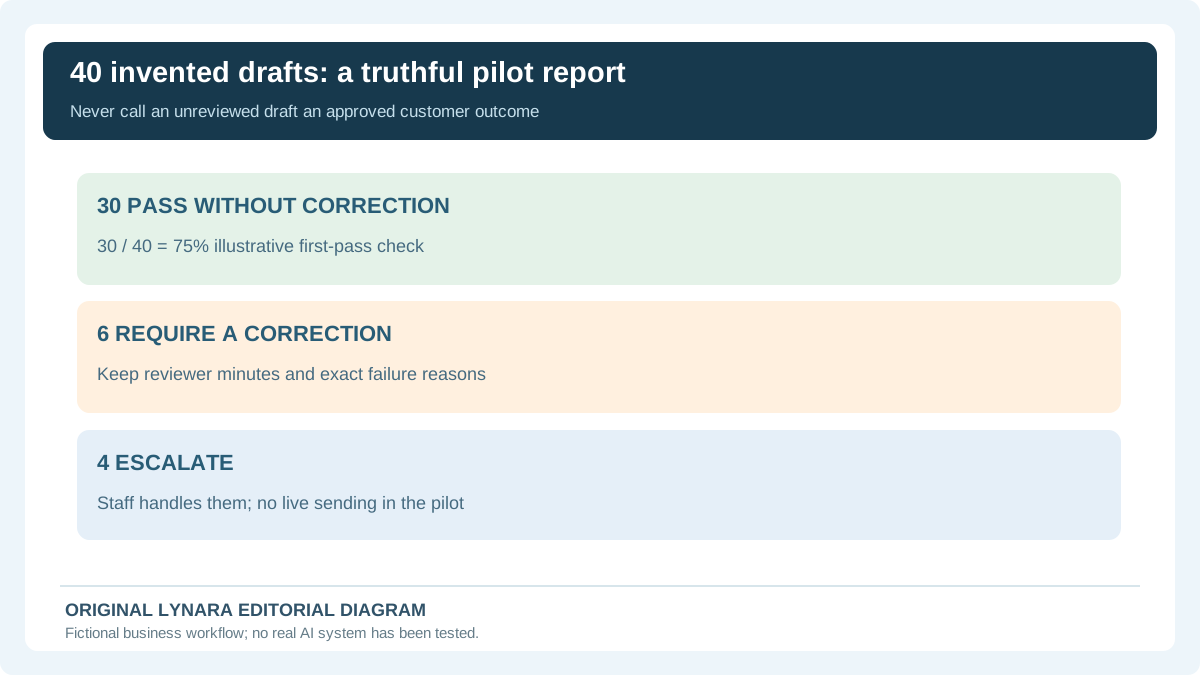
Return to the bicycle-repair shop example. The owner has permission to test 40 invented, routine opening-hours inquiries using only the approved public hours page. No customer account is connected and no automated message is sent. Before the trial, the staff agree that a human will compare every draft with the source and document corrections. The example below is fictional and should not be treated as a performance benchmark or an acceptable error threshold for another business.
| Observed category | Count | What happens next |
|---|---|---|
| Accurate drafts requiring no correction | 30 | Reviewer records a pass after checking the source |
| Drafts corrected by a reviewer | 6 | Record the actual mistake and time needed to repair it |
| Drafts needing escalation | 4 | Human handles the question; do not invent the answer |
| Total examined | 40 | All rows stay in the approved testing environment |
Thirty out of 40 drafts passed the specified first-pass check, or 75%. That calculation describes only these illustrative tests. It is not the same as a customer satisfaction rate, a model accuracy guarantee or proof the workflow can send live responses. If the shop saw only the 30 clean drafts in a demo and omitted the ten troublesome ones, the report would be misleading.
Now consider the work time. Suppose a manual reply would have taken five minutes on each of the 40 cases: 200 minutes in total. In the supervised AI pilot, preparing drafts takes one minute each (40 minutes), checking every answer takes four minutes each (160 minutes), and the four escalations require another six minutes each (24 minutes). The trial uses 224 minutes, which is 24 minutes more work than the manual comparison. Even before software charges, this trial has not demonstrated time savings. A nicer-looking draft or a fast generation step does not erase the staff time needed to verify and repair it.
The owner can change the task, improve the approved source, test a narrower category or decide not to automate. They should also define in advance what stops the pilot: unapproved data exposure, missing source information, a proposed autonomous action or an error that the available reviewer cannot catch. A local suitability check records the screen before a trial. The business ROI tool can then compare properly measured time and expenses, but neither tool grants deployment permission or replaces a trained reviewer.
Keep documentation understandable to a small team
A lightweight decision record can state the task objective, data classification, approved software, source owner, reviewer, allowed outputs, prohibited actions, escalation trigger and date for reassessment. It should be clear enough that an employee can recognize when they are outside the approved scenario. The local screening tool can copy its self-reported choices and resulting questions to a simple note. That output is not a contract or a technical risk assessment, and it should never be used to falsely claim approval that a supervisor or administrator did not give.
What to measure before expanding automation
Track the share of tasks where AI is actually used, the number requiring corrections, end-to-end minutes and cases that needed human escalation. A support team might discover that the routine inquiries are quick but the difficult ones produce most of the costs and errors. A freelancer may find that AI helps outline reports yet cannot check their client-specific facts. Either finding is valuable. Compare the outcome with the AI ROI for Small Business guide and the freelance workflow guide, choosing a next step based on evidence rather than a software company's financial promise.
Continue with the AI for Work & Business hub for related professional guides and verified local calculators.
A pilot funnel prevents inflated savings claims
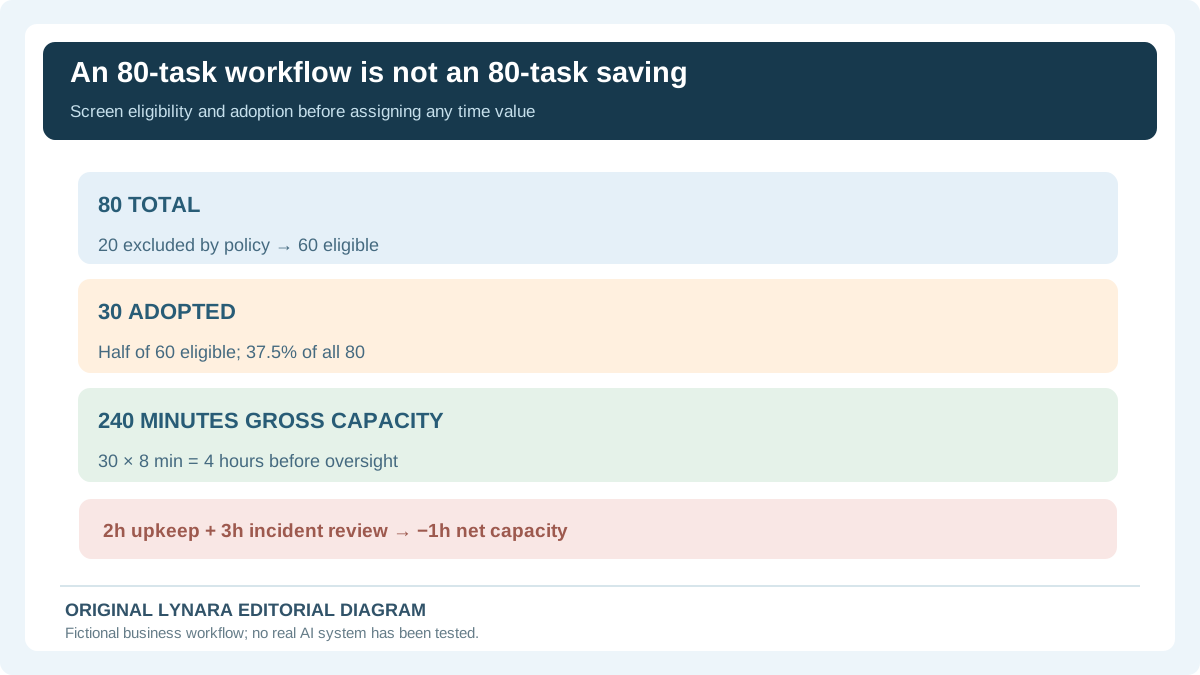
A fictional shop handles 80 inquiries a month. Its policy excludes 20 sensitive or unresolved cases from AI assistance, leaving 60 eligible. Staff elect to use a reviewed draft for only half of those eligible cases: 30 adopted tasks. Suppose the measured end-to-end difference for each adopted task would be eight minutes after checking the answer. The modeled capacity saving is 30 × 8 = 240 minutes (four hours), not 80 × 8 = 640 minutes. The example is invented; it does not represent Lynara customers or a deployed product.
| Stage | Count or time | Decision |
|---|---|---|
| All monthly tasks | 80 | Do not assume every task is automatable |
| Excluded by policy | 20 | Remain human-only |
| Eligible, then adopted | 60; 30 adopted | Adoption is 50% of eligible, 37.5% of all |
| Modeled capacity | 30 × 8 = 240 minutes | Four hours before setup and ongoing oversight |
If monthly setup and maintenance consume two hours, the remaining potential capacity is two hours. A further three hours of incident review would instead make the process one hour slower overall. Record these costs in the Business AI ROI Calculator after checking permission in the AI Workflow Suitability Checker. The NIST AI RMF Playbook is voluntary risk-management guidance, not certification or permission to automate customer decisions.
Publish a pilot report that does not hide refused or excluded tasks
Before paying for another AI service, a small shop can test a single public-information workflow using invented customer questions and the shop's actual approved public policy. Assign one person to maintain the policy source and another to approve the outbound wording if possible. Do not copy live customer names or payment records into a free chatbot to run a pilot. Your test may reveal that the assistant is helpful for drafting public opening hours but unsuitable for shipping status or refunds. Recording an escalation as the correct outcome is more valuable than marking it as an automation failure simply because it involved a human.
| Route | Cases | Review outcome |
|---|---|---|
| Accurate first-pass draft | 30 | Human matches the reply to the approved source |
| Draft requiring correction | 6 | Record the mistake and time spent fixing it |
| Escalation instead of completion | 4 | Staff completes the inquiry through an approved route |
| All synthetic tasks | 40 | 30 / 40 = 75% first-pass acceptance only for this example |
Requiring a human to check each draft changes the true operating economics. The NIST AI RMF Playbook is voluntary guidance for governing, mapping, measuring and managing risks, including human oversight. It is not a safety certificate or an instruction to automatically approve tasks that sound polite. Make your own controls match actual business permissions and applicable rules.
For the independent monthly capacity scenario, keep the denominators distinct. Of 80 hypothetical inquiries, 20 are excluded, leaving 60 eligible. Half are adopted, so only 30 tasks receive the assisted process, or 37.5% of all incoming tasks. If each saves a net eight minutes after routine review, that is 240 minutes of potential capacity. Two hours of setup and maintenance leave only two hours. If incident investigation adds three hours, the exercise yields minus one hour of net capacity, not a business benefit. Do not call eight minutes a 'saving' if it omits the normal review workload or use an attractive pilot percentage to conceal the escalation rate.
A release gate therefore asks whether an approved owner, a trusted source, a real complaint/escalation process and a full time log exist. If a task requires modifying customer records or triggering irreversible financial actions, defer it until a separate security and authorization review has approved that exact route. A better outcome may be a small library of human-approved templates rather than any autonomous integration.