AI Workflows for Freelancers: Cost, Quality and Client Approval
Price the review, clarify the client's rights, and keep control over the final work.
Choose repeatable freelance work before adding an AI subscription
Freelancers often see generative AI marketed as a shortcut to more clients, more deliverables and more profit. A better starting point is to identify which parts of a paid job are repeatable and which still demand your own professional judgment. Converting rough notes into an outline may be a reasonable assistive task. Inventing client facts, claiming to have interviewed a customer or sending a final legal or financial recommendation without review is not. The tool should help produce a reliable deliverable rather than a larger volume of unverified content. Start with a service you already know how to complete without AI so you can recognize bad output.
Workflows that are useful without exposing clients
Consider a freelance graphic designer who needs to write an initial project brief. An assistant could help convert the designer's own nonconfidential questions into a checklist, but the actual client requirements, budget and usage rights must come from the client. A copywriter might use a tool to identify inconsistent headings in a draft while still researching claims personally. A virtual assistant could design a template for common follow-up messages without uploading private customer conversations. For every task, separate general reusable structure from records you are not authorized to disclose.
Keep the human review stage visible
AI-generated drafts can contain invented dates, pricing, citations or promises. Every one of those errors can affect a client relationship. Define review as actual work: checking statements against original material, adjusting tone, confirming the scope and testing the delivered format. If you price only the generation minutes, the estimate may appear profitable even though you spend two more hours correcting the result. The Freelance AI Project Quote Calculator explicitly separates production time and review/revision hours to make that hidden cost harder to omit.
Original pricing example: small report project
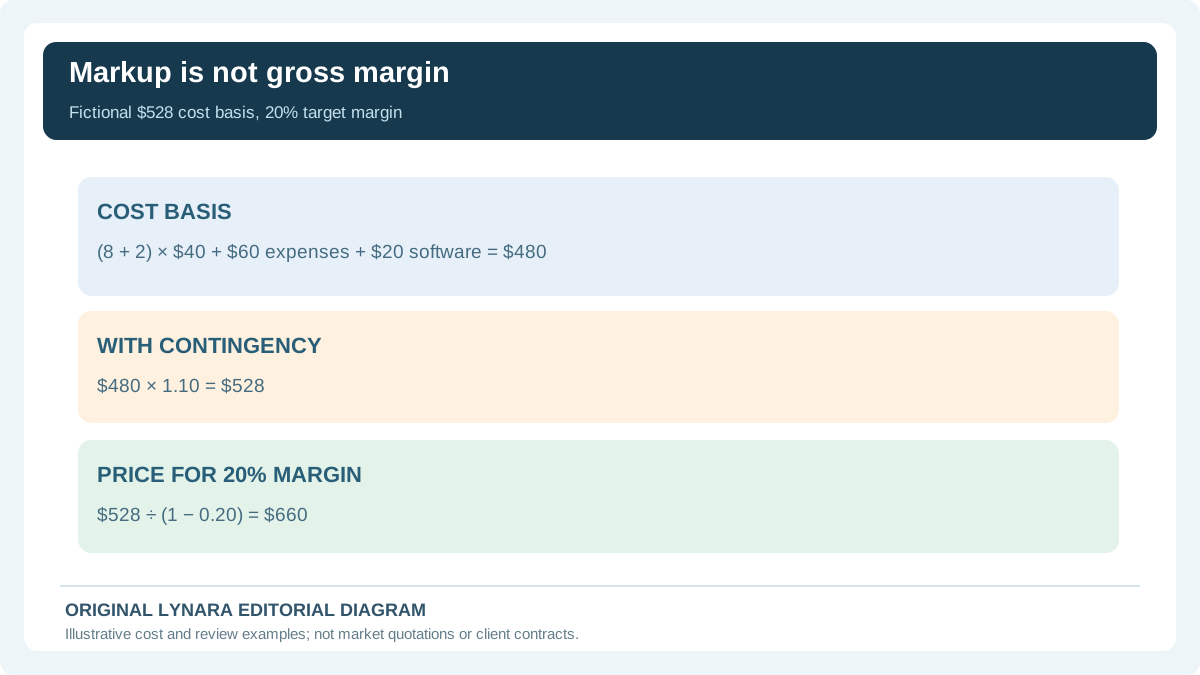
Imagine a fictional freelancer preparing a structured market summary using sources that a client has approved for the assignment. They forecast eight hours of research, drafting and layout, two hours of fact-checking and revisions, an internal labor cost of $40 per hour, another $60 in project expenses and $20 of allocated software cost. Base cost is (8 + 2) × $40 + $60 + $20 = $480. Adding a 10% contingency produces a $528 cost basis. A 20% target gross margin on selling price leads to $528 ÷ 0.8 = $660. Every dollar and hour is an invented worksheet input, not a market benchmark.
Gross margin is not a 20 percent markup
Many freelancers price a task by adding a percentage to the cost without checking what that percentage means. A 20% markup on $528 results in $633.60, but the margin on that selling price is only (633.60 − 528) ÷ 633.60, approximately 16.67%. A 20% gross margin on the selling price instead requires dividing the cost basis by 1 − 0.20. Our quote calculator uses that second definition and labels it clearly. It does not include taxes, financing, late payment risk or a client contract, so its suggested quote is a starting arithmetic result rather than a legally binding proposal.
Do not confuse software subscriptions with client expenses
An AI subscription may support several jobs or clients. Charging the entire monthly expense to each project without an allocation method overstates costs and may mislead customers. Choose a documented allocation based on expected usage or internal policy, or treat software as an overhead included in your hourly target. Whatever approach you select, avoid counting the same cost twice. Client-specific licensed imagery, stock photos or data purchases may have their own usage restrictions and separate fees. Do not assume that a generated visual is automatically cleared for every commercial campaign or jurisdiction.
Build a repeatable brief-to-delivery process
A workable sequence begins with an explicit client brief: audience, goal, deliverable, deadline, revision allowance, source requirements and approval authority. Next write a human-owned checklist of what can be assisted. Generate only a draft or organization aid on permitted data; then verify factual claims, compare against the brief, run the required format checks and request client feedback. Save a versioned list of approved changes before final delivery. This process does not require an elaborate autonomous agent. Reliability and a transparent owner for every decision matter more than a chain of opaque prompts.
What to tell a client about AI assistance
Disclosure requirements differ across contracts, industries and professional obligations. Review the signed agreement and obtain permission where needed before supplying client material to a third-party model or using generated content in a deliverable. If a client explicitly requests manual authorship or prohibits particular services, comply rather than trying to make the output appear human. Avoid claiming a source was interviewed or tested when it was not. Describing the real research and revision process is more defensible than claiming the automation did the whole project perfectly.
Data privacy and intellectual property are project constraints
Do not paste private customer lists, credentials, unpublished product plans or copyrighted client files into tools merely because the interface accepts text. Check the provider's retention, administrative access and data-use terms, and use only authorized business accounts. The NIST AI Risk Management Framework is a voluntary way to think about risks throughout a system's lifecycle. It is not a blanket license to upload confidential materials. For contracts involving personally identifiable information, professional advice and business approval may be necessary before any AI processing begins.
Evaluate a freelance AI tool without affiliate hype
Software comparisons should use the actual feature a freelancer needs rather than a ranked list of brands copied from promotional materials. Questions include whether the subscription permits commercial use, whether outputs can be exported, whether collaboration or version history is available and whether relevant client data can be handled appropriately. Ask about cancellation, seat limits and additional charges. If a product changes plans or removes a capability, update the workflow and cost model. A tool you can operate without compromising clients may be more useful than one with more advertised automation.
When AI savings are not worth the review
A job with very few repeating elements may not benefit from a standard AI workflow. A sensitive health document, contract clause, tax form or engineering specification may require expert work that cannot be replaced by casual model output. Even when an assistant speeds up outlining, verification can take longer than the original drafting. Test with several representative tasks and record where it helps or fails. Use our Business AI ROI Calculator for repeated monthly tasks, rather than assuming a project-by-project price automatically proves an investment will pay back.
Close the scope before sending the quote
A sound proposal defines the deliverable, accepted inputs, revisions included, excluded work, access requirements, dependencies, payment milestones and who is responsible for source approval. For our fictional $660 quote, the client might ask for an additional report or a new audience segment; that change deserves a revised scope, not hidden unpaid hours. Recalculate the estimate using the quote worksheet and preserve both versions. Before accepting, ask whether the quoted amount covers your actual labor, software, third-party costs and enough contingency for a realistic review.
Set a concrete acceptance test before generating the first draft
Here is an ordinary client scenario. A small neighborhood bakery hires a freelance writer for four short seasonal product pages, each with a headline, a 90–140-word description and two suggested image captions. The client provides an approved product list and asks for a version to review by Friday. AI may help brainstorm layout alternatives, but the actual ingredients, allergy information, availability and final selling claims must come from the bakery's authoritative records and authorized reviewer. The writer should not ask an AI model to invent those facts from a product name.
Instead of accepting vague feedback such as “make the copy sound premium,” the writer can propose four testable conditions before the project begins:
| Check | Evidence to keep | When to stop |
|---|---|---|
| Product facts | One approved current product sheet per page, with every concrete ingredient and product claim checked by a person | Any source is missing, out of date or inconsistent with the brief |
| Deliverable completeness | Four distinct pages, four headlines, four descriptions within the requested length, and eight caption suggestions | Missing page, repeated generic text or wrong format |
| Client rights and data | Written approval of permitted AI assistance, image assets and any confidential inputs before processing | Required permission or commercial usage rights are unclear |
| Revision control | Version 1, a consolidated client feedback list, named approver and a documented revision limit | The client requests a new product, language or campaign outside the agreed scope |
This matrix changes the business outcome. A freelance writer can now show what was actually delivered, what was checked and why a proposed change might be additional work. It also makes the review time measurable: someone must open the source sheet, compare each claim and inspect the final exported file. “The AI said it looked correct” is not evidence of any of those checks.
Keep a change log that protects both the freelancer and the client
At delivery, attach a small note describing the output files, the brief version, the source documents actually used, unresolved questions and the client's next approval step. If the client requests a revision, record whether it corrects a mistake in the agreed deliverable, changes an approved fact or adds new scope. Those cases should not be silently treated as the same type of work. A typo you introduced is normally a quality correction; a fifth product page is an additional deliverable. The contract and agreed terms control what is billable, and the freelancer should not guess that a broad statement like “two revisions” covers every future request.
If the project uses an AI service, keep an internal note of the permitted data category and the human review steps, not a public dump of client prompts, names or confidential records. Test a generic template on synthetic examples when permission for production data is still pending. If a customer later asks how the work was made, answer accurately about the process you really followed. That is more useful for a lasting client relationship than trying to disguise the use of an assistive tool.
Finally, look at the time log from the completed job. Suppose drafting felt fast but fact checking and formatting took longer than planned. The next quotation should increase its review allowance instead of using the original optimistic estimate. Track the result over several projects before concluding that an AI subscription improved profit. The freelance project quote calculator lets you model those updated assumptions, while the business ROI tool is more appropriate when you are evaluating a repeated monthly workflow.
A practical first-week action plan
On day one, document how you deliver a service today and what information is sensitive. On day two, create a reusable brief template without entering client secrets. On day three, try one AI-assisted step on authorized material and record the time spent checking. On day four, test the final deliverable against a client-like checklist. On day five, price the same job both with and without the assistant, including software and corrections. If the difference is modest, that is a valid result. Sustainable freelance earnings depend on real client value, not inflated output numbers.
Explore related tools and guides in AI for Work & Business, including practical advice for freelancers, small businesses and office workers.
When a client adds revisions: protect the quote with a change-order calculation
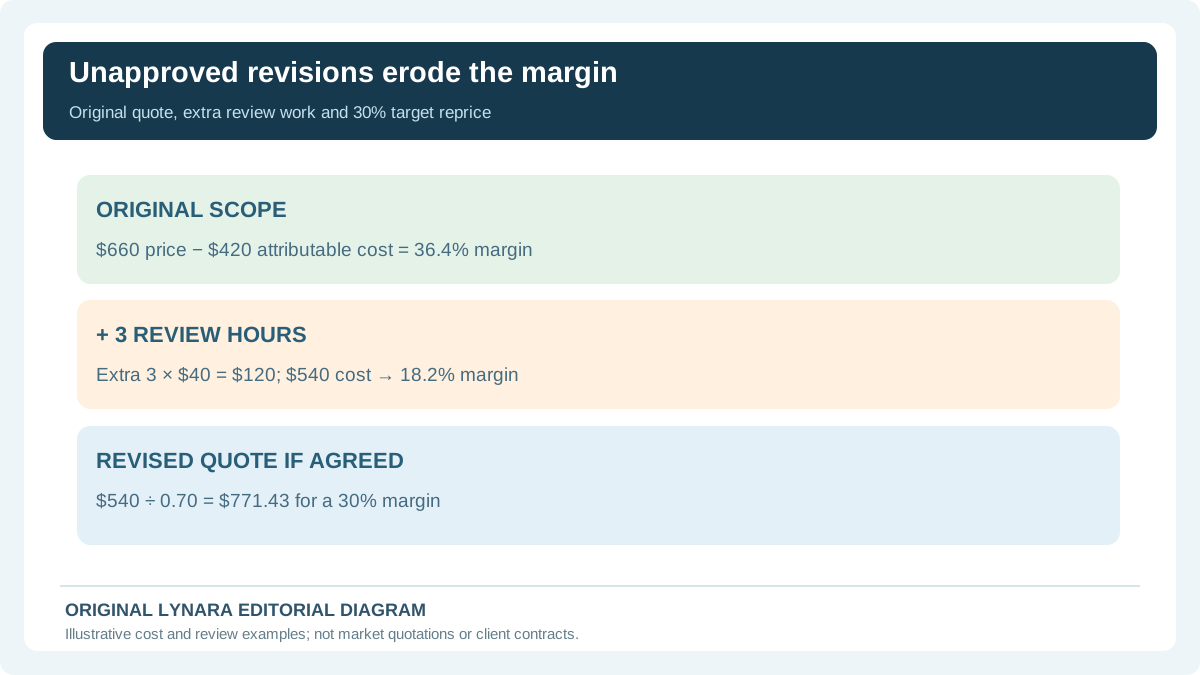
A freelancer may correctly price the first deliverable but lose the planned margin after an unpriced request. In this separate fictional example, a fixed project is quoted at $660 with $420 in attributable labor and direct costs. That leaves $240 before taxes and other overhead, a gross margin of (660 − 420) / 660 = 36.4%. The client then requests three extra review hours at a hypothetical internal cost of $40/hour, adding $120. If the price stays at $660, attributable costs rise to $540 and margin falls to 18.2%.
| Scenario | Price | Attributable cost | Gross margin |
|---|---|---|---|
| Original agreed scope | $660 | $420 | 36.4% |
| Unpriced extra revision | $660 | $540 | 18.2% |
| Requoted at a 30% target margin | $771.43 | $540 | 30.0% |
At a hypothetical 30% target margin, the revised price is 540 ÷ (1 − 0.30) = $771.43, or $111.43 above the original quote. This is not a contractual right to charge extra: confirm the agreed revision allowance, approval and payment terms before doing the work. Enter actual hours, expenses and target margin in the Freelance AI Project Quote Calculator, and give the client a clearly scoped change request. AI drafting speed does not eliminate human verification or create free revisions.
A practical invoice and scope gate before starting extra work
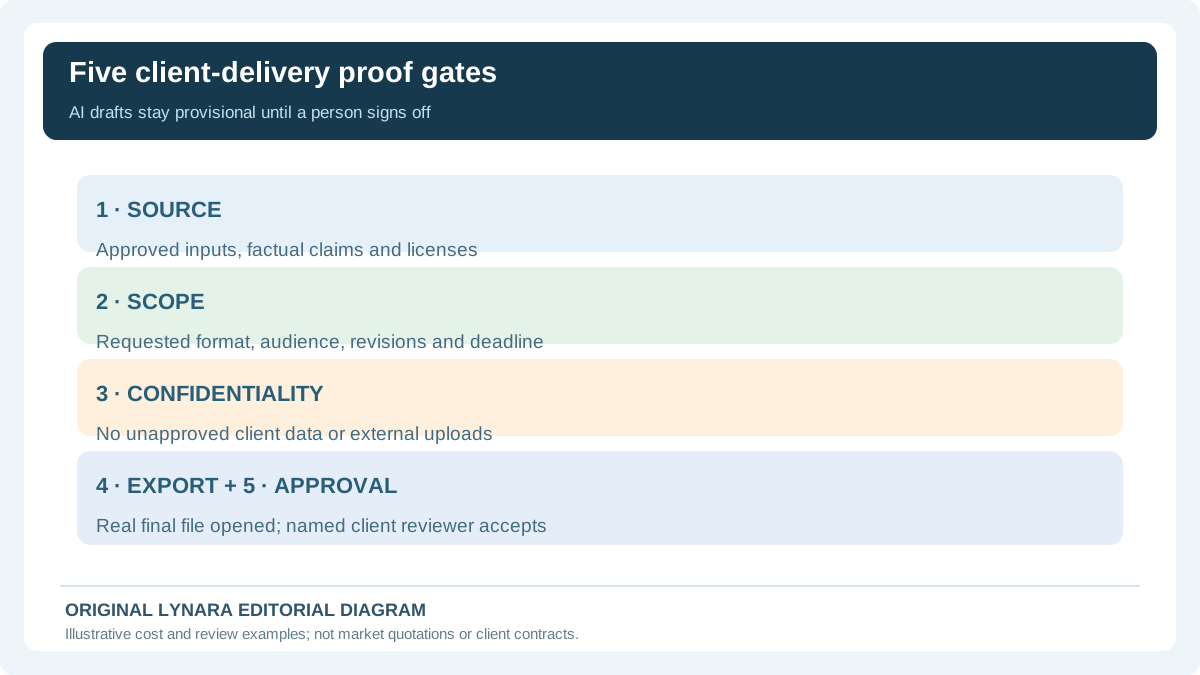
In this fictional project, a client accepts a $660 quote for one market report using permitted sources. Before an AI assistant starts drafting, the freelancer should have a written brief naming the deliverable, original audience, source limitations, file format, included revision rounds and the person authorized to approve changes. The freelancer should not assume that an email asking for 'a few tweaks' necessarily expands the contract or that the assistant's plausible answer proves a source is accurate. Put the original approval next to the final files so a reviewer can compare what was promised with what was delivered.
| Check | What the freelancer actually inspects | Result if missing |
|---|---|---|
| Authorized source | The client provided or approved the underlying facts, rights and references | HOLD any unsupported claim |
| Exact scope | Report length, audience, output and included revision allowance | Request explicit change approval |
| Confidentiality | Whether particular documents may enter a third-party service | Keep sensitive material out |
| Final file | Open the export and inspect visible charts, citations and formatting | Repair before delivering |
| Named approval | Document an actual client acceptance or requested corrections | Do not represent work as approved |
The underlying financial model is also checkable. Eight production hours plus two review hours at a fictional internal rate of $40 per hour totals $400. Add $60 project expense and $20 allocated software to reach $480, then a 10% contingency to reach $528. The target of 20% gross margin on the selling price requires dividing $528 by 0.80, yielding $660. A 20% markup on cost would produce $633.60 and only a 16.67% selling-price margin. A software calculator is useful for these amounts but does not establish tax treatment, a lawful contract term or the client's willingness to pay.
For a change request, identify what was included before naming a new charge. Three additional review hours at the invented $40 internal cost increase attributable costs by $120. If no price change is approved, the margin falls to roughly 18.2% on that separate $660-price/$420-base-cost example. The Freelance AI Project Quote Calculator can help compare assumptions, but the final commercial decision must follow the agreement and obtain the real client's consent.