AI ROI for Small Business: Costs, Time and Break-Even
Make an AI purchasing decision with actual workflow measurements, not guaranteed-earnings promises. Updated October 2026.
What US small-business AI adoption research actually says
Two independently published US sources help explain why businesses are asking this question. The Federal Reserve Bank of San Francisco's March 23, 2026 analysis says nearly 40% of respondents to the 2024 Small Business Credit Survey reported using or planning to use AI. It reports varied motivations and obstacles, such as training, costs, accuracy and limits on sensitive uses. Separately, the US Chamber of Commerce's October 2026 survey report says 66% of surveyed small businesses report using AI. These figures are not directly comparable growth measurements: one mixes current and planned adoption from a 2024 respondent sample, while the other measures reported current use in a different later study. Nor does a cross-sectional association prove that buying AI causes revenue or profit growth.
The immediate practical lesson is to choose a specific workflow you can measure. The survey numbers support relevance of the question; they do not tell an individual business how many minutes it will save or whether a subscription will pay for itself. That decision requires the baseline, adoption, review and cost inputs in our calculator.
Check whether the task is suitable before comparing financial returns
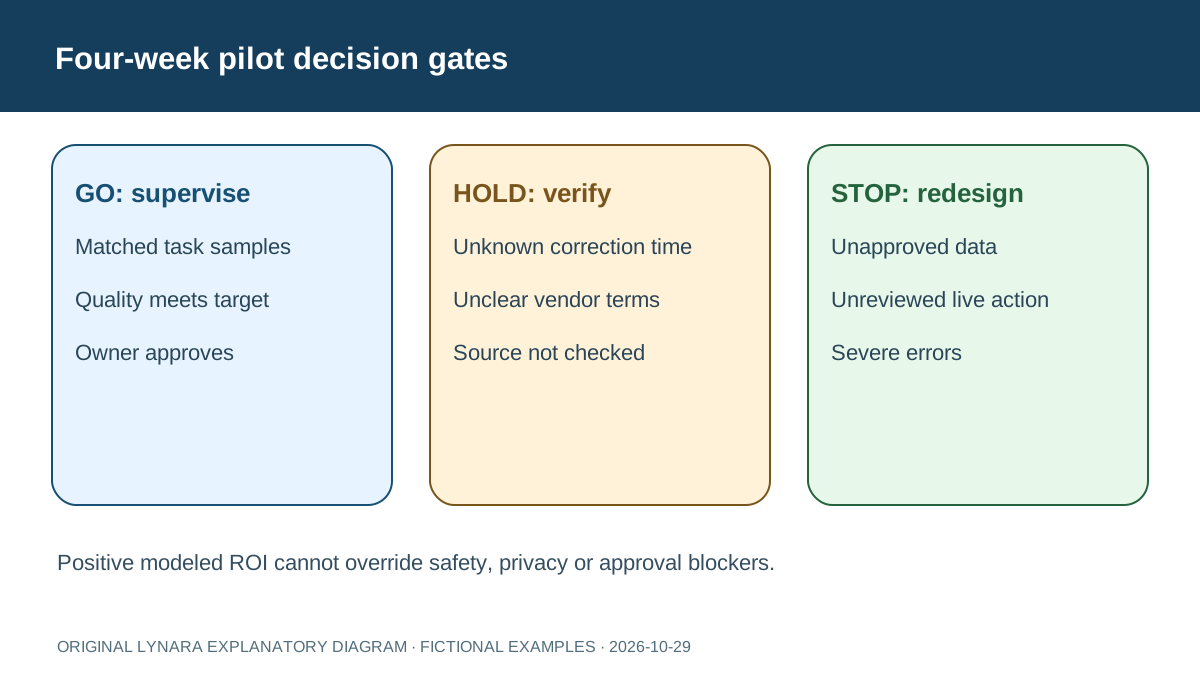
Some proposed automations are unsuitable even if the spreadsheet predicts savings. Try our AI Workflow Suitability Checker first to document software approval, information sensitivity, the consequence of a wrong decision, authority to send or edit records, source verification and human oversight. A stop result cannot be overridden by a positive modeled ROI. A pilot recommendation is only an educational screening result, not professional authorization.
Start with one task, not a promise that AI will double revenue
A small business does not buy software because a dashboard says “AI powered”; it buys time, quality or a better customer experience. Before evaluating a subscription, choose one repeated process that you can measure: assembling a weekly status email, classifying a set of routine inquiries, extracting a few fields from non-sensitive invoices or preparing first drafts of publicly shareable product descriptions. Define what a correct result looks like and how a person will review it. An AI system that drafts faster but creates extra correction work can make the workflow worse. Your baseline should come from actual recent work, not a vendor's unverified savings claim.
What an AI ROI calculator can and cannot estimate
Our AI ROI Calculator for Small Business estimates the value of time freed on a repeated task under explicit assumptions. You enter weekly task frequency, minutes before and after introducing the tool, human review minutes, a labor cost rate, expected adoption, monthly software and other costs, and one-time implementation expense. The output shows estimated monthly hours, the labor value of those hours, monthly modeled costs and net value. It does not measure additional sales, certify an AI product or prove actual savings. Time freed is financially valuable only if it can be productively redeployed, avoid a real cost or improve a measurable result.
Build a baseline without collecting sensitive information
Use a representative sample of completed tasks to time the existing process. For example, a small plumbing office might time the process of turning publicly available service notes into a generic appointment reminder, but should not submit identifiable customer addresses or health information to a general AI service just to measure a workflow. Record the number of tasks, actual minutes and quality failures across a typical week. If the timing includes interruptions, note them rather than pretending every task takes exactly 20 minutes. Your estimates need context so a future comparison tests the same kind of work.
A fully transparent hypothetical case
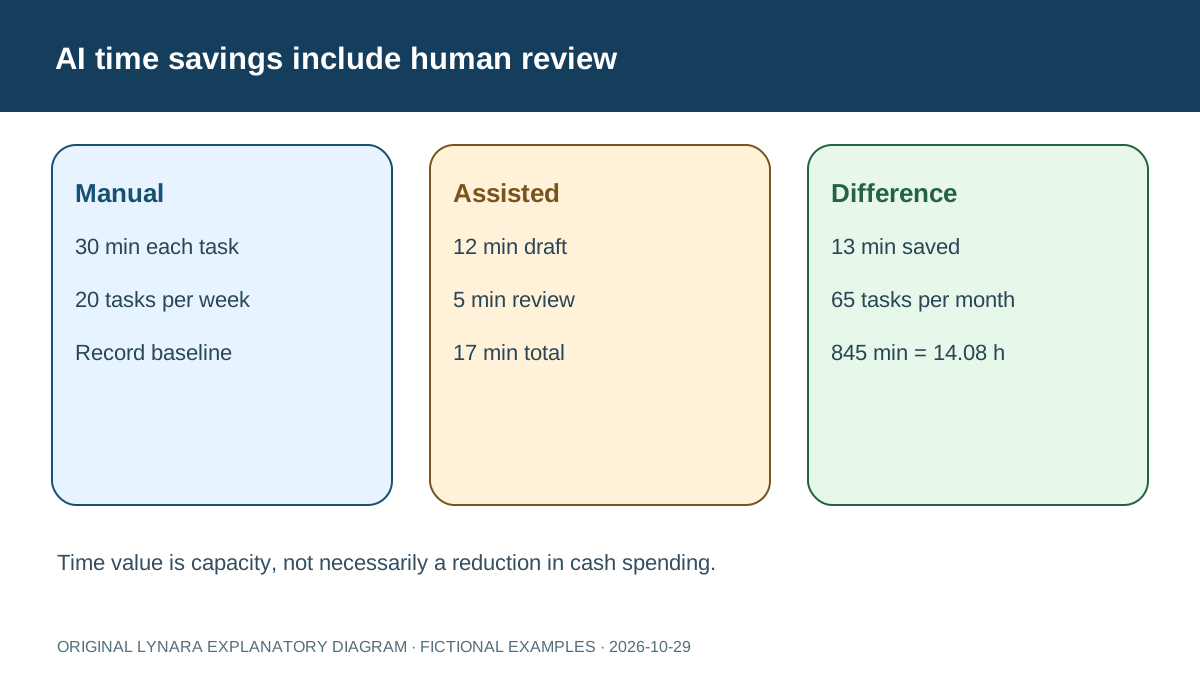
Consider a fictional business with 20 eligible tasks per week. Each takes 30 minutes manually. After introducing a reviewed assistant workflow, the draft takes 12 minutes and checking it takes another five. Suppose only 75% of tasks actually use the workflow, the business values work time at an illustrative $30 per hour, pays $40 for software and $10 for another recurring expense, and allocates $120 of setup across six months. The example contains invented numbers for calculation and is not a market price survey or a case study of an actual company.
Work out the net time and cost yourself
On average the scenario has 20 × 52 ÷ 12 × 75% = 65 participating tasks per month. Each saves 30 − 12 − 5 = 13 minutes, giving 845 minutes or about 14.08 hours. At $30 an hour, this is $422.50 in modeled labor value. Recurring costs total $50 per month and the allocation for setup adds another $20 per month. Therefore the scenario's modeled net monthly value is $422.50 − $70 = $352.50. Enter the same numbers in the calculator and then change the adoption share to zero to see why the software expense still matters.
New: calculate the adoption break-even point
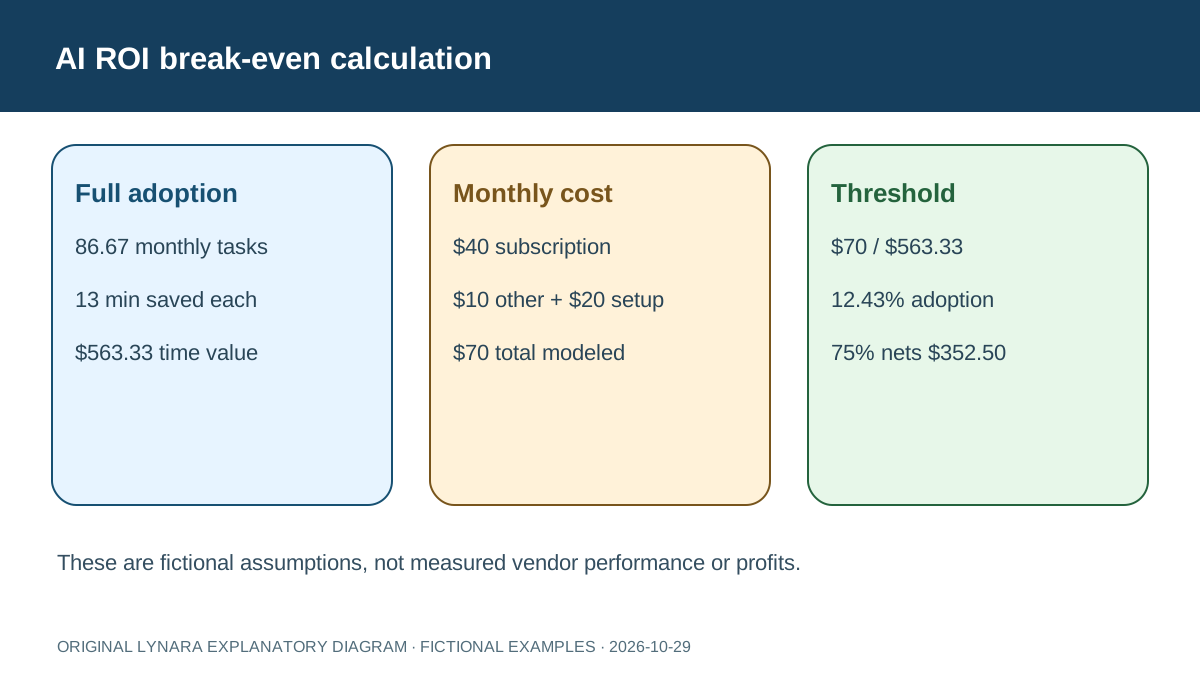
Under the fictional 20-weekly-task example, the modeled fixed monthly cost is $70. If every eligible task adopted the process, it would create about $563.33 in time value at the assumptions above. Dividing the monthly cost by that full-adoption value yields a 12.43% minimum adoption share to break even under this particular model. At 75% adoption, the business could spend at most about 15.85 review minutes per participating task before the modeled time value stopped covering cost. These thresholds are sensitive to the labor rate, task eligibility and setup allocation; they do not guarantee future outcomes. Try changing inputs in the live scenario calculator to see whether adoption alone could ever overcome the costs.
Why adoption and verification rates change the business case
Suppose the AI draft is quick but frequently wrong. If the checking stage increases from five minutes to 20, net savings fall from 13 minutes to negative two minutes per participating task. The output will show additional work rather than hiding it. Another failure mode is low adoption: staff may prefer existing methods, the tool may be blocked for certain records, or the model may not handle uncommon requests. A business should measure both the fraction of tasks eligible for the workflow and the fraction that actually use it. Buying a company-wide license before a small pilot can turn an attractive scenario into a recurring loss.
Differentiate staff-hour value from money in the bank
If employees are already on salary, a saved hour does not automatically reduce payroll. It may instead create capacity for callbacks, training, customer service or work that was otherwise delayed. Describe that as capacity, not cost savings, unless the business can demonstrate a corresponding spending change. An owner working evenings might personally value reclaimed time, but an hourly monetary conversion remains an assumption. A useful decision memo reports measurable time and financial expenditure separately. If the value is mainly faster response or reduced stress, collect a quality indicator instead of manufacturing revenue from minutes saved.
Measure quality alongside speed
A test of an AI-supported customer response needs a human quality checklist: was the customer's actual question answered, were policy or price claims correct, and was private data handled appropriately? For spreadsheet tasks, recalculate totals or sample the extracted fields rather than trusting a confident summary. Record correction time and the proportion of items needing rewriting. A workflow that saves ten minutes but introduces expensive mistakes may not be worth deploying. Our AI spreadsheet data guide covers practical checks for formulas, joins and missing values without claiming that automated text output has verified the underlying records.
Account for setup, training and vendor changes
The first cost is rarely the monthly subscription alone. A team may spend hours defining an approved prompt, writing a review checklist, configuring access, testing exceptions and training staff. The calculator spreads an entered one-time expense over a chosen number of months, strictly for simple monthly comparison; it does not simulate cash-flow timing or financing. Add ongoing support or monitoring as a recurring cost when relevant. Tool features, prices and terms can change; the correct input comes from a current written quotation and your own pilot. Do not apply a national average to a local business without a reason.
Protect customers and company records
Before allowing an AI assistant to process any information, ask who owns the records, what the vendor retains and whether the organization has approved the use. Avoid entering secrets, personal identifiers, personnel records or protected customer data into a new tool without formal authorization and an appropriate agreement. The NIST AI Risk Management Framework offers voluntary guidance on mapping, measuring, managing and governing AI risk. It is not a certification that a particular service is safe. For regulated or consequential decisions, include specialist review beyond a simple prompt checklist.
Be skeptical of guaranteed-earnings marketing
The US Federal Trade Commission's March 24, 2026 settlement announcement describes earlier allegations about unrealistic AI business-growth and earnings promises and a proposed settlement restricting business-opportunity marketing. The existence of that enforcement action does not mean every AI vendor is dishonest. It does mean a business owner should request the evidence behind projected financial outcomes rather than accept a made-up success rate. Ask for the contract, cancellation terms, permitted usage, human-review costs and meaningful trial data before paying for a long commitment.
Compare three plausible outcomes before paying for AI
A single optimistic ROI number hides uncertainty. Keep the same task definition, baseline, drafting time, hourly valuation and fixed cost, then change adoption or human review time. The fictional example has 20 eligible tasks each week, or about 86.67 per month, and $70 in modeled monthly expenses including the setup allocation. These three scenarios are sensitivity tests, not observed business results.
| Scenario | Adoption | Review per task | Modeled monthly net | Practical decision |
|---|---|---|---|---|
| Base case | 75% | 5 minutes | $352.50 | Verify quality and real savings |
| Low adoption | 25% | 5 minutes | $70.83 | Investigate workflow fit |
| Heavy corrections | 75% | 20 minutes | −$135.00 | Stop or redesign |
For the low-adoption row, 86.67 × 25% gives about 21.67 monthly tasks. At 13 minutes saved each and $30 per hour, time value is $140.83; after $70 modeled costs the net is $70.83. Heavy correction changes net time per task to 30 − 12 − 20 = −2 minutes. For 65 adopted tasks, the time-value loss is $65, so net modeled value is −$135 after costs. Keep extra rework separate from review already counted; otherwise the model will double-count effort.
Before approving a paid subscription, collect a baseline sample, an assisted sample with comparable complexity, the error and exception log, a current written quote, and a decision owner. If staff time is freed but payroll and contractor spending stay unchanged, report capacity rather than cash profit. If a response invents a refund policy or reveals confidential data, the appropriate decision can be STOP even with positive modeled ROI. Screen the workflow in the suitability checker and enter observed values in the ROI calculator rather than presenting a vendor's forecast as evidence.
A four-week evaluation that can actually answer something
In week one, record the baseline minutes, quality issues and task types. In week two, configure a restricted workflow and test with safe, non-sensitive examples, collecting every correction. In week three, compare a similar sample of real authorized tasks with the old process, using equivalent measures. In week four, assess adoption, quality, recurring cost and any additional review burden. Present the results with sample size and limitations. Then enter observed figures, not hopes, into the AI ROI calculator. If the net value is negative or uncertain, revisit the workflow rather than claiming the technology has already paid for itself.
Where to go next
If the work is project-based rather than a daily repeated process, the return calculation above may be the wrong first tool. A freelancer pricing an individual deliverable can use our Freelance AI Project Quote Calculator, which accounts for production, review and direct expense. If your work involves structured records, follow the spreadsheet verification guide. The important habit is to align a calculator with the question it actually answers. No numerical output from these tools substitutes for legal, privacy or procurement review or proves an increase in future profits.
Explore related tools and guides in AI for Work & Business, including practical advice for freelancers, small businesses and office workers.
Compare matched tasks and count exception work before buying
A before-and-after trial can exaggerate gains if the assisted group receives easier tasks. A more informative pilot uses the same task definition, similar complexity, an approved source and a recorded review standard. For a small illustrative comparison, imagine ten manual tasks averaging 25 minutes each: 250 minutes in total. Ten comparable AI-assisted tasks average 14 minutes of drafting plus nine minutes of checking each: 230 minutes. The apparent saving is 20 minutes across ten tasks, or two minutes per task—not 11 minutes just because drafting alone fell from 25 to 14.
| Method | Total time | Difference from manual |
|---|---|---|
| Manual baseline | 250 minutes | Baseline |
| AI draft plus routine review | 230 minutes | 20 minutes saved |
| AI plus one 35-minute correction | 265 minutes | 15 minutes slower |
If one of those AI tasks later needs an additional 35-minute correction not included in routine checking, the assisted total becomes 265 minutes and the modeled saving reverses to 15 minutes lost. Do not double-count a correction already included in the nine-minute review average. Ten tasks cannot establish statistical confidence or a universal business result. Track eligibility, errors, severity, correction time and repeatability; compare actual subscription costs in the Business AI ROI Calculator. NIST's AI measurement resources provide context for selecting appropriate testing and verification methods, not an endorsement of this fictional calculation.
Document your AI pilot before approving a rollout
Record observed task performance and review obligations in one place. This does not calculate ROI for you; enter verified quantities and expenses in the linked calculator.
Define one repeated task, its eligibility rules, sample size and the manual comparator.
Include preparation, AI drafting, human review and all correction time; note outliers.
Record material errors, policy escalations, unsafe outputs and who reviewed them.
List one-time setup, recurring fees, review time cost and current vendor terms.
Specify the exact type of data permitted, vendor access, retention terms and owner.
State scale, revise or stop, supported by measured reasons and a review date.
Use fictitious or non-sensitive notes here; never paste customer records, credentials or restricted business information into a website field. Entries stay in this browser tab and are not sent to us. Copy your answers before leaving this page.