AI Customer Service Emails: Safe Small-Business Workflow
An email that sounds helpful is not necessarily authorized to promise a refund or confirm an appointment.
Customer service automation should improve the answer, not just its speed
A small store or service company may answer the same questions repeatedly: delivery areas, appointment windows, return procedures and whether a particular service is available. An AI assistant can help draft replies from an approved knowledge base. It can also invent a refund promise, quote an outdated price or misunderstand an unhappy customer. A business should therefore begin with a narrow, human-reviewed template workflow rather than claiming to have built an autonomous support department. The appropriate outcome is a correct, polite and traceable response, not a large count of machine-generated emails.
Pick low-risk questions for an initial pilot
Start with questions whose answers are already public or recorded in an approved internal reference, such as store hours, a general appointment-preparation checklist or how to contact a human. Avoid billing disputes, account access, medical guidance, legal interpretations, identity verification or safety incidents. Those may require trained staff or established procedures. Classify incoming questions into routine, sensitive and escalation categories. If the assistant cannot find a supported answer or the question includes protected personal details, route it to an authorized human instead of inventing a plausible explanation.
Create a single source of truth for policies
Suppose a fictional repair shop receives questions about its opening hours. An assistant might draw from a website, an old social post and a PDF flyer, all with different schedules. Before drafting anything, decide which version is authoritative and record a review date. Every standard response should reference that approved source. If the owner changes an appointment policy, update the knowledge base and retest the relevant sample questions. Source control is more important than experimenting with increasingly elaborate prompt wording. Without a maintained policy source, faster drafting can simply distribute misinformation more efficiently.
A safe response template
A service email can include a greeting, a one-sentence answer sourced from the approved policy, any necessary clarification, and a clear human contact option. For example, a fictional shop might respond: “Thanks for contacting us. Our current booking page lists weekday appointments. We cannot confirm a specific slot from this email alone; please use the booking page or contact our team to check availability.” The wording deliberately avoids inventing a date, price or guarantee. It is an original illustrative template, not an actual business policy or a claim that any appointment is available.
Where an AI-drafted reply can fail
Imagine the customer asks whether a product can be returned after 45 days, while the approved published policy permits 30 days for the item category. An assistant might write a friendly exception without authorization because it wants to be helpful. A reviewer must detect that the proposed answer changes the policy rather than restates it. Similarly, an assistant may combine two orders belonging to different customers if a transcript contains ambiguous identities. That is not a formatting error. The review checklist should specifically check policy validity, identity context, prices, personal data and any commitment the company would be expected to honor.
Classify four email types before allowing a draft
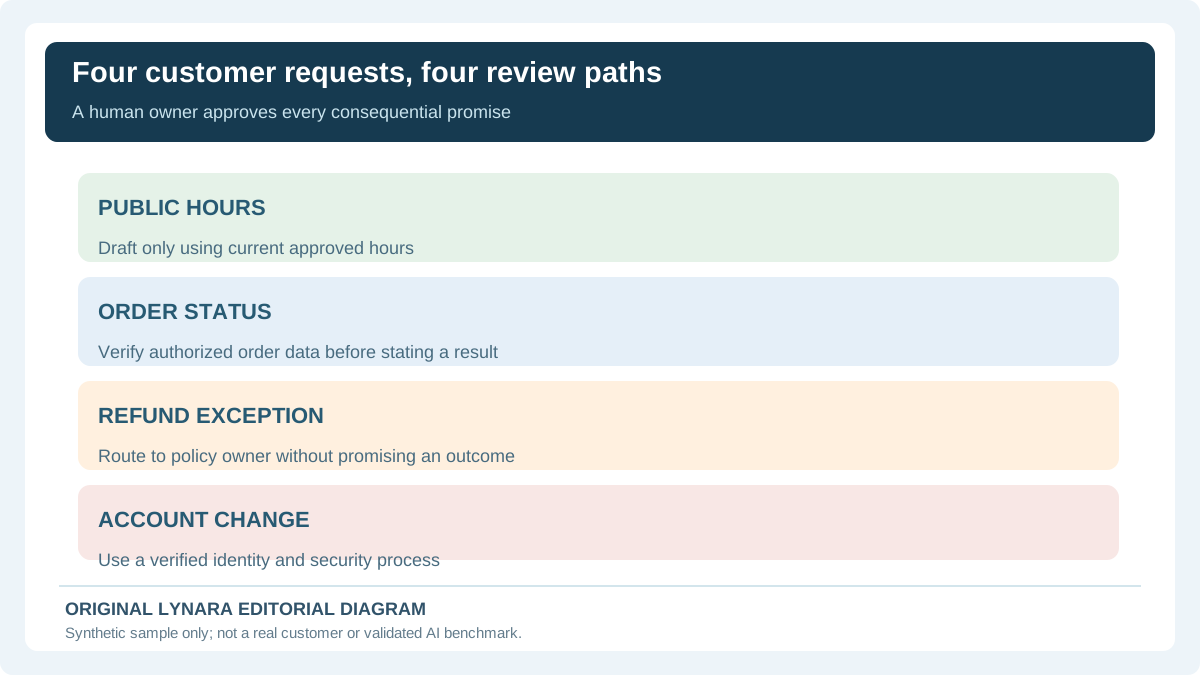
Two messages that both contain the phrase “my order” can require very different handling. The workflow should decide what the business is allowed to answer before asking a model to produce polished text. A practical first version of the routing table is below; every example assumes the policies and customer details are fictitious for testing.
| Customer question | Allowed AI assistance | Human control |
|---|---|---|
| “What are your opening hours?” | Draft from a dated, approved public hours page. | Confirm the current source and approve the message. |
| “Has my parcel shipped?” | Suggest a neutral request for the order reference. | Verify authorized order-system data before stating any status. |
| “Can you refund this after the deadline?” | Summarize the published standard process without promising an exception. | Send the case to an owner with authority to decide. |
| “Please change my account email.” | No account-action draft using copied personal identifiers. | Use the company's verified account-security process. |
This classification prevents a common trap: treating every polite answer as a routine task. If source policy is absent, identity cannot be verified or the request would create a binding commitment, a human decision is part of the job rather than a failed automation metric.
A 12-message pilot you can reproduce with synthetic data
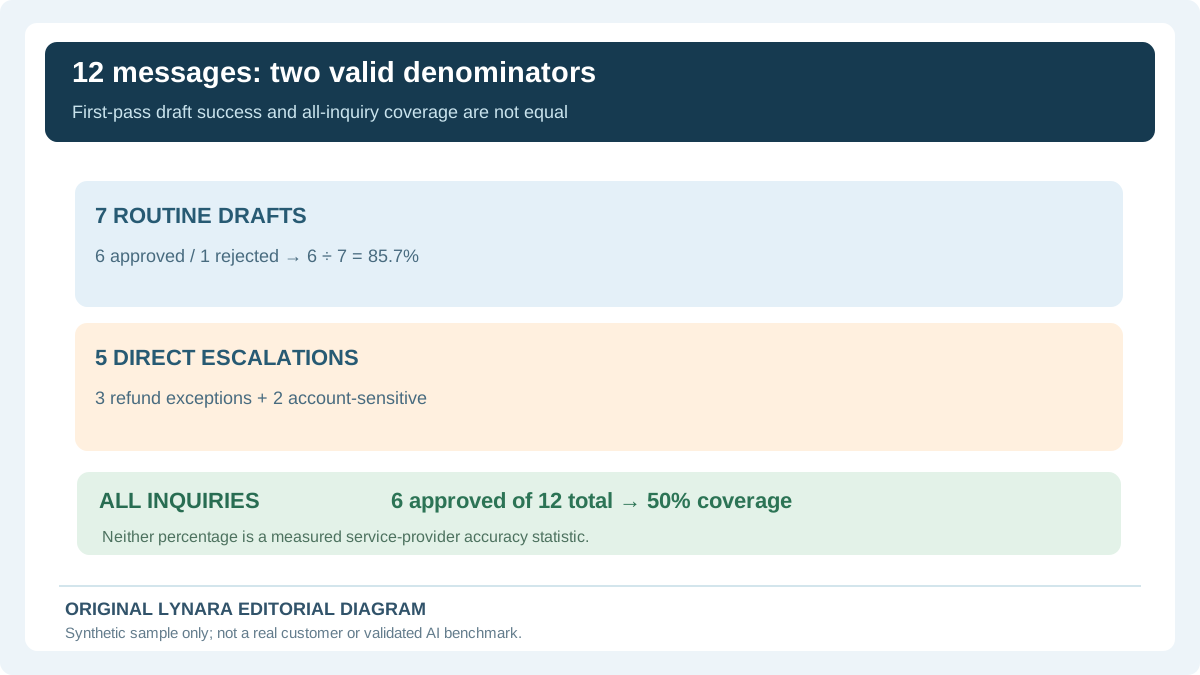
Write twelve fake customer questions without real names, order numbers or addresses. Label seven as routine policy questions, three as refund or service exceptions, and two as account-sensitive requests. Let a draft assistant attempt only the seven routine messages against approved fictional policies. Suppose the reviewer accepts six and rejects one because the draft invented an opening-time exception. The other five questions never enter the drafting path. The counts are then six approved routine drafts, one rejected draft and five direct human escalations.
The routine-draft first-pass acceptance rate is 6 ÷ 7 = 85.7%, but the share of all twelve inquiries that can be answered by an approved assisted draft is only 6 ÷ 12 = 50%. Reporting “85.7% automation” would misrepresent the workload: it ignores the cases excluded by design. Likewise, a corrected seventh draft is not an original first-pass success. Record the correction and its time cost. These numbers are a worked classroom-style exercise, not Lynara performance data or results from a tested commercial system.
Repeat the same cases after a policy update. If the source says one thing and the generated draft says another, the case fails even if it sounds helpful. Test an ambiguous message (“I need my order changed”) to confirm that the workflow requests clarification rather than guessing whether the customer means an address, product or delivery date. Keep the earlier test answers and policy revision label so a reviewer can tell whether the system improved or the test itself changed.
Three reusable drafts with explicit approval boundaries
1. A public-information answer
Example prompt for a reviewer-approved draft: “Write a short answer using only the business-hours page copied below. State the published weekday hours exactly; if a public-holiday schedule is not present, say it must be confirmed with the team. Do not infer special hours.”
Reply pattern: “Thanks for contacting us. According to our currently published hours page, [verified weekday schedule]. We have not confirmed a holiday schedule in this message. You can contact [approved team channel] before visiting on a public holiday.” Replace every bracket using a current approved source or omit that sentence. Never send the literal placeholders.
2. A delivery-status question without system access
Reply pattern: “Thanks for checking in. I can't confirm the shipping status from this email alone. Please use [the business's verified tracking process] or contact [the authorized support channel] so our team can check the order securely. We won't ask you to share a payment-card number by reply.” This is only appropriate if the business really offers the stated process. An AI draft cannot say “your parcel is on the way” unless an authorized person or verified integration has checked the actual shipment.
3. A request for a policy exception
Internal draft for the agent, not an automatic customer promise: “Customer requests an exception to [specific policy]. Approved policy reference: [dated source]. Reason supplied: [minimal factual summary]. Decision required from: [authorized manager]. No refund, credit, account change or delivery commitment has been made.” The human decision-maker reviews the case and writes the final customer response. If the business has no escalation owner, the project is not ready to automate exception handling.
Build a reviewer log that can falsify a savings claim
For each synthetic ticket, record a case ID, category, approved policy version, reviewer, draft status, exact failure reason and end-to-end minutes. Keep a field for “no draft attempted” so sensitive requests do not disappear from the denominator. Calculate first-pass acceptance from the drafted subset and coverage from all incoming inquiries. The two percentages answer different questions. A useful record might look like “S-07 • routine hours • policy v3 • rejected • invented holiday hours • 7 total minutes”; no real customer data is required to learn from it.
Measure manual and assisted handling on equivalent case mixes. Include escalation time, policy lookup, corrections and supervisory checks. If the assisted process saves less time than a monthly subscription is worth at your defensible internal time value, it may be better to keep a small template library and use AI only occasionally. A business gains more from correct, well-documented customer responses than from an inflated percentage of supposedly automated tickets.
Track the full human-review workload
Before and after introducing a tool, time an equivalent sample of messages. Include reading the request, retrieving source policy, generating or selecting a draft, checking facts, personalizing it and sending through the approved platform. In our AI ROI Calculator, the initial processing time, assisted time and additional review time are separate inputs. This avoids calling a five-second draft a five-second resolution. The model counts monthly task volume, software charges and training costs, then reports potential time value rather than guaranteed financial savings.
Example: 40 weekly inquiries, with a review bottleneck
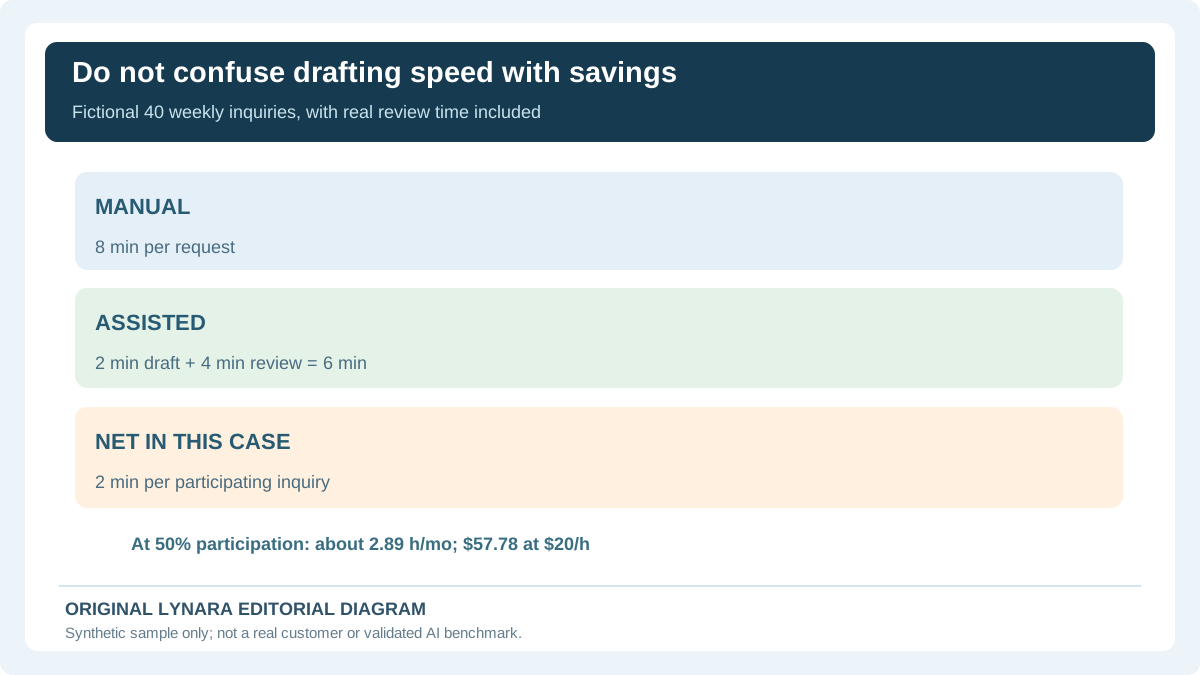
In a fictional business with 40 similar inquiries each week, the old manual drafting and checking process takes eight minutes per inquiry. A candidate AI workflow takes two minutes to prepare a draft but four more minutes to review the accuracy and customer context. Net savings are only two minutes per participating request. At 50% adoption, that is roughly 40 × 52 ÷ 12 × 0.5 = 86.67 participating monthly inquiries, or about 2.89 hours saved. If licensing costs $75 a month and a business values that time at $20 per hour, the modeled labor value of about $57.78 does not cover the recurring charge. The hypothetical calculation exposes a weak business case instead of hiding it behind a chatbot demo.
Should an assistant draft or send your customer response?
Before automating communications, complete our AI Workflow Suitability Checker. An approved human-reviewed draft using a verified public policy is different from automatically sending refunds or modifying customer records. The tool flags unreviewed live actions and restricted data rather than relying on a financial ROI score alone.
Automation needs a refusal and escalation path
A workflow should include a visible rule for what happens when the approved source is missing, two policies conflict, a customer expresses serious dissatisfaction or the case needs a refund exception. “Ask a human” must be a real route with a responsible owner, not a misleading sentence in a generated email. Review a sample of false or incomplete responses and document the response types that should never be automatically handled. For business owners, one costly incorrect refund or security instruction may outweigh many minutes of saved drafting time.
Privacy rules depend on the records and the service
A business may have a reason to use a hosted customer-service platform, but that does not mean it can paste raw tickets or account numbers into any public AI chatbot. Check agreements, business account settings, access controls, retention, regional requirements and client consent where applicable. Minimize identifying details in a test sample; when real personal data is needed for an approved business purpose, use systems and procedures authorized for it. The NIST AI Risk Management Framework offers voluntary concepts for governing, mapping, measuring and managing risks. It does not replace legal advice or a security review.
Avoid fake reviews and invented outcomes
Marketing teams may be tempted to use an assistant to create testimonial-like text, guarantee faster issue resolution or claim that a shop answers every request automatically. Those claims require actual evidence and must match the customer experience. The Federal Trade Commission's business guidance provides a public source for understanding the risks of deceptive representations. A case study about hypothetical faster replies must be labeled as a scenario, not a real customer success story. If a new workflow improves response times, publish the measured data with its time window, limitations and sample size.
Quality scoring should include a manual sample
A manager can score a small, authorized set of messages against a simple rubric: correct source policy, no fabricated commitment, no private data disclosure, useful next action and respectful tone. Do not call a chatbot “99% accurate” merely because its answers sound grammatical. Record cases that required corrections and how many minutes they consumed. If customer satisfaction is an outcome, choose an appropriate measurement method rather than inferring it from the assistant's tone. A pilot should document both improvement and failure modes so the business can decide if it is safe to expand.
Connect the workflow to business operations, not just email
An email draft may depend on a calendar, order-status system or current pricing table. Unless an authorized integration actually verifies those systems, the draft should not say an appointment has been reserved or a refund processed. The same principle applies when the customer writes through live chat, social messaging or a website form. An assistant that generates text has not necessarily taken the requested action. Use a human-approved handoff and a record that confirms what happened. Our AI meeting and SOP guide shows how to maintain approved procedures and review version changes inside the team.
Simple launch checklist
Write five representative routine questions with verified source answers; test the assistant on synthetic examples; mark every invented fact or unsupported policy promise; define sensitive categories; assign a human reviewer; measure end-to-end minutes rather than generation speed; and assess ongoing subscription costs. Only then test a limited authorized production pilot. Before purchasing a larger service plan, recalculate time value with our ROI tool, including the observed exception rate and verification workload. If quality drops or costs rise, retaining a human-first workflow is a reasonable outcome.
Explore related tools and guides in AI for Work & Business, including practical advice for freelancers, small businesses and office workers.
A customer-email pilot needs two denominators, not one accuracy claim
Suppose a small business tests 40 fictional inquiries against an approved, dated policy sheet. Twelve involve disputed charges, sensitive records or promises the assistant cannot verify, so staff handle them without an AI draft. The remaining 28 are eligible for draft-only assistance. Human reviewers accept 24 after checking the policy, and reject four for unsupported or incorrect wording. These are illustrative counts, not observed results from a deployed Lynara system.
| Measure | Calculation | Meaning |
|---|---|---|
| Draft eligibility | 28 / 40 = 70% | How often the workflow was permitted |
| Draft acceptance | 24 / 28 = 85.7% | Accepted among eligible drafts, after human checks |
| All-inquiry coverage | 24 / 40 = 60% | Accepted drafts as a share of the full sample |
Calling the 85.7% figure “85.7% of customer emails solved automatically” would be false: none was sent automatically, and acceptance is not proof of customer satisfaction or final resolution. Track unsafe promises, response quality, staff review minutes and escalation separately. Use the AI Workflow Suitability Checker to record exclusions before testing and the Business AI ROI Calculator only after measuring actual end-to-end time. Stop the pilot if the policy source is outdated or the reviewer cannot verify a claim.
When does a human reviewer actually stop a customer email?
In a fictional repair shop, the public help page states a 30-day return procedure for a product. A customer says they bought the item 45 days ago and asks for an exception. The model may write a friendly apology and claim that the shop has approved a refund, but the chatbot cannot grant that exception simply by producing persuasive text. A reviewer must inspect the exact policy revision, confirm that the question is not a protected identity or billing request, and route the case to someone with genuine decision authority. That owner must record whether any exception was approved before a final customer commitment is sent.
| Customer intent | Permitted draft | Human release requirement |
|---|---|---|
| General published opening hours | Quote the current approved hours page; flag missing holiday details | Check exact source date, approve and send |
| Shipping status for an order | Explain the approved secure tracking process without guessing status | Use authorized order records; never expose another customer |
| Refund request after policy deadline | Outline the published process without promising a discretionary refund | Named manager decides any exception |
| Account email change | No account modification based on free-text claims | Verified account-security and identity procedure |
Make the refusal path a working business procedure, not a polite AI promise. A reviewer needs a named owner for exceptions, a dated policy document and a way to document the disposition. For regulated or sensitive products, use the company's professional escalation procedures rather than relying on a generic response template. The NIST AI RMF Playbook describes voluntary governance and human oversight, but it does not by itself certify a particular chatbot or override any legal requirement.