Build a Source-Checked AI Support FAQ: Policy and Pilot
A useful support knowledge base begins with decisions someone has already approved, not with polished text a model invented.
Useful companion tools
Screen the risk of a proposed automation with Lynara's AI Workflow Suitability Checker, and keep disputed statements organized in the AI Claim Verification Tracker. Both are decision aids. Neither connects to your customer database, checks your company policies automatically or grants permission to use personal data.
A good FAQ is a policy system in miniature
Picture a small online shop answering the same delivery and return questions every morning. The owner wants an AI assistant to reduce repetitive writing. The tempting shortcut is to paste ten customer emails into a chatbot and ask for a beautiful FAQ. The result might sound helpful yet quietly promise free returns, nationwide next-day shipping or refunds after an expired deadline. The language looks better than the evidence behind it. That is a business risk, and it does not disappear merely because a person clicks Publish.
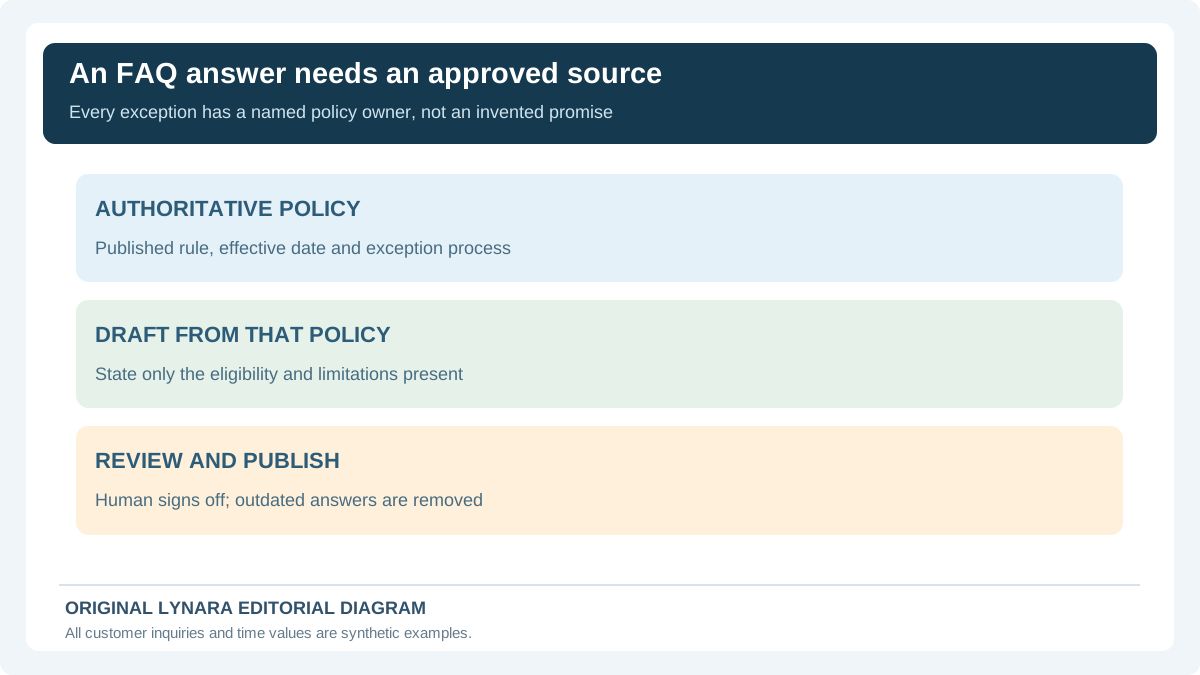
A reliable FAQ has a different foundation: a verified source document, an owner, an effective date, clear limits and a way to correct mistakes. AI can assist with structure, alternative plain-language phrasing and identifying unanswered questions. It should not decide what the company's commitments are. The difference is especially important where a promise might affect consumer rights, money, access or sensitive information. A FAQ is not merely web copy; customers may reasonably rely on it when making decisions.
Inventory real questions without copying private conversations
Begin with the categories that repeatedly generate legitimate questions: shipping geography, payment methods, order changes, returns, warranties, account access and escalation. Ask the staff who handle support which situations truly recur, and identify the policy document that governs each one. If you have actual ticket analytics, use aggregate themes and permissioned data rather than pasting personal names, addresses, order details or full conversations into a public AI service. You can prepare a completely fictional sample set to prototype the workflow before processing sensitive records.
A practical spreadsheet might have columns for question, approved answer source, policy owner, last verified date, geography, exceptions, confidence and next review date. Mark rows without a source as unresolved, not as an invitation for the model to improvise. An unresolved question is valuable feedback: perhaps your business has not defined the policy, or perhaps staff have been making inconsistent promises. That operational gap needs a decision from the appropriate owner before it becomes a public answer.
Write a bounded draft instruction
If using a model is authorized, give it the precise approved policy extracts needed for one topic. A suitable instruction is: Draft a short FAQ answer using only the approved source below. Preserve all conditions and exceptions. If the source does not resolve the question, say that human review is required. Do not invent prices, times, legal rights or eligibility. Add the target audience and reading level, then ask the model to point to the paragraph supporting each sentence. These pointers are review aids, not proof that the source itself is complete or current.
For policies that change frequently, prefer a small batch of independently reviewed questions over a huge document generated in one pass. Keep drafts separate from published answers. A system may be very fluent while misunderstanding an exception or merging two policies intended for different products. Never ask the model to make a confident answer merely because the final FAQ should look professional. A careful please contact support for this specific case can be more useful than a confidently wrong promise.
Worked example: a return window with an exception
Suppose a completely fictional store has an approved policy: unopened standard items may be returned within 30 days after delivery; customized items cannot be returned for a change of mind; defective products are handled through a separate documented process. A draft question asks, Can I return an order after two weeks? A careless AI might answer, Yes, all orders can be returned within 30 days. That erases the customized-item condition and muddles the defect process. The accurate answer needs to distinguish the category and avoid making a universal promise.
A source-checked draft might read: For standard items that remain unopened, a return request can be made within 30 days after delivery. Customized items follow a different rule, and concerns about defective products use our separate defect-resolution process. Contact our team with the item category if you are unsure. This is illustrative training copy, not a real store policy or legal advice. A human reviewer must still check whether the hypothetical wording matches the approved current terms and any applicable legal requirements. The important technique is to preserve the conditions rather than just the appealing number.
Review every claim against its owner
Give reviewers a simple checklist: does the answer directly address the question, use the current policy, preserve exclusions, avoid unapproved guarantees, explain escalation and maintain a respectful tone? The policy owner should approve substantive terms, while an editor can improve readability without silently altering obligations. If several policies appear to conflict, log the conflict and stop the answer. A model is not an appropriate final arbitrator of a disputed contract term or a consumer complaint.
Lynara's AI Claim Verification Tracker can record claims awaiting support, sources found and contradictory evidence, but its status labels reflect what you enter. It cannot validate a company's hidden policy. Keep a copy of the actual source and the version reviewed. If a claim cannot be traced, remove it or mark the question for human handling. This approach also makes later corrections faster: instead of rereading the entire FAQ, you can locate every answer based on a replaced policy document.
Design an escalation route before publishing
Not every question belongs in a static FAQ or an automated chatbot. Payment disputes, identity verification, vulnerable customers, complaints about discrimination, health or safety incidents and unusual account problems can require specialized handling. Decide which categories the FAQ will address and which must go to a person. Specify the actual available support channel and realistic response expectation; do not invent a 24-hour service promise to sound reassuring. If the team has no live chat, the answer should not offer one.
Use the AI Workflow Suitability Checker to screen whether a task involves sensitive data, meaningful financial or safety consequences, uncertainty and human approval requirements. Treat it as a structured prompt for judgment, not as certification. The NIST Generative AI Profile describes risks such as information integrity and inaccurate generated content within a broader risk-management framework. A simple FAQ is still a system that needs ownership and controls.
Test with cases that should fail
Before launch, assemble a sample of realistic questions including ordinary cases, ambiguous wording and tricky exceptions. For the fictional return policy, test an unopened standard item on day 14, a customized item on day 14, a potentially defective item and a request outside the stated window. The correct outcome in some cases is escalation rather than an automatic yes or no. Give each case an expected answer or review path, then compare the draft response. Record errors by category: wrong facts, missing condition, ungrounded confidence, tone or routing.
Consider a 20-question pilot where three drafts omit a required exception and two invent a timeframe. That is five problematic drafts out of 20, or 25 percent in this fictional scenario. It is not a measured AI error rate. It demonstrates how to calculate an observed issue rate for your own tested sample. Correct those failures and rerun comparable cases after changes. Do not select only easy questions that make the tool look accurate. The difficult cases are often where automation has the greatest downside.
Protect customer information and vendor access
Check what data the selected provider receives, how it is retained, who can access it and whether the proposed use matches internal and external privacy commitments. Remove unneeded identifiers, obtain necessary permissions and restrict access to the smallest appropriate group. The U.S. Federal Trade Commission's discussion of AI privacy and confidentiality commitments underscores why business claims about data use matter. This source does not replace jurisdiction-specific legal review for your organization.
Keep test datasets separate from live accounts. A fictitious order number is enough to test whether a draft asks for a receipt; there is no reason to expose a real customer's address. Do not place unpublished company policies into tools that your organization has not approved. Assign a person responsible for withdrawing inaccurate content promptly. Transparency also matters: avoid implying that an automated answer has been individually verified by a human when it has not. A knowledge base should clearly reflect the process the business actually operates.
Count the total work, not just generation time
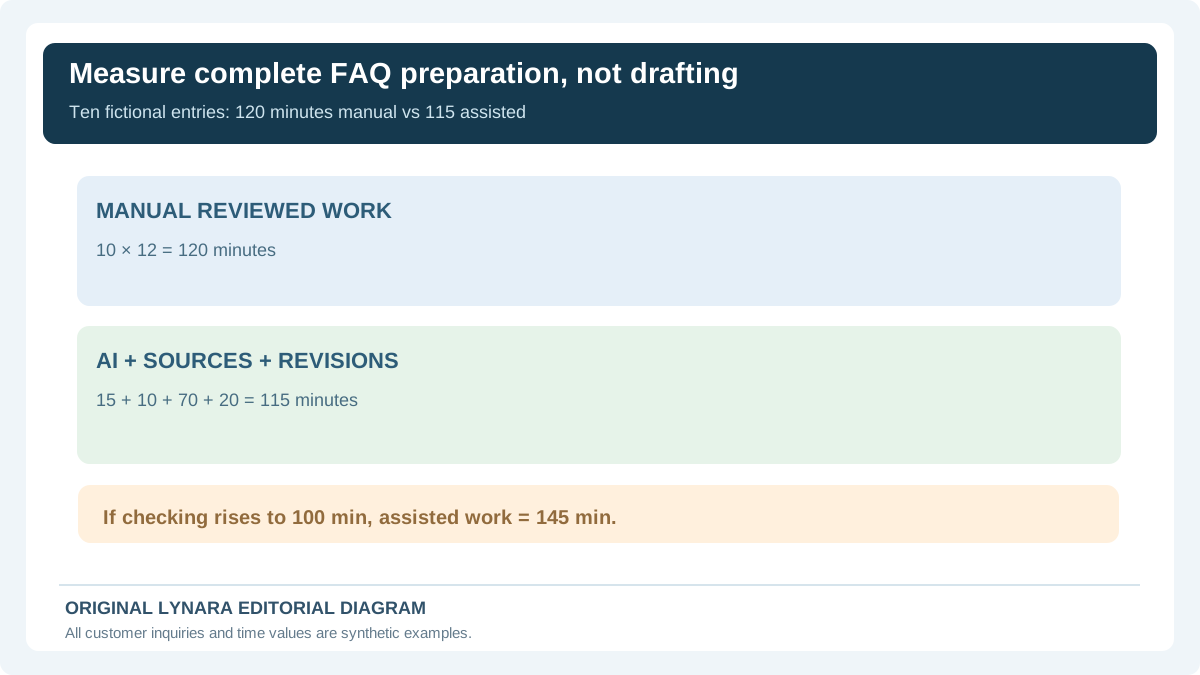
Assume ten FAQ answers take a human editor 12 minutes each to draft and verify manually: 120 minutes total. Now imagine an AI-assisted process takes 15 minutes to organize sources, 10 to generate drafts, 70 to verify and correct them, and 20 for final approval. The total is 115 minutes—a five-minute savings in this invented example. If correction takes 100 instead of 70 minutes, the AI path rises to 145 minutes and becomes slower. Both examples show why the initial generation speed tells you very little about operational return on investment.
When the process repeats every month, track source maintenance, exceptions, escalations and customer confusion alongside staff time. The Business AI ROI Calculator can model editable financial assumptions, but it cannot measure satisfaction or legal risk for you. The most useful pilot might show that two categories are safe and efficient to standardize, while one category should remain fully human-operated. That is a positive result: the goal is to find the right boundary, not to automate every possible answer.
Publish a versioned knowledge base
Every public FAQ entry should have an answer owner, a reliable source, an effective policy version and a practical review trigger. Triggers might include a new shipping provider, a change to payment options, an updated return policy or a repeated customer complaint. Avoid adding a visible “last reviewed” date unless somebody actually completed that review. Store old versions for accountability and make sure obsolete drafts do not continue appearing in chatbot retrieval or internal shortcuts after a policy change.
One strong approach is to launch a small, thoroughly checked set of ten questions, review the support tickets they influence and expand only when recurring needs justify it. If readers keep asking a question after seeing the FAQ, the answer may be unclear, hard to find or missing a critical exception. Improve the answer and navigation before creating 40 near-identical entries. A reliable knowledge base earns trust by resolving the customer's next action, not by having the longest list of questions on the page.
Write a source-owner release log that can survive policy changes
Imagine a fictional online shop with a published 30-day return window and a customer who asks for a refund after 45 days. The FAQ may accurately explain the ordinary procedure, but an AI draft must not promise an exception without a real approval. A policy record should identify the product category, the actual rule and effective date, its human owner and the location where a customer can ask about an exception. A support agent must not treat a generated phrase such as 'we have approved your refund' as proof that a payment or service action occurred.
| FAQ intent | Source evidence | Stop condition |
|---|---|---|
| Return within policy period | Current product-category return page | Item, order status or exclusions unclear |
| Return after policy deadline | Published normal process; named exception approver | No individual authority to promise a refund |
| Package tracking status | Authorized order system, not general policy text | No verified identity or actual tracking record |
| Payment or account changes | Secure official account workflow | Request asks AI to process a private action |
Use the FTC's official discussion of AI confidentiality commitments to understand why a service's own promises about data use matter. It does not mean the shop has permission to share all customer tickets with a third-party AI company. The NIST generative AI risk profile identifies confident erroneous output as a risk; neither source substitutes for privacy arrangements, account access review or professional advice where appropriate.
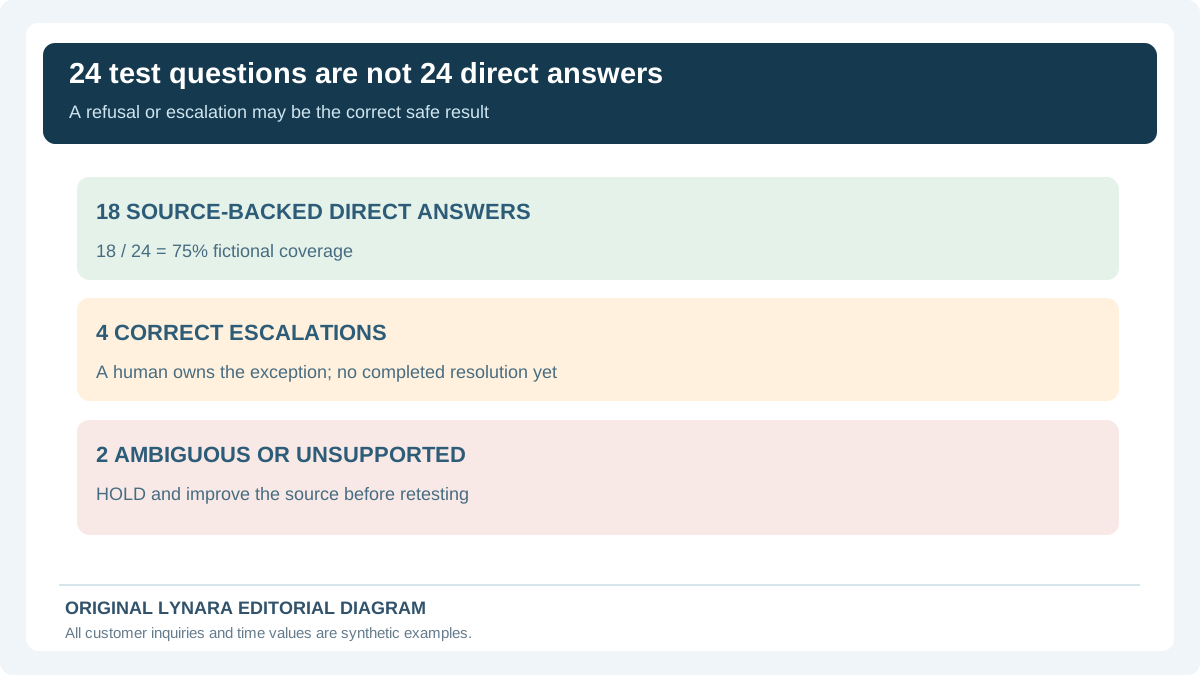
Preserve the earlier 24-question challenge set: 18 direct source-backed answers are 75% of the sample, while four appropriately escalated and two unresolved questions are 25% requiring further work. Keep the approval denominator separate from customer issue resolution. If a later policy revision changes the return period, repeat the challenge set against the new approved document. Updating only one public answer while a retrieval index still serves an obsolete passage defeats the purpose of controlled FAQ publication.
For ten FAQ entries, 10 × 12 = 120 manual minutes. The fictional assisted alternative costs 15 minutes to organize sources, 10 to generate drafts, 70 to verify, and 20 to approve: 115 minutes, only five saved. If checking consumes 100 minutes instead of 70, the result is 145 minutes and the AI workflow is slower. Do not optimize away the checks required to avoid misleading customers; use the AI Claim Verification Tracker to record supporting documents and exceptions.
Editorial limits
The return rules, test set and time calculations in this guide are fictional examples; no store, model or product was tested. AI-generated answers should be checked against authorized primary policies and applicable requirements before customers rely on them. Lynara's tools do not access your confidential policies or make compliance determinations. See our methodology.
Use a challenge set, not just a polished demonstration
Before publishing a support FAQ, have the policy owner write test questions that cover standard cases, exceptions and requests the business cannot safely answer from the approved policy. For a fictional 24-question pilot, suppose 18 answers match the authorized wording, four correctly request a human decision and two are too ambiguous to publish. That is 18 ÷ 24 = 75% direct-answer coverage and 6 ÷ 24 = 25% needing escalation or revision, not a 100% success rate.
| Outcome | Questions | What the reviewer does |
|---|---|---|
| Source-backed direct answer | 18 | Approve only after checking the exact policy version and exception. |
| Correctly escalated | 4 | Keep the handoff and named support owner visible. |
| Ambiguous or unsupported | 2 | Hold publication; rewrite the source or question before retesting. |
Record the claim and source in the AI Claim Verification Tracker. A correctly escalated question can be a safe outcome, but it is not a completed customer resolution. Re-run the challenge set after a policy change, and keep real customer identifiers out of the testing data.