How to Plan a Literature Review With Verified Sources
A literature review should explain what credible sources collectively show, where they disagree and why the limits matter. It cannot be built from plausible-looking citations that nobody checked.
Start with the paired evidence matrix
Our Literature Review Evidence Matrix Builder is a small, local browser worksheet for organizing up to twelve sources by citation, question, study method, finding, limitation and original URL. It counts missing evidence fields and separates sources you still need to check from sources you personally marked reviewed. It does not authenticate papers, generate findings or fabricate a literature review. Use it to compare sources you have actually read, not to create an imaginary bibliography.
For a reference whose factual claims remain unverified, use the separate AI Claim Verification Tracker to record original links and independent checks. After collecting accurate publication details, the citation generator hub can help format a reference in the required style. These tools solve three different problems: extracting and comparing evidence, verifying a claim, and formatting a citation. A correctly formatted entry does not prove a source exists.
Turn a broad topic into a reviewable question
“Does technology improve studying?” is too broad for a useful short undergraduate review. It contains many technologies, outcomes, populations and possible meanings of improve. A more focused teaching question might be: “How have published studies measured the relationship between automated written feedback and revision quality in undergraduate writing courses?” That question defines a learning setting, a class of intervention and an outcome while still allowing studies with different designs. It does not presuppose that automated feedback improves anything.
Write down terms that belong to the question: automated feedback, formative feedback, undergraduate writing, essay revision, writing quality and student perception. Then identify possible alternatives for a library search. The same paper might describe “automated writing evaluation” rather than “AI feedback,” so exact phrasing can miss useful evidence. Define a realistic assignment boundary: publication period, languages, eligible disciplines, empirical versus conceptual work, and any specific instructor requirements. This is a scope decision, not a rule to discard studies merely because their findings are inconvenient.
Search libraries and record how you found each paper
Start with the institution's library discovery tool, subject databases and reading list rather than a list of citations proposed by a chatbot. Search terms can be combined and adjusted; save enough information to reproduce what you tried. For example, one query may combine “automated writing evaluation” with “revision” and “higher education.” A separate query may combine “formative feedback” with “student writing” and “experiment.” Record the date, database, exact query and major limits used. If an initial query returns only irrelevant papers, explain how you changed it.
University of Toronto's guide to finding assignment sources discusses scholarly sources and more efficient library research. Purdue Libraries' literature search toolkit covers source discovery and methods for wider research syntheses. A typical classroom literature review does not automatically become a systematic review: the latter has additional methodological expectations and reporting standards. Do not promise comprehensive coverage if your search was restricted to two databases or a handful of examples.
Document criteria before choosing sources
A small assignment often benefits from simple inclusion and exclusion rules. For a fictional review of undergraduate writing feedback, include sources that directly study students' writing or their revision processes, report methods clearly and provide an accessible original publication. Exclude an unrelated marketing blog about writing software, an AI-generated citation that cannot be traced, and an article that discusses school admissions without reporting any relevant writing outcomes. A theoretical paper may be appropriate if the assignment allows conceptual evidence; label it as such instead of forcing it into an empirical-results category.
Record reasons for exclusion consistently. “I didn't like the result” is not a legitimate criterion. A study of secondary-school pupils may be outside a question explicitly defined around university writing, though it could still inform background context if that use is explained. If the class rubric requires peer-reviewed journal articles only, follow it; if quality conference work or scholarly books are allowed, do not exclude them by accident. A search log helps the student show what was actually considered and why the final set is limited.
Verify the record and read beyond the abstract
A paper's title, author list, date, journal, DOI and abstract are useful starting points, but the relevant evidence usually requires examining the methods and results. An abstract may emphasize a headline while the full article specifies a narrow population, short time frame or weaker secondary outcome. If a source is paywalled or unavailable, do not manufacture its sample size or conclusions from a search snippet. Record “full text not checked” and either seek authorized access or explain why it cannot support a detailed quantitative claim.
For a source retrieved by an AI assistant, independently locate the actual publisher or repository record. Verify that the title matches the authors, the DOI or stable link resolves to the right work, and the described finding exists in the original text. If a chatbot invents a plausible title, it should not enter the evidence matrix as a confirmed study. Our AI homework claim-checking guide addresses the general process; the literature-review matrix keeps study method and limits beside the finding so you cannot rely on a bare quotation detached from context.
Extract comparable information, not just summaries
For each source, capture its research question, participants, study design, measurement method, main outcome, limitations and relevant context. A source that reports “students liked the feedback” may be measuring satisfaction, not improved writing quality. A source that uses a randomized study may estimate a different outcome from a survey that simply asks students whether they feel more confident. Put these alongside each other in the Evidence Matrix Builder so the distinction is visible before drafting.
Purdue OWL's literature review guide distinguishes reviewing and synthesizing literature from simply describing each work in turn. It recommends considering patterns, differences, strengths and weaknesses. University of Toronto's research guide links to examples and templates of synthesis matrices. Neither resource means a matrix alone is the finished prose; it helps you decide what the studies collectively show.
A worked example with three clearly fictional studies
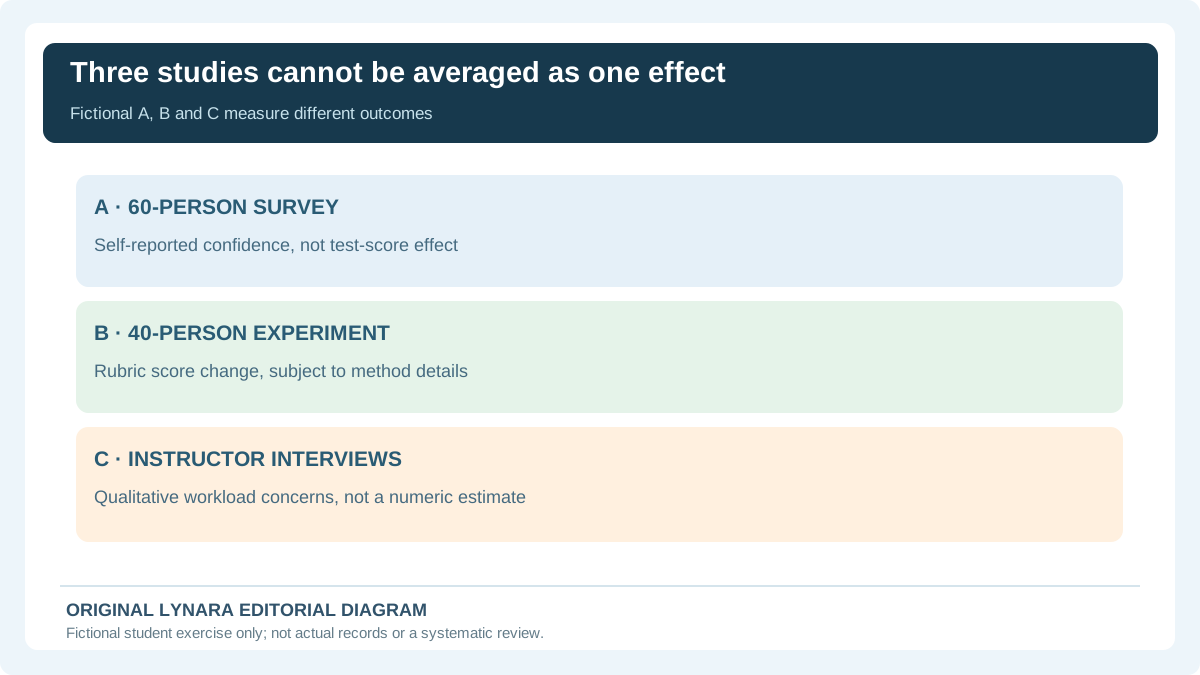
Suppose a classroom exercise uses three entirely hypothetical papers labeled Study A, Study B and Study C. They are not real references and must not be cited as evidence. Study A is described as a one-semester survey of 60 students who used automated feedback; the students reported feeling more confident about revising an essay. Study B is a hypothetical small randomized classroom comparison with 40 participants, measuring rubric-based changes between drafts. Study C is a set of fictional instructor interviews about time demands and student dependency. These scenarios exist only to demonstrate how a review question and evidence table work.
The matrix should record distinct methods rather than converting all three descriptions into an average effect. Study A speaks to self-reported confidence, not independently measured score improvement. Study B might speak to rubric changes but would still need information about assignment, randomization and measurement to justify a causal claim. Study C provides qualitative accounts about implementation, not a numerical estimate of essay quality. The proper draft organizes the findings by the question each addresses, then explains why the evidence types differ. When writing an actual assignment, replace A, B and C entirely with verified published works and check the outcomes yourself.
Synthesis: write about patterns and differences
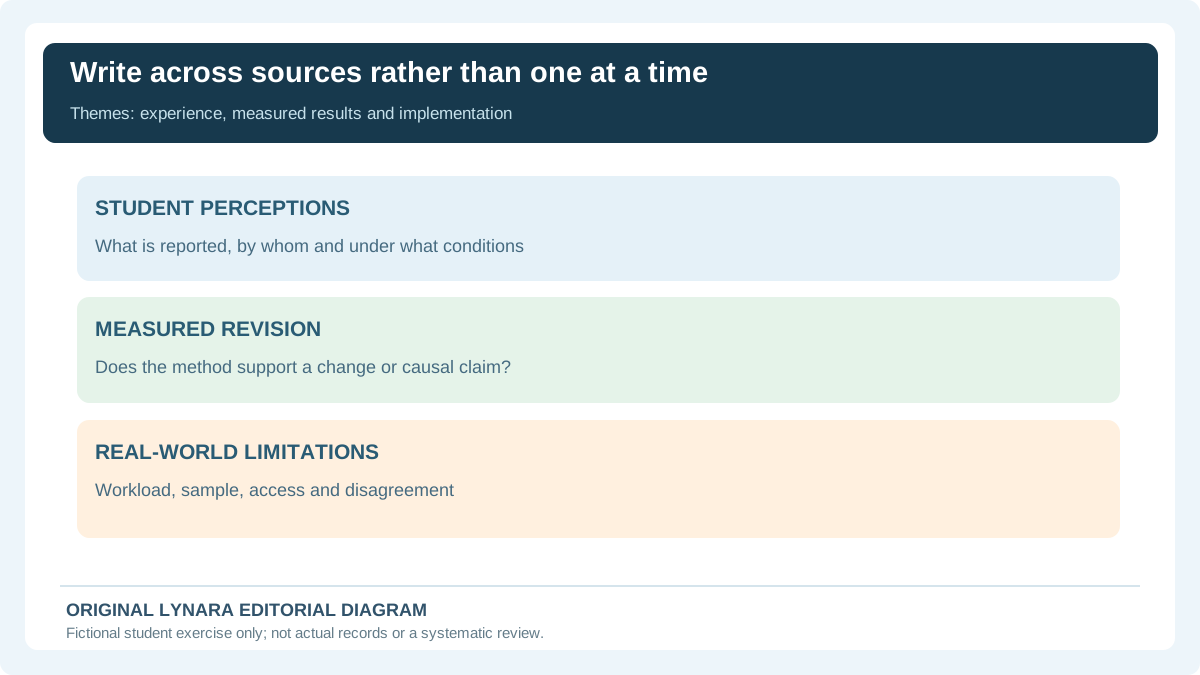
A weak review has a paragraph beginning “Author A says,” another beginning “Author B found,” and a third beginning “Author C concludes.” This structure can become a disconnected set of summaries. A stronger approach opens with an interpretive question: “What outcome do the studies measure?” and groups relevant sources by that question. One section might discuss student perceptions; another might examine measured revisions; a third might discuss workload or equity. Within each theme, compare whether study designs support similar conclusions and where disagreements remain.
Some sources may agree that feedback is frequently used but disagree about its effect on quality. That is not a contradiction to erase. Their samples, exposure time and definitions may differ. If a literature-review paragraph makes a claim about “most studies,” it needs enough accurately reviewed studies for that summary, not a pair of convenient examples. Use measured language such as “In the sources included in this review...” and state the review's limited selection. The aim is an original, accountable explanation, not a confident-sounding consensus invented to fill a word count.
Make limitations part of the reasoning
Studies with smaller samples can be informative, but sample size alone does not prove validity or invalidity. Ask how participants were recruited, whether groups were comparable, which variables were measured and whether missing data could change the observed result. In observational research, selection into an activity may explain some differences; a higher score among students who opted into an AI tool does not automatically show the tool caused it. Where randomized designs exist, review attrition, assignment procedures and outcome validity before drawing causal conclusions.
Describe strengths as well as weaknesses. One small study may use direct writing samples scored independently, while a larger survey may provide broader participation but only self-reported beliefs. They address different outcomes. The Academic Source Evaluation Guide provides another tool for assessing methodology and relevance. A literature review should neither reject every imperfect paper nor treat all papers as equally persuasive just because each has a DOI.
Keep citation formatting downstream of evidence checking
A correct reference usually records the creator, title, publication year, publication venue and a retrievable link or identifier where appropriate. Requirements vary by APA, MLA, Chicago and other styles, so consult the class instructions and official style guidance. Formatting does not establish that the citation is authentic. A fake journal title may still look polished after passing through a generator. That is why evidence extraction and verifying the source should happen before final bibliography formatting.
Our Citation Generators can reduce mechanical reference work when you provide accurate metadata. For datasets rather than journal articles, the Dataset Citation Guide covers original data providers, versions and dates. If you relied on a preprint, record the version actually consulted rather than silently treating it as a later peer-reviewed journal article. When quoting from a source, verify the wording against the original and follow assignment rules for quotation length, page or paragraph information and attribution.
What an AI assistant may and may not do
An AI assistant can help reorganize your own verified evidence notes into possible thematic headings, suggest alternative search keywords or identify questions you have not yet addressed. It may also produce convincing but nonexistent publications, misquote a real paper, confuse two studies by the same author or invent a sample size. Avoid prompts such as “Write a literature review with fifteen citations” when you have not assembled the literature. A coherent paragraph does not compensate for missing provenance.
A safer workflow starts with real source files and a human-reviewed matrix. Ask for possible structural groupings of your verified notes without letting the assistant supply additional references or factual numbers. Then return to each original source to verify the final claim and page reference. If the course disallows some AI uses, follow that rule rather than assuming summarization is always permitted. The evidence matrix never calls an AI service and keeps entered text local to the page session; copying it out remains the user's own action.
Practical drafting structure for a short class review
Begin with a focused introduction explaining the research question, why it matters and the scope of the review. Next describe the search approach briefly, especially if the instructor wants a transparent method: which databases you searched and your main eligibility criteria. The main body can consist of two to four thematic sections; for each, identify the relevant sources, their evidence, agreement and disagreement, and the limits of each design. End by summarizing what can be concluded within your selected literature and which questions remain open.
Suppose the assignment requests about 1,500 words. An illustrative allocation could be 180 for context and scope, 180 for search and selection, 850 for several thematic comparisons, 190 for limitations and 100 for the conclusion. These numbers sum to 1,500, but they are a planning example, not a universal academic standard. Use Lynara's Essay Word Budget Calculator to adjust the structure to your actual rubric. The bibliography and any appendices may have different counting rules; verify those with the assignment.
A final pre-submission source audit
Read each reference and ask: Does the cited source exist? Do the recorded author, year and title match the original? Did I review the full text or only an abstract? Do the methods and outcome measures support the claim made in the draft? Is it clear why the source belongs in this review? Are any important disagreements hidden? Have I distinguished fictional teaching examples from real evidence? Does every paragraph that makes an empirical claim point to an actual checked source?
Then review the matrix for missing fields, unresolved verification labels and excluded items whose findings were accidentally used. A matrix showing “checked” is only a record of your declaration; it cannot independently certify source authenticity. Recheck the original evidence one last time, format your citations with the appropriate Lynara generator if useful, and make sure the final interpretation says only what the research supports. A smaller review built from real, carefully compared studies is better than a long, fluent bibliography of invented or misunderstood papers.
Maintain an honest screening ledger with explicit arithmetic
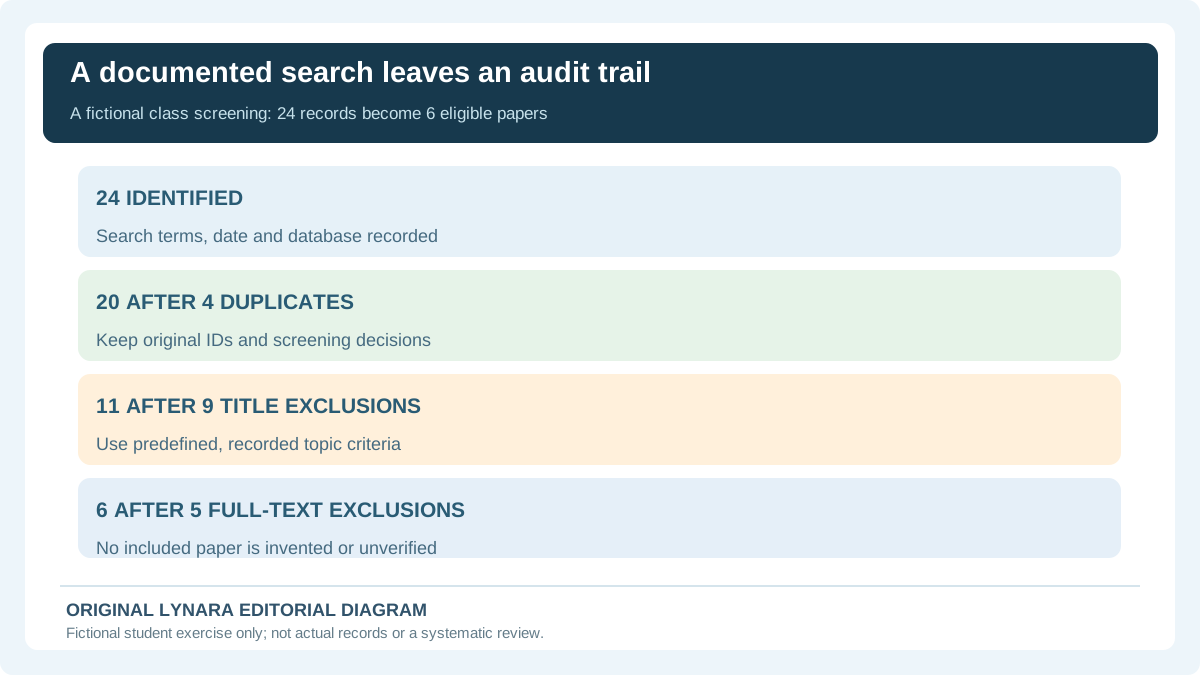
A class literature review need not claim to be a registered systematic review to explain how papers were found. Suppose an invented search produces 24 records across a university library and a bibliographic database. Four are duplicates, leaving 20. Screening titles and abstracts excludes nine that do not address the stated question, leaving 11 for fuller evaluation. Five of those eleven fail prewritten eligibility criteria or cannot provide the needed outcome evidence, leaving six candidate papers. The counts are 24 − 4 − 9 − 5 = 6. Keep the actual search query, database, date, inclusion rule and exclusion reason with each record rather than retrofitting the story after finding favorable conclusions.
| Screening step | Records remaining | Evidence to retain |
|---|---|---|
| Identified records | 24 | Actual query, date and bibliographic IDs |
| Remove duplicates | 20 | Four matching records with duplicate reason |
| Screen relevance | 11 | Nine off-topic exclusions with stated criteria |
| Review retrieved evidence | 6 | Five exclusions plus why each fails eligibility |
The PRISMA 2020 reporting resources are specifically designed for systematic reviews, where detailed reporting of identification, screening and inclusion is expected. An undergraduate narrative review may have a different scope and class rubric. You can learn from transparent screening without labeling your six-paper homework exercise a PRISMA-compliant systematic review. In a real review, a record can be excluded for multiple reasons and more than one report may describe one study; track those distinctions carefully.
Next, use the existing three fictional studies as a synthesis exercise. Survey respondents' confidence, measured rubric outcomes and instructors' accounts do not share the same definition of success. A paragraph that says all three studies 'proved feedback improves writing' would invent agreement across incompatible outcomes. A stronger synthesis states what each actually measures and how its method limits generalization. Purdue OWL's literature-review guide distinguishes source-by-source description from analysis and thematic synthesis.
Before placing any citation in the final assignment, open the real article, verify the author and publication information and read the passage containing the claimed finding. If a paper is unavailable, mark it not reviewed rather than pretending the abstract confirmed a detailed outcome. The Literature Review Evidence Matrix Builder stores the student's supplied evidence, but cannot certify that the cited source actually exists or that the conclusion is defensible.