How to Cite a Dataset: Census Example and Metadata Checklist
Record the original statistical source before formatting a bibliography entry.
A dataset is not the same as the article that mentions it
Suppose a student reads a news article describing population changes and wants to use the underlying numbers in a class report. Citing the news article may credit that secondary explanation, but it does not necessarily identify the dataset used to produce the chart. A dataset citation should let readers locate the actual collection or file, know which version and time period the student analyzed, and distinguish the data publisher from the student's own conclusions. The right source is the item whose numbers you actually used. This guide does not repeat instructions for formatting ordinary books or webpages. It focuses on data provenance: the original provider, the dataset's name, table identifier, reference year, published version and retrievable location. A correct-looking APA or MLA entry cannot compensate for choosing the wrong year or inventing a file that does not exist. The US Census Bureau's official data citation guidance lists fields recommended for data products and their individual tables.
Identify the creator rather than guessing from a website domain
The organization serving a file is not always the original creator of the underlying observations. A repository can host data from another research group; a journal can publish an article that analyzes a government series; a chart-building tool can display numbers it did not collect. A student should trace the source chain to establish who owns or produced the dataset and where its methodology is documented. Record any sponsoring agencies where the provider recommends them. Do not invent a personal author merely because the citation generator expects a surname. For example, the Census Bureau explains when the US Census Bureau and sponsoring agencies should be listed as authors of its products. If an interactive tool shows an estimate from an American Community Survey release, the dataset or statistical table is still the underlying source. You may also cite the tool if relevant, but doing so alone can hide the actual origin. The goal is to allow a reader to reproduce where the claim came from rather than crediting whichever website rendered the nicest chart.
Record the complete title and table or file identifier
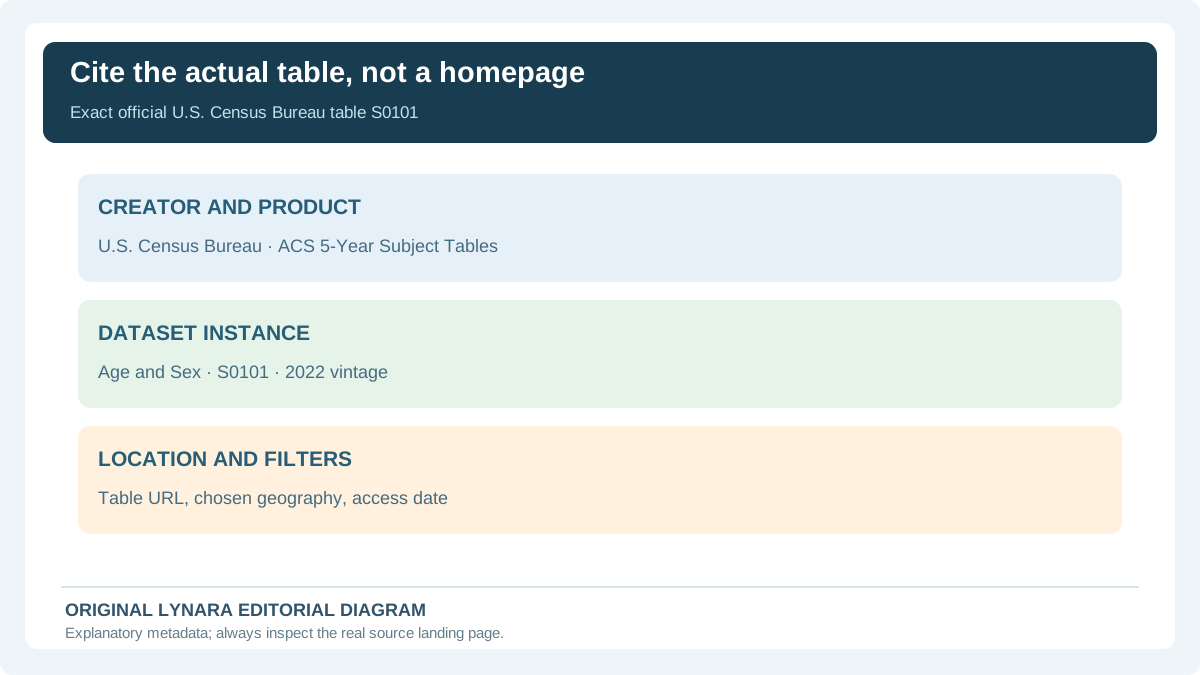
A broad title such as Census data is usually insufficient for identifying the numbers used. The name of the program, table title, identifier and vintage may all be necessary. For an article using a row from American Community Survey table S0101, record the table name and S0101 identifier rather than citing only the Census homepage. A different table, survey year or geographic breakdown could contain values that are not comparable. Keeping exact metadata also prevents errors if a teacher or teammate later revisits the analysis. The Census Bureau offers a real example using its 2022 American Community Survey five-year subject table S0101, Age and Sex. This is an identifiable statistical table, not a made-up research publication. It is accessible through the Census data system, and the provider's citation guidance explains how to include the product name, table identifier, vintage, URL and access date. When a website provides a built-in Cite control, start with the generated metadata but still inspect whether you selected the correct table and year.
Vintage, release date and access date answer different questions
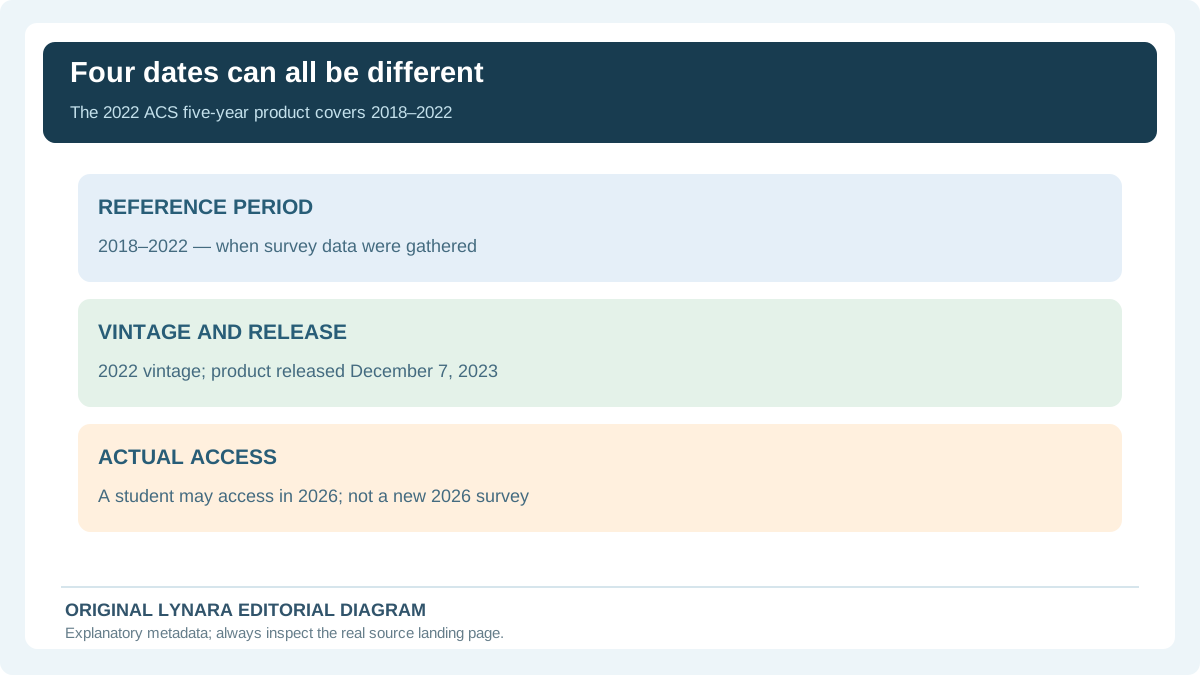
A dataset can describe the year 2022 even when it is published later and accessed in 2026. These dates refer to different events. The vintage or reference period identifies the underlying data's time frame. A release date describes publication or availability where the provider supplies it. A version indicates the exact state of a dataset when multiple releases or revisions exist. The date accessed records when the student consulted a potentially changing resource. A citation that swaps these values can mislead readers about how current the analysis actually is. Suppose a student downloads a 2022 table on October 20, 2026. It would be incorrect to label the observations as 2026 solely because of the access date. Similarly, the report should not imply that an old estimate was collected last week. Keep separate fields in a small source record. If the data provider uses release numbers or archive links, capture them. When a file gets updated or corrected, the version field can be essential for making a calculation reproducible.
A worked Census citation built from an identifiable table
Consider the Census Bureau example: US Census Bureau, Age and Sex, American Community Survey 5-Year Estimates Subject Tables, Table S0101, 2022, with its table-specific link and an access date. In prose, a student can explain that their analysis used the 2022 ACS five-year estimates for the chosen geography, rather than describing the result as an official Census conclusion about a new question. Importantly, the 2022 five-year ACS vintage covers data collected from 2018 through 2022; it is not a measurement made entirely in calendar year 2022. The Census Bureau release notes confirm that period, and its citation instructions recommend using the table's own Cite control to copy the correct reference. Confirm whether you selected ACS one-year or five-year tables, since those are different products. The official guidance provides a sample URL for the table: 2022 ACS table S0101. A school's required style may rearrange punctuation and elements. Suppose the student calculates a percentage difference between two legitimate cells. They should keep the original values, geography, units and year in their notes, then show the formula used. The Census Bureau is the source of the underlying estimates, but the student's own computed difference and interpretation are the student's work. A citation cannot imply that the agency approved the interpretation. This distinction is explicitly reinforced in the Census Bureau's citation policy. Verify the actual table and selected parameters before stating any empirical result.
API queries and exported files need their own records
When downloading a data file or calling an API, record the original source title, reference year, API base URL or file name and any options that change the returned rows. Geographic filters, variable selections and data vintage can all affect the result. A generic API homepage does not necessarily allow someone to reproduce the numbers. If a student transformed the data, keep the steps that produced the analysis table, including excluded rows and unit conversions. Before treating a CSV export as trustworthy, use the local CSV quality checker to identify malformed rows and blanks, then document any repairs instead of silently changing the source. The fact that a CSV was created today does not make the underlying observations current. The Census Bureau separately describes citation approaches for API datasets and downloadable data files. Its open-data overview links to the sources and tools. A dataset's API may change, so an archived query or documented exact version may be helpful where allowed. If the project depends on reproducibility, provide enough detail for readers to find the same release. Always check whether sensitive or restricted-use data have special access and citation obligations.
A DOI improves location, not the validity of the analysis
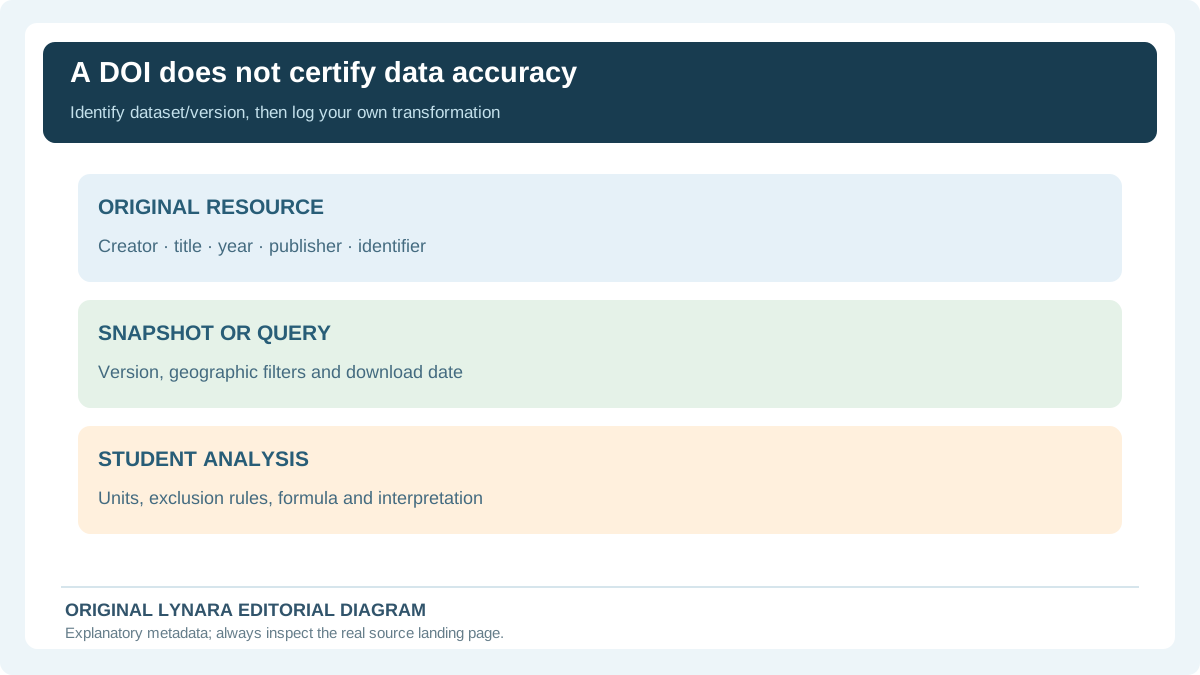
Some repositories assign a digital object identifier to a dataset or a particular version. That can make a durable citation easier, but having a DOI does not prove that the data were collected without bias or that every conclusion is justified. Likewise, a valid identifier for a research paper does not necessarily point to the spreadsheet behind its results. Check what the identifier actually resolves to: a dataset, article, software package or landing page. Record the correct version and creator from the source record. Lynara's citation generators help format verified metadata according to relevant styles. Other research identifier guidance explains the difference between several identifiers. Use those tools after you know what you are citing. Typing a plausible DOI into a generator cannot make an unrelated dataset appropriate. If the dataset has no DOI, a stable repository URL with sufficient title and version information can still identify it under applicable style guidance.
Cite the visualization separately when the picture matters
A chart can be a direct display of data, a visualization whose transformations matter, or an interpretation created by a third party. If a student reproduces a particular official figure, citing the visualization can be appropriate, with the original underlying dataset also credited where required. If they build their own graph from raw numbers, describe the source of the data and make clear that the visualization is their own work. Do not imply that the data publisher chose the chart's colors, axes or interpretations when the student did those things. The Census Bureau gives separate guidance for data visualizations, tools and underlying statistical products. That reflects a useful principle: what you viewed and what you analyzed may be two different artifacts. Before submitting, check graph titles, axis units, time periods, geography and any omissions. If AI assisted with a chart or caption, verify every plotted value and avoid using a generated decorative image as though it were a real statistic. A precise source trail is more valuable than a visually impressive reference list.
Avoid the most common dataset citation mistakes
The first mistake is citing only a broad website when a specific table or downloadable file was used. The second is hiding the vintage by substituting the date accessed. The third is failing to record filters such as geography or subgroup. The fourth is treating a secondary chart or article as if it produced the original data. A fifth is generating a citation with an AI assistant but never checking that the dataset, author and identifier exist. Any one of these can make a research result difficult to verify even if its arithmetic is correct. A useful fix is a source log with creator, dataset or table title, identifier, program, vintage, version or release, stable link, access date and transformation notes. Fill it out when you collect the data, not a week later when the browser tab is gone. If fields genuinely are unavailable, follow the required style's rule for missing information rather than inventing them. Keep your interpretation separate from statements directly made by the publisher.
Finish with the source record before formatting
Once all necessary details are verified, choose the style requested by the instructor and format the citation accordingly. Check whether the style expects square-bracket descriptions such as Data set, a retrieval date or a publisher field. The exact order and punctuation can differ between APA, MLA, Chicago and other systems; do not claim that the same string is universally correct in every style. Prefer the provider's recommended metadata for the selected product and then apply the institution's style rules. The key quality test is practical: could a classmate locate the same source, identify the same year and table, and understand which transformations produced your result? If yes, the reference is doing its job. If it only says US Census, accessed online, it is probably missing important context. Continue with our source evaluation guide when deciding whether the dataset can support your claim, and with the citation tools after the underlying item has been confirmed.
Source record: a complete citation begins before the style formatter
The U.S. Census Bureau offers a checkable example for students: its Age and Sex Subject Table S0101 in the 2022 American Community Survey (ACS) five-year estimates. The table's 2022 data vintage represents collection from 2018 through 2022, not a survey conducted entirely in 2022. The Census Bureau's official release history reports that the 2018–2022 five-year estimates were published on December 7, 2023. If a student views the table in October 2026, that is a later access date, not the publication year or period of observation.
| Field | Verified value or required check |
|---|---|
| Creator | U.S. Census Bureau |
| Product and table | ACS 5-Year Estimates Subject Tables, Age and Sex, S0101 |
| Vintage and period | 2022 vintage; 2018–2022 observation period |
| Published | December 7, 2023 for the five-year estimates release |
| Location | Official S0101 table link plus selected geography |
| Access date | The actual date the student consulted the version |
The agency's citation policy explicitly recommends the individual table's Cite control and distinguishes the original federal statistics from a researcher's own calculations and conclusions. Follow the school's APA, MLA or Chicago requirements when formatting that verified source record. Do not assume that the release date must replace the vintage in a particular style; capture both and use the intended citation convention.
For a separately deposited dataset with a DOI, the DataCite Metadata Schema identifies standard properties including creator, title, publication year, publisher and persistent identifier. Add version when the underlying resource has multiple releases. A DOI cannot show which columns a student excluded, which geography a researcher selected or whether a transformation contained an error. Preserve the actual download name or API endpoint, parameters, access time and processing steps in the analysis notes. The reproducible spreadsheet guide explains how to keep those transformations auditable.
Before submission, open every cited URL and verify that it lands on the exact table, release or downloadable dataset. Record the real value or feature being studied instead of inventing a number from a source title. Never use a DOI-shaped guess from a text generator as a publication record. A reference is successful when an authorized reader can locate the same resource and reconstruct which observations and transformations support the student's claim.
Editorial scope
Examples show identifiable Census products and deliberately hypothetical student scenarios. Apply the relevant institution's citation requirements and confirm the actual data vintage, filters and publication record before use.