How to Fact-Check AI Homework Answers: A Source-by-Source Guide
Turn fluent generated paragraphs into individual, verifiable claims and document what the evidence actually supports.
Use the interactive companion
Record each claim, original source, evidence note and review status. The tool runs locally and does not pretend to read or certify the original sources for you.
Start by dividing the answer into claims
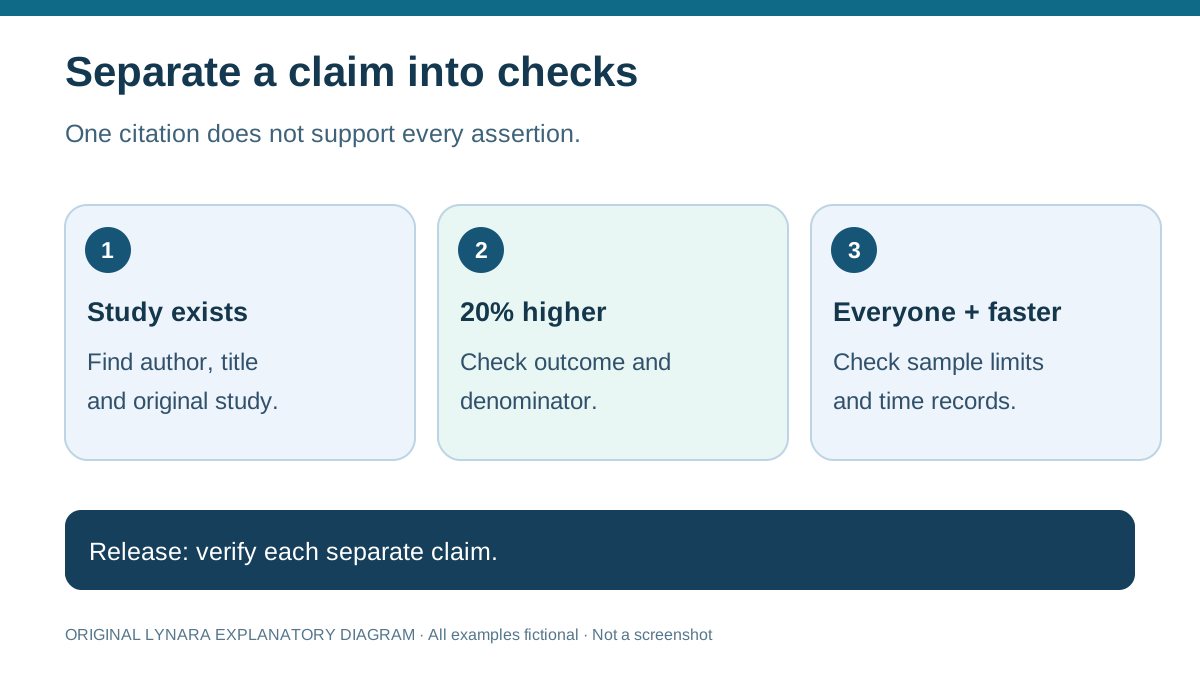
A paragraph produced by an AI assistant may contain several types of statements at once. Some are definitions, some are numerical claims, some describe real studies and others merely suggest a possible explanation. It is difficult to verify an entire fluent paragraph with a single search. First underline each assertion that would need evidence if you wrote it yourself. Translate the long answer into short individual claims that could be supported or contradicted by a specific source. This is a different task from deciding whether a paper is generally credible. Imagine a generated sentence saying that a study method improves exam results for everyone by twenty percent and takes half the normal time. That actually contains at least three assertions: there was a study, it found a twenty-percent improvement and the results apply to everyone; the time-saving phrase adds a fourth. A source might support only one. Treating them as separate rows avoids the common mistake of attaching one legitimate publication to a much stronger conclusion that the paper never made.
Do not confuse a working link with real confirmation
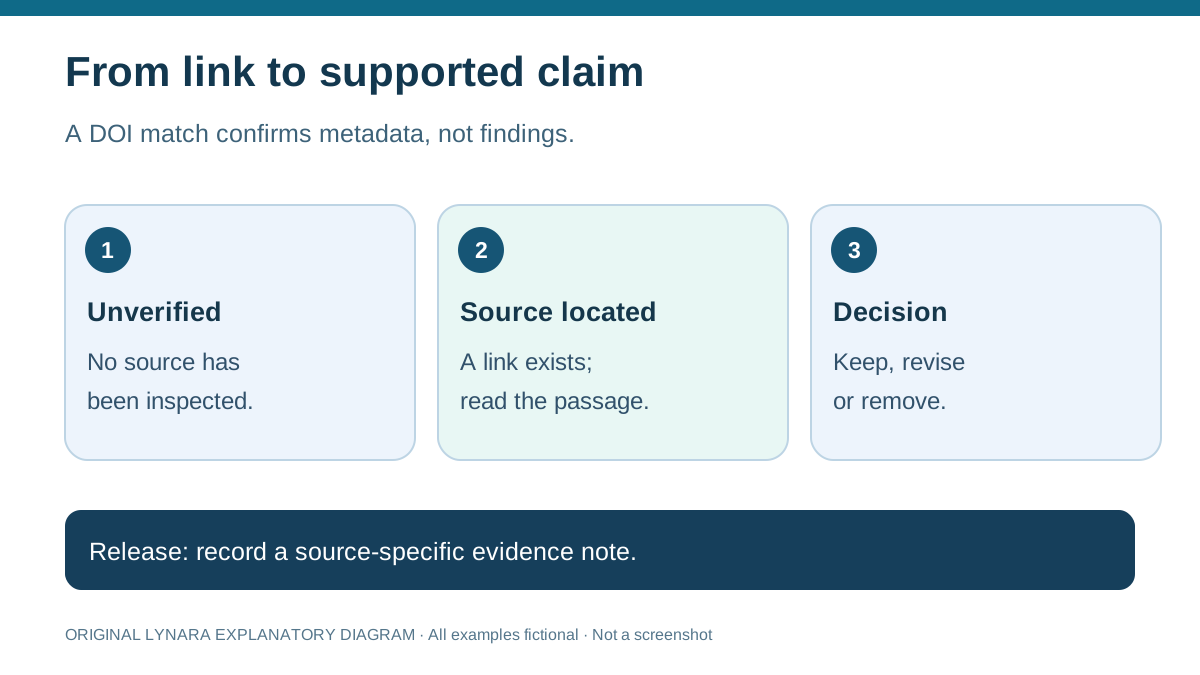
An AI assistant can present a link that exists without accurately describing what is on the page. The linked document may address another group, use an older dataset or make a narrower point. Finding a publisher page is the beginning of verification, not its conclusion. Open the original source and compare the exact claim with the actual relevant passage, table or study result. If the source is an abstract, determine whether it contains enough detail for the claim or whether access to the complete method is necessary. Lynara's AI Claim Verification Tracker separates four statuses: unchecked, source located, supported and contradicted. A student should never move directly from source located to supported just because the link resolves. The source-located stage exists specifically to preserve uncertainty until the underlying evidence has been read. Even a DOI that resolves to a real publication cannot guarantee that the publication proves the wording supplied by an AI model.
Find original sources instead of repeating an AI summary
When a generated answer mentions a school study, a government statistic or a scientific finding, look for the institution, journal article or official dataset that actually produced the result. A newspaper explanation can be useful for context, but it may simplify the evidence and omit restrictions. Search by a distinctive quoted phrase, publication title, official agency name or dataset identifier, and confirm the details in the original record. If a particular research citation cannot be found, mark it unresolved rather than inventing a replacement. The MIT Libraries guide to evaluating AI content recommends tracing citations and checking original evidence through lateral reading; a real reference still needs to support the exact claim. For a claimed journal publication, Crossref Metadata Search can help confirm bibliographic details, although a metadata match does not establish that the reported conclusion is correct. The academic source evaluation guide goes deeper into study design, evidence limitations and traceability. The new claim tracker addresses another part of the workflow: it makes sure each individual sentence in an AI answer has a status and next action. Students can use both without duplicating the same task. The source guide asks whether a publication is suitable evidence; the tracker records whether a particular statement matches the evidence the student actually inspected.
A worked example of an exaggerated percentage
Consider this invented AI statement: Students who used a study planner scored twenty percent higher in every school. Imagine the only located original document is a survey in one college where forty volunteers rated how organized they felt. Even if the survey genuinely reports a positive change in satisfaction, it does not establish examination scores, a causal effect or applicability to every school. The honest review status is contradicted or unsupported as worded, depending on exactly what the original source says. The student could rewrite a supported statement such as participants in this one survey reported feeling more organized, but only if the genuine source actually reports that finding and the wording is appropriately qualified. The made-up example is a reasoning exercise, not a reference to a real study. It shows why a quantitative claim should be compared with the actual outcome, population and method. Replacing a universal conclusion with a narrower one is a substantive correction, not merely a stylistic change.
Numbers need units, denominators and the right time frame
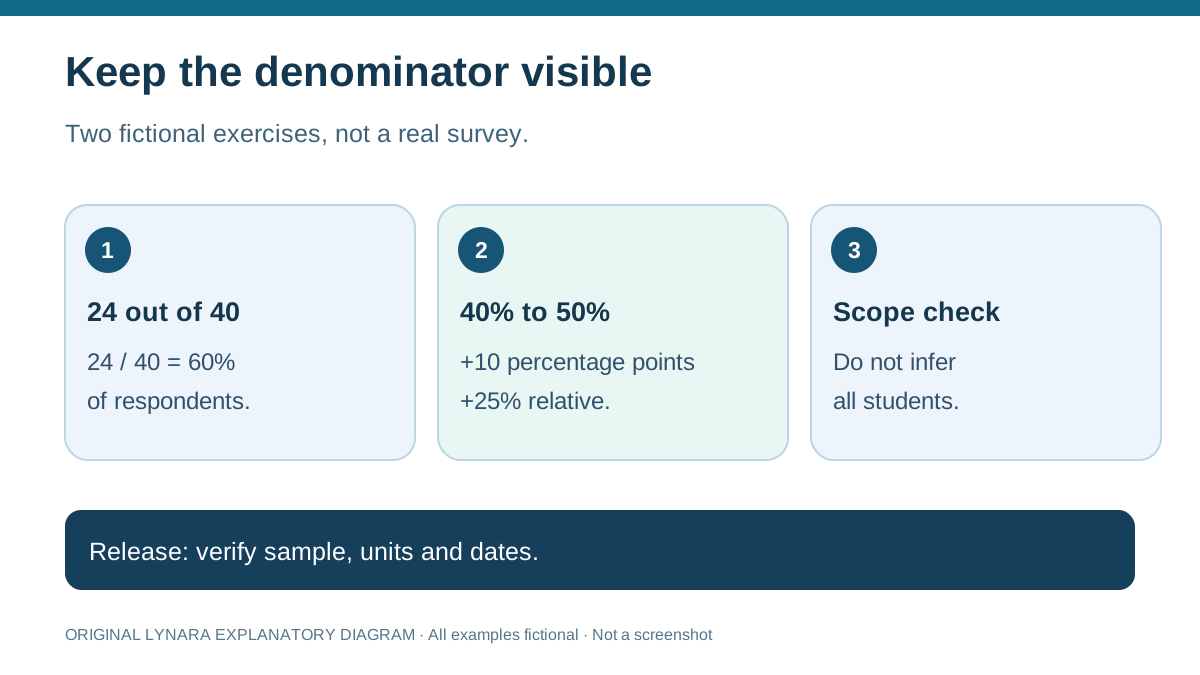
Suppose a model says sixty percent of students prefer a teaching method. Ask sixty percent of whom, selected how and when? If twenty-four people out of forty voluntary respondents selected the option, the arithmetic is 24 ÷ 40 = 0.60, or sixty percent of those respondents. It is not automatically sixty percent of everyone enrolled. A claim might also mix changes measured in percentages with percentage-point changes. Rising from forty percent to fifty percent is an increase of ten percentage points, not ten percent relative to the starting value. Check whether the reported measurement concerns all users, a selected sample or a particular time window. If the underlying source is a historical dataset, its collection year is not the same as the year the student opened it. Our dataset citation guide explains why source vintage and retrieval date belong in separate fields. These details matter because a plausible numerical sentence can be technically false without a single arithmetic operation being wrong.
Separate observations from causation
A generated answer might describe an association as proof that one factor caused another. If students who use a planner tend to have higher scores, several explanations are possible. Perhaps students already committed to regular studying are more likely to choose planning tools. Perhaps a different resource or course requirement influenced both the planning and the results. The original research design determines which interpretations are plausible; fluent wording does not resolve that uncertainty. When inspecting an empirical study, note whether researchers used randomized assignment, observational comparisons, interviews, self-report questionnaires or another approach. Check who was included, what was actually measured and what limitations the authors acknowledged. If the paper only reports a correlation, use wording that preserves that boundary. Do not ask a model to change the result into a stronger claim to make a conclusion seem impressive. Academic integrity includes keeping the strength of your language proportional to the evidence.
Check dates, changes and real-world product facts
AI assistance can also fail on facts that change quickly. An assistant may describe an older version of an app, quote a feature no longer available or give an outdated educational policy. A general research paper is not always the right evidence for a question about what a specific tool can do today. For current software features, inspect official documentation and the actual version available to the student. For a school deadline or rule, the school's own instructions govern the assignment. Avoid giving the date an online page was last edited as if it were the date of its underlying observations. Similarly, a model's wording in the present tense is not proof that it checked a live source. Record the time frame that matters: the experiment year, current product version or applicable academic term. In the tracker, use an evidence note to describe these boundaries instead of assigning a supported status simply because a page appeared in search results.
Use a checklist to identify four different outcomes
After reviewing each statement, choose an explicit outcome. Unverified means no adequate source has been inspected yet. Source located means a likely document exists but the passage, method or interpretation still needs checking. Supported means the reviewer has identified a legitimate source that actually justifies the bounded claim, with an evidence note explaining why. Contradicted means the source conflicts with the claim or reveals an overstatement needing correction. These statuses reflect the student's judgment and can still be mistaken. Lynara does not claim to fetch and authenticate each link or certify evidence automatically. The tracker requires a source link for checked claims and a substantive evidence note before a statement can be marked supported or contradicted. That extra friction is intentional: it prevents a convincing status badge from being generated without any explanation. It also gives the student a concrete next action when they discover a reference is irrelevant or incomplete.
When the model is useful during checking
A model can help reformulate a long sentence into checkable subclaims, suggest broad keywords for locating original evidence or point out possible assumptions in an argument. Those tasks can reduce preparation time because the student's final decision still depends on real sources. But if the same model that invented a statistic is simply asked are you sure, its reassurance is not independent evidence. A second confident paragraph is not a verification method. A more useful question is: what specific evidence would be required to support this claim, and what competing explanations should I check? The answer can guide the student's independent search without pretending that the tool already performed it. Where the instructor permits AI planning, use that assistance with disclosure as required. When AI is prohibited for the assignment, use ordinary research tools and manual notes instead. The checker's value lies in recording what the student actually verified, not automating an academic responsibility away.
Finish the assignment with a claim-to-source audit
Before submission, read the final document sentence by sentence. For every factual assertion that needs support, ask whether the cited source exists, is the correct version and actually substantiates the exact wording. Remove invented or irrelevant citations. Qualify claims when a source applies only to a narrow group. Recalculate numerical summaries from real inputs and check that diagrams or AI-generated visuals do not invent information. Preserve a short note on major changes so you can explain your work. Use the interactive evidence checklist to track up to eight assertions at a time. You can copy a summary of the statuses and unresolved issues locally. Do not paste restricted class materials or private personal records into a public service. The tool stores no verified database and sends no content to a model. Its purpose is to prevent an attractive AI answer from becoming a submitted fact without the independent examination a student would expect of any other research source.
A five-row claim audit you can reproduce
Suppose a fictional AI response says, “A university experiment found that every student scored 20% higher and finished studying in half the time.” This is an invented classroom exercise, not a report of any actual experiment. The sentence hides several assertions that need different original evidence. The following table describes what you would need to inspect; it does not claim that the documents exist.
| Claim | Evidence needed | Status | Next decision |
|---|---|---|---|
| A university experiment existed | Original title, authors, method and publication record | Unverified | Find the study; never invent a DOI |
| Scores rose by 20% | Measured outcome, baseline, sample and denominator | Unverified | Recalculate before repeating the effect |
| Every student benefited | Sample selection and subgroup results | Unverified | Remove universal wording unless justified |
| Study time was halved | Time measurements and their dates | Unverified | Remove if no time data were collected |
| The planner caused improvement | Research design and alternative explanations | Unverified | Do not turn association into causation |
A responsible outcome may be “do not use this sentence.” If no study can be found, do not retain an unsupported statistic with a softer adjective. If a genuine source only measured how organized volunteers felt, it cannot justify a claim about grades or every student. Replace the statement with a genuinely sourced, narrower observation or omit it.
Try two independent fictional calculations. Twenty-four favorable responses among forty volunteers give 24 ÷ 40 = 60% of respondents, not necessarily a whole school. Separately, if a rate rises from 40% to 50%, the difference is 10 percentage points, and the relative increase is (50 − 40) ÷ 40 × 100 = 25%. The two examples are not measurements from the same study; preserve the denominator, outcome and time frame for each.
Primary-source checkpoints and a final editorial decision
The MIT Libraries source-evaluation guide describes tracing claims to their origin and checking what a source actually says. Crossref's metadata documentation explains that its bibliographic records largely come from member deposits. A metadata match helps locate a work; it does not certify that an AI summary is accurate.
For each consequential statement, decide KEEP if its exact wording matches inspected evidence, REVISE if a narrower statement is supported, or REMOVE / HOLD if evidence is absent or conflicting. Record the relevant passage or table, the publication or data year and limitations. Follow your teacher's actual AI and citation policy; a factually accurate statement can still violate an assignment's rules if obtained or used in a prohibited way.
Editorial standards
The student examples are hypothetical and clearly labeled. This article describes a manual evidence-verification workflow, not the results of a proprietary AI factuality benchmark. Review the editorial policy.