How to Evaluate AI Essay Feedback: Rubric, Evidence and Meaning
Compare edits, retain source accuracy and keep responsibility for the final argument.
Try the local revision comparator
Track exact additions and removals between a student draft and the revised version without sending them to an AI service.
Start with the instructor's goal, not the model's preferences
An AI writing assistant can offer dozens of suggestions that sound confident and polished, but its preference for longer vocabulary or a different paragraph order is not the same as the instructor's rubric. Before accepting any change, identify what the assignment requires: a defensible argument, source interpretation, a specific structure, personal reflection or another kind of work. A simpler student-written sentence that supports the thesis may be better than a long AI rewrite that changes the point. The first quality gate is whether the proposed modification serves the real task. Purdue OWL's revision checklist asks writers to check the thesis, audience and evidence before polishing sentences; that human editorial judgment cannot be inferred from a word-count difference. Compare the source draft and the suggested version as separate documents. Do not overwrite your only copy with AI-generated text, particularly when your school limits or requires disclosure of such help. It is easier to explain your own work if you can see what changed and why. For a short paragraph or essay section, use a revision log rather than trusting that the updated version must be an improvement because it reads more formally.
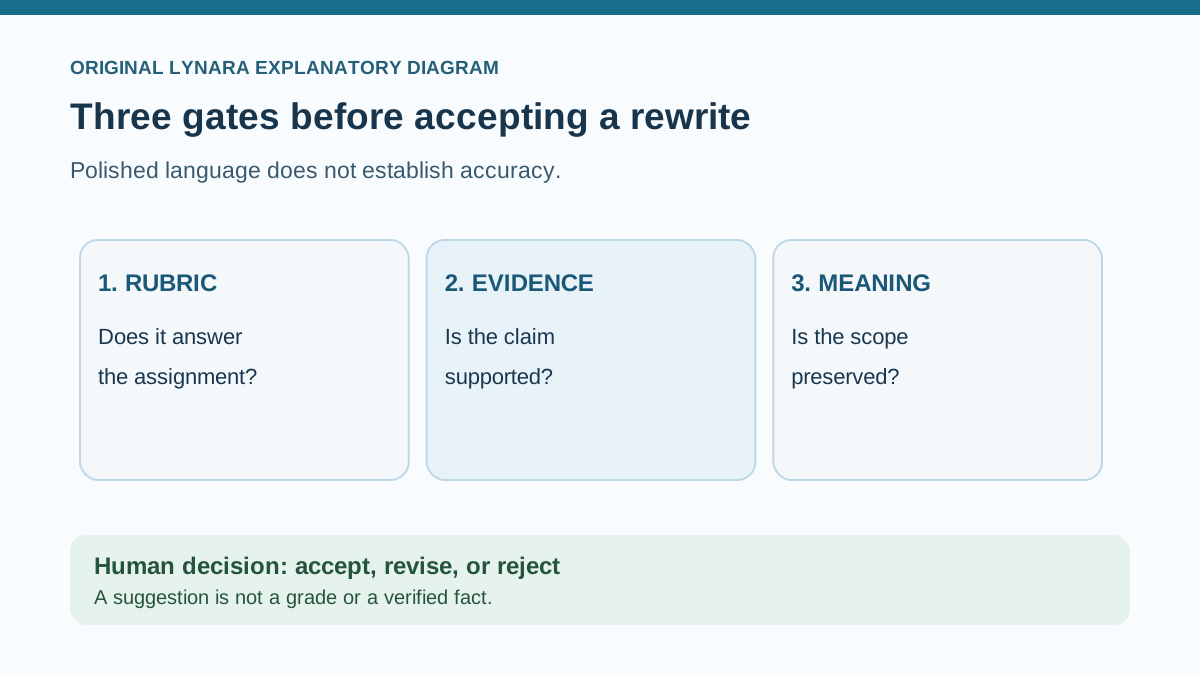
Divide feedback into categories before editing
AI feedback can concern spelling, sentence clarity, paragraph structure, evidence, logic, tone or citation style. Each category requires a different check. A grammatical correction can often be inspected locally against the intended meaning. A recommendation to reorganize an argument must be compared with the thesis and rubric. A factual suggestion, added quotation or new study citation requires independent source verification. Treating all suggestions as equally trustworthy creates avoidable errors. Write a small table with the original passage, suggested change, claimed reason, evidence needed and your decision. For example, change an unclear pronoun only after identifying what it refers to; do not change a result from possibly to definitely because the model says strong writing is more persuasive. A suggestion can be rejected with a reason. Keeping a revision decision log also helps avoid cycling through repeated prompts that generate many slightly different versions without resolving the original weakness.
What the local comparison tool actually measures
Lynara's AI Essay Revision Comparison Tool takes an original and revised draft and counts words in both. It identifies exact sentence-like passages that appear unchanged and lists passages present only in one version. It deliberately uses approximate punctuation-based sentence boundaries, so abbreviations can sometimes cause extra segments. A heavily rewritten sentence is treated as one removal plus one addition, rather than as a machine-certified improvement. The tool does not send either text to a model. This distinction matters because a generic compare feature can be mistaken for an editorial judgment. If the revised paragraph is fifteen words longer, nothing in that count proves the argument is stronger. If an important sentence disappears, the comparison makes that omission visible so the student can check whether the missing idea was intentional. An exact-text diff is a useful starting point for review, not a substitute for understanding, originality or academic integrity.
Worked example: one seemingly helpful factual rewrite
Imagine a student's original paragraph says the school library opens at eight every weekday. An AI-assisted revision changes eight to nine, keeps the remaining text and adds that the timetable is available on the official school site. The revision may sound more precise, but the new opening hour is now a factual claim that needs checking. If the official schedule says eight, accepting the change makes the essay worse even though the model presented it confidently. If the schedule has genuinely changed, the original version may have been outdated. The comparison tool lists the changed opening-hour sentence among additions and removals, and the new statement as an addition. It cannot determine which opening time is correct. The student must inspect the official school schedule, use its relevant date and revise the statement accordingly. This fabricated school example is a demonstration of a verification workflow, not a claim about a real institution or an AI system's measured accuracy.
Check whether a rewrite strengthened or weakened the thesis
A revision may unintentionally shift the scope of the argument. The student might write that some participants in a small classroom study reported feeling more organized, while an AI suggestion says the technique improves achievement for all students. This changes a limited observation into a universal causal claim. Removing words such as some, in this sample and reported can make prose smoother while making it less defensible. The correct response is to preserve the scope or return to the actual underlying evidence. Ask whether the revised sentence still answers the essay question and whether each part of the claim is supported by the same original sources. A paragraph can be elegant while contradicting a research paper's method. Our source evaluation guide explains how to inspect results, samples and limitations. For claims introduced by AI, use the claim verification tracker rather than inventing a reference because the new sentence seems persuasive.
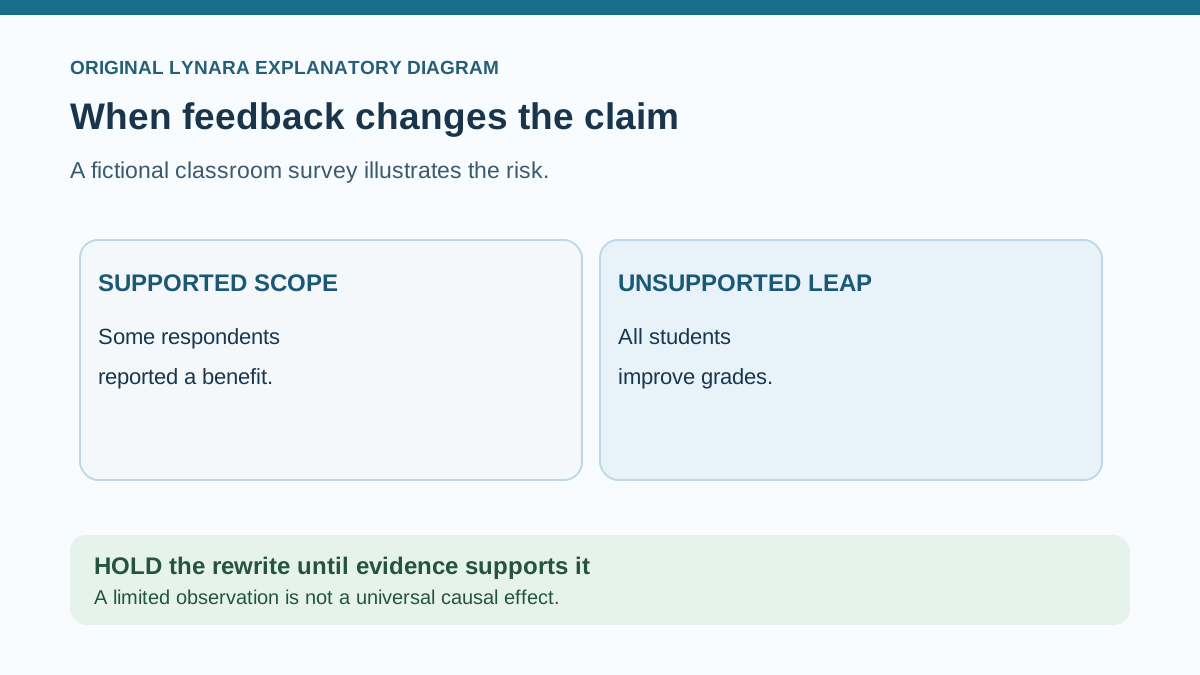
Separate style revisions from new information
Changing repetitive wording or shortening a clumsy sentence can be a relatively straightforward editorial decision when it preserves meaning. Adding a new historical fact, statistical figure, quotation or study attribution is fundamentally different. A model may offer the new material without actually checking it. Mark any added or substantially altered factual statement and give it a source-status review before inclusion. A citation generator cannot retroactively make a fabricated quote genuine. Similarly, deleting part of the original draft can remove necessary qualifications or a counterargument required by the assignment. A simple side-by-side or sentence-level log helps identify those omissions. Not every removed sentence is a mistake; repetitive material can be cut constructively. The student should explain the decision in terms of the rubric and argument. The fact that a change was suggested by AI does not create either a duty to accept it or an automatic reason to reject it.
A quantitative example that shows why word count is limited
Suppose the original essay section has 220 words and the revised one has 185. The net change is 185 − 220 = −35 words. That may be useful if the submission has a tight maximum length, but it does not guarantee clarity. An important source limitation might have been removed along with repeated phrases. Another revision that grows from 220 to 260 words adds forty words, which could represent deeper explanation or merely unnecessary filler. A word count is a measurement of length, not a score of academic quality. Lynara's tool reports the counts and the added or removed sentence-like text so the student can investigate the difference. It does not calculate a fabricated grade, grammar score or AI detection probability. A student who wants to improve a draft should measure progress by rubric coverage, validity of evidence and whether the argument can be understood, not by the amount of text changed. More editing activity is not necessarily more learning.
When to use AI again and when to ask a person
If a suggestion has an unclear reason, it can help to ask the assistant what ambiguity the original sentence creates or which rubric item its recommendation is intended to address. That may reveal an actual issue worth examining. But asking the same system to certify its own factual claims is not independent checking. Where sources disagree, inspect the original publications or ask an instructor or librarian for guidance. For a personal reflection or assignment requiring authentic experiences, no model can supply experiences the student did not have. Sometimes a peer reviewer can point out an assumption a generic model missed, especially one related to course context. The goal is not to choose between human and AI feedback as absolute categories. It is to use appropriate help for specific tasks and retain personal responsibility for the submitted work. Our AI versus human task guide provides a broader comparison; this page focuses on the concrete act of accepting or rejecting edits.
Preserve privacy and follow the actual class policy
An essay draft can contain an institution's name, private feedback, a student's identity or information about classmates. Copying the full document into a consumer AI service may not be permitted or necessary. Consult the school's rules and the provider's account-specific data practices. In some cases, anonymized excerpts or a local-only comparison are more suitable. The student data privacy checklist explains how to reduce unnecessary disclosure. Our revision comparator processes the entered text in the browser without requesting a hosted model. That does not mean every tool linked from a webpage has identical privacy behavior. Nor does it authorize AI use where an instructor prohibits it. If a teacher permits brainstorming but not AI-written final prose, use any suggestion only within those limits and disclose assistance when required. Keep your original draft and significant decisions when helpful for explaining authorship and revision.
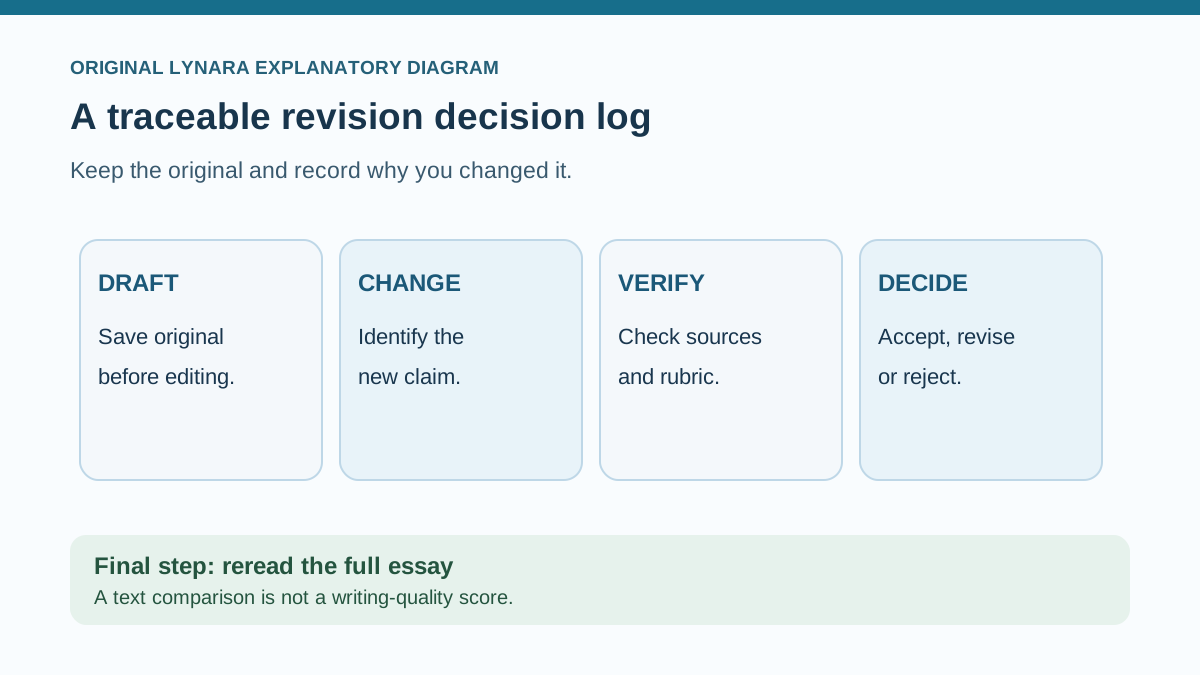
Worked revision log: four suggestions, four different decisions
Imagine a student is writing a short argument about a fictional campus recycling survey. The original thesis is modest: some students say labeled bins make sorting easier, but the survey cannot establish that the labels changed actual recycling rates. The student asks an AI assistant for feedback, not for a replacement essay. The resulting suggestions should be evaluated one by one rather than accepted as a bundle. This is an invented practice worksheet, not a real study or a measured AI result.
| Suggested edit | What changes? | Human decision |
|---|---|---|
| Replace "some students" with "students" | Broadens the population beyond the surveyed respondents. | REJECT until representative evidence exists. |
| Change "easier to find" to "easier to identify" | May clarify wording without changing the reported observation. | ACCEPT only after reading the sentence in context. |
| Add "recycling increased 30%" | Introduces a numerical outcome that the survey did not measure. | REJECT; do not invent a source or percentage. |
| Move the limitations paragraph earlier | Changes organization but not necessarily the claim. | REVISE and reread transitions against the rubric. |
A useful log has five fields: the original wording, the suggestion, its claimed benefit, the evidence or rubric item checked, and the final decision. If a teacher asks for a record of AI assistance, retain the prompt and relevant responses according to the course policy. Do not imply that a private log automatically satisfies every institution's disclosure rules. Purdue OWL's writing-with-feedback guidance describes prioritizing comments and maintaining a change list.
A 25-minute review plan for one revised paragraph
When time is limited, do not spend the entire session asking a model for alternative phrasing. The following is an illustrative 25-minute allocation, not a validated productivity benchmark: spend five minutes reading the assignment rubric and marking the paragraph's purpose; eight minutes comparing the original and suggested version; seven minutes checking changed claims against the actual source; and five minutes rereading the paragraph in its essay context. The arithmetic is 5 + 8 + 7 + 5 = 25 minutes. If evidence checking takes longer, pause the edit instead of treating the clock as a reason to approve an unsupported statement.
Prioritize changes by risk. A new statistic, quotation, author name or causal assertion deserves verification before a synonym or punctuation change. A deleted counterargument deserves a rubric check before cosmetic polish. If the suggestion changes the thesis, revisit the essay outline rather than making sentence-level edits in isolation. Purdue OWL's revision questions focuses on main point, audience and supporting evidence, which makes them a useful independent review checklist. This sequence also helps avoid the trap of measuring quality by the number of words changed.
Privacy and citation release gates
Before copying any draft into an external assistant, check whether it includes another student's identifiable comments, a teacher's private feedback, unpublished group material or protected education-record information. Do not assume deleting a name makes a detailed story anonymous. The U.S. Department of Education's school-tool guidance tells educators to consult school approval and data-handling rules. It does not establish that every student's private draft is a FERPA education record, or that every local browser tool is automatically approved. Follow the actual course and institution policy.
Before submission, verify that every new quotation exists in the cited source and that paraphrases still reflect its meaning. A revised claim can be true in general but irrelevant to the specific evidence in the assignment. Check the publication date and page or section, distinguish observation from causation, and ensure the bibliography corresponds to material actually consulted. If a source cannot be opened or the claim cannot be verified, mark it HOLD and either remove the claim or ask the instructor for direction. The local claim verification tracker can organize your decisions, but its supported status is entered by you; it does not independently authenticate the linked source.
A complete human revision sign-off
Read the revised essay one more time without the highlighted comparison. Check that it answers the question, preserves the intended thesis, follows the instructor's structure, uses authentic sources, accurately quotes or paraphrases others and describes statistics with correct units and qualifications. Verify any changed names, dates or numerical results. Confirm that removed sentences did not contain required evidence or objections. Then inspect the submission format, length and any AI disclosure requirement. For a repeatable process, compare the two versions in the revision comparison tool, use the claim checker for changed factual statements and record the final choice in your own notes. You do not need a separate AI prompt for every punctuation change. The most important question is whether you can explain why the final sentence is accurate and appropriate for your assignment. That is a stronger sign of useful revision than a high percentage of rewritten words.
Editorial scope
Examples are hypothetical and word-count differences do not establish writing quality. Always follow the teacher's rules. See our editorial policy.