AI Shift Handover Notes: Verify Every Open Task
A neat AI summary is useful only if the next shift knows which work is still open, who owns it and what the source record actually says.
The quiet cost of a bad handover
A small ecommerce support team closes at six. The morning team begins at eight. Between those times, customer messages arrive, a supplier revises a delivery estimate and one agent leaves an unresolved refund question. A handover note should let the next employee understand what needs attention without rereading the entire day's chat history. An AI assistant can help turn structured notes into a concise summary. It can also turn a tentative statement into a false commitment or quietly omit a difficult exception.
The most dangerous handover is often not obviously wrong. It looks organized, says the right names and uses professional language. But if “waiting for warehouse confirmation” becomes “delivery scheduled for tomorrow,” the next shift may promise a customer something nobody approved. The practical goal is to use AI for drafting while keeping the ticket or task log as the authority. This is different from our meeting-notes and SOP guide, which covers extracting decisions from meetings. A shift handover is a live operational state transfer with named owners and unfinished actions.
Define exactly what the next shift must know
Choose a standard structure before introducing an AI tool. A small customer-service operation might need: open ticket ID, customer-safe summary, current state, verified last action, next action, owner, deadline if confirmed, priority and source record. A retail store might use inventory shortages and unresolved supplier questions instead. The structure must reflect how work is handed over in that business, not generic corporate language. Keep the note short enough to scan and detailed enough to act on.
Do not treat every field as free text. A ticket ID must match the system. “Owner” should mean the person or queue actually assigned in the task tracker, not the person who last wrote a comment. A due date is different from a date mentioned in a customer's message. Priority should follow the company's approved triage rules, not a model's sense of urgency. If no owner or deadline has been set, the handover should say unassigned or not confirmed, followed by who must resolve the gap.
Use a small, controlled snapshot of the task log
Start with authorized business records. Export or copy a limited set of task fields from the approved system rather than uploading entire customer conversations by default. Set a snapshot time: for example, “status as of 5:45 p.m. Eastern.” This matters because a summary may be correct when generated and outdated twenty minutes later. If the task system offers an API or report view, verify that its status and ownership fields match the actual live state. A manually pasted list can be enough for a small operation if somebody checks it.
Separate internal operational information from sensitive customer or employee data. Ticket IDs and generalized issue descriptions may be sufficient for a shift note; names, payment details and full message histories may not be needed. Follow client permissions and your employer's data-handling rules. If staff intend to send records to an external AI service, use an approved provider and a permitted data category. Our AI vendor approval guide explains that earlier procurement decision.
An illustrative nine-ticket shift
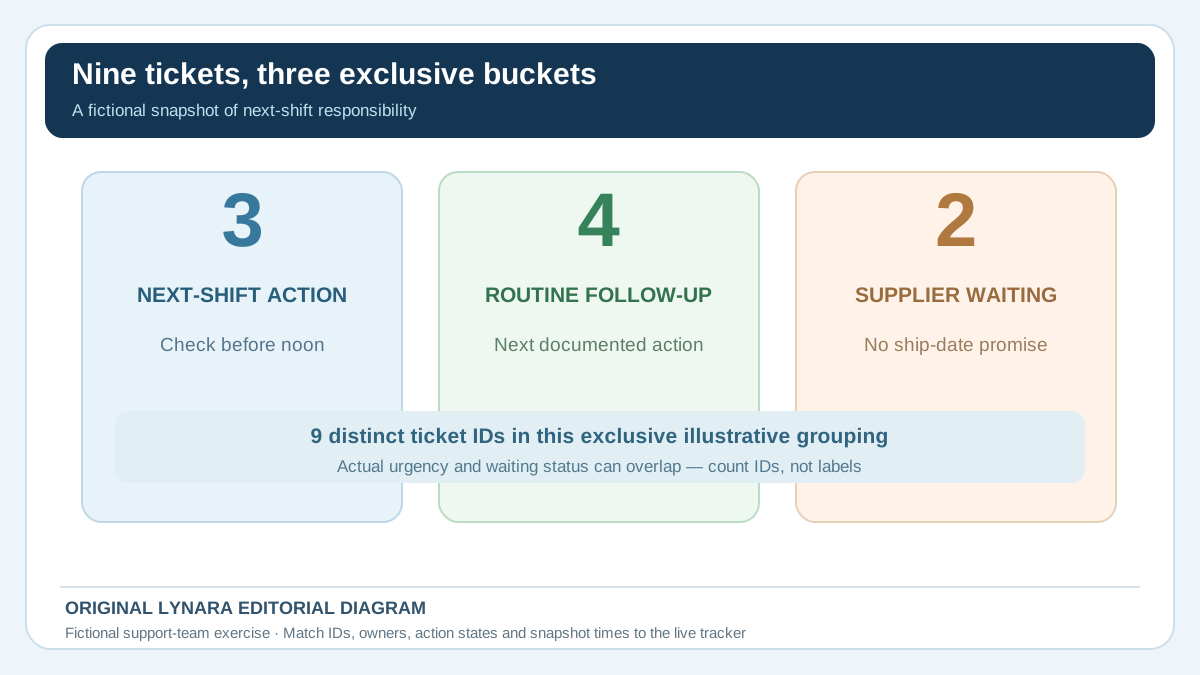
Consider a fictional support desk with nine open items at 5:45 p.m. Three need next-shift action before noon, four are normal-priority follow-ups and two are waiting for an outside supplier. The three groups add to nine only because this example assigns each ticket to one exclusive handover bucket. In a real task system, urgency and waiting state can overlap, so count unique IDs rather than casually adding status labels. A handover that says “nine open tickets” should be reconcilable with the approved tracker.
One example record reads: T-104, replacement part requested; waiting for supplier stock confirmation; assigned to purchasing queue; no confirmed ship date. A model-generated version might say, Replacement ships tomorrow; customer notified. That introduces two unsupported facts. The corrected handover should keep the actual state and assign the next step: Purchasing queue to check supplier response by the next scheduled review; do not promise a dispatch date until confirmed. Ticket numbers and events in this paragraph are invented teaching examples.
Prompt for a source-backed status, not a reassuring story
A constrained instruction could say: Draft a concise shift handover using only the attached approved task snapshot. Preserve ticket IDs, exact assigned owners, verified deadlines and current statuses. For every open item, report the next human action and cite the source row. Do not infer that a task is complete, that a refund was approved, that a supplier has replied, or that a customer was contacted unless the snapshot explicitly says so. Return MISSING DATA for any essential field that is absent. Tell the model which fields have controlled values.
The instruction is only one control, not a guarantee. Models can still omit rows, change dates, confuse issue status with resolution status or merge two similar customer cases. Requesting a source-row reference makes review faster because a person can check where a statement came from. If the AI tool cannot preserve stable ticket references, use it only for limited prose editing after the task list has been reconciled manually. A human-written short note is preferable to a beautiful summary that cannot be audited.
Review every state-changing statement
Separate harmless language polish from statements that change operational meaning. “The customer asked about delivery” might be safely shortened to “delivery inquiry.” “The order is out for delivery” needs evidence from the carrier or fulfillment system. “Refund approved” requires the actual authorized decision. “Escalated to manager” must match a real assignment or notification. The difference matters because the next employee may act on the summary without seeing the underlying conversation.
Lynara's AI Claim Verification Tracker can help a reviewer list the handover's factual claims and record whether each one has support. It does not connect to ticket software or independently verify customer states. For each high-impact line, the reviewer should return to the current source record. Remove unsupported commitments or mark them explicitly as decisions still needed. A claim labeled uncertain should never be silently copied into a customer-facing message as fact.
A five-point quality check before the next shift starts
Count: does the note contain all unique open IDs from the approved snapshot? State: do “open,” “waiting,” “assigned” and “resolved” agree with the current tracker? Ownership: is every required action attached to a real person or queue? Time: are dates and time zones explicit only when established? Promises: does any sentence claim that a customer, supplier or staff member already acted when the evidence only shows an intention? These checks are concrete enough for someone on shift to apply in a few minutes.
Add a sixth, practical question: what will the next worker do first? A handover with nine paragraphs and no clear action ordering is still weak. Keep urgent verified actions visible without allowing an AI system to invent priority from emotional wording. A simple table with ID, next action, owner and evidence reference may be more useful than polished prose. The text should serve the workflow, not the other way around.
Check for missing rows and duplicate customers
Suppose a pilot starts with nine unique open tickets but the AI output contains eight. The summary could be eloquent and still fail the acceptance test. Investigate the missing record before anyone approves the handover. If it contains ten lines because one issue was repeated under two descriptions, reconcile the IDs so two agents do not duplicate work. Avoid counting a parent ticket and its subtask as separate customer cases unless the source system intentionally tracks both as independent actions.
Use simple arithmetic to detect the obvious failures. In the fictional nine-ticket example, the reviewer should be able to point to nine unique source IDs and nine corresponding output rows, or a documented exception. An item that closed after the snapshot should be rechecked against the live tracker before the next employee acts. A stable snapshot improves drafting consistency; a final live-state check improves operational accuracy. Both are needed when the environment changes quickly.
Does drafting actually save time?
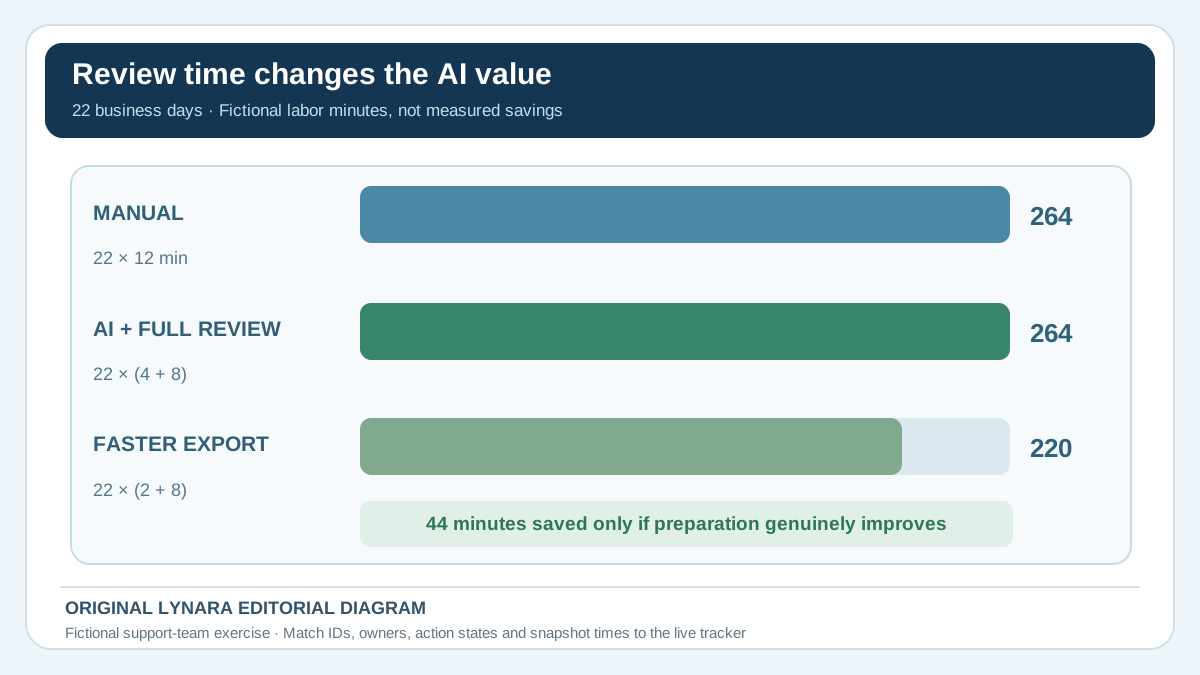
Consider another hypothetical month with 22 business days. A manager spends 12 minutes per day writing a manual handover, for 264 minutes. With AI, preparing the approved snapshot takes four minutes and checking all facts takes eight minutes per day, also 264 minutes in total. Generation speed has not created a saving at all in this illustration. If an improved export lowers the preparation step to two minutes while full checking stays at eight, the process takes 22 × 10 = 220 minutes, or 44 minutes less across the month, before maintenance and provider costs.
These are deliberately simple scenarios, not measured performance estimates. A new system may need extra time for staff training, exception handling and incident correction. Use the Business AI ROI Calculator only after confirming the inputs reflect real observations. The honest answer might be that a structured manual template beats the model for a tiny operation. That is still a useful result; it avoids paying for automation that merely hides review labor.
Make the workflow robust when somebody is absent
A handover should survive a sick day or an unexpected shift swap. Store the approved note where authorized staff can retrieve it, and state which system remains the authority if the summary conflicts with live data. Assign a backup reviewer and document how to flag errors to the prior shift. If the model produces a paragraph that cannot be linked to a known ticket, the team should reject it rather than treat it as a new instruction. Keep a simple revision history so disputed assignments can be traced to a source and time.
If a handover contains personal customer information, use the company's approved channels and retention rules. Do not paste it into public chats for convenience. If a task can trigger refunds, price changes, medical/safety decisions or legal commitments, do not allow an AI-written note to authorize that action. The AI Workflow Suitability Checker can help frame whether those activities require additional human controls. The responsibility for the actual decision stays with the authorized team.
A practical handover, not an AI showpiece
The best use of AI here is a narrow one: turn a verified, approved log into an easy-to-read shift note while making missing evidence visible. Ask the next shift whether the note helped them act correctly, and measure omissions, duplicated work and time spent checking. If staff repeatedly need to repair invented claims, stop or restrict the automation. NIST's Generative AI Profile is a useful primary source on managing risks from confident but incorrect model output.
Ticket IDs, workloads, dates and time comparisons in this article are fictional and are not service-performance benchmarks. A real handover must reflect the organization's systems, permissions and local obligations. Lynara has not tested a named commercial AI provider for this workflow. See our methodology for the distinction between worked examples and verified outcomes.
Reconcile unique ticket IDs before counting handover coverage
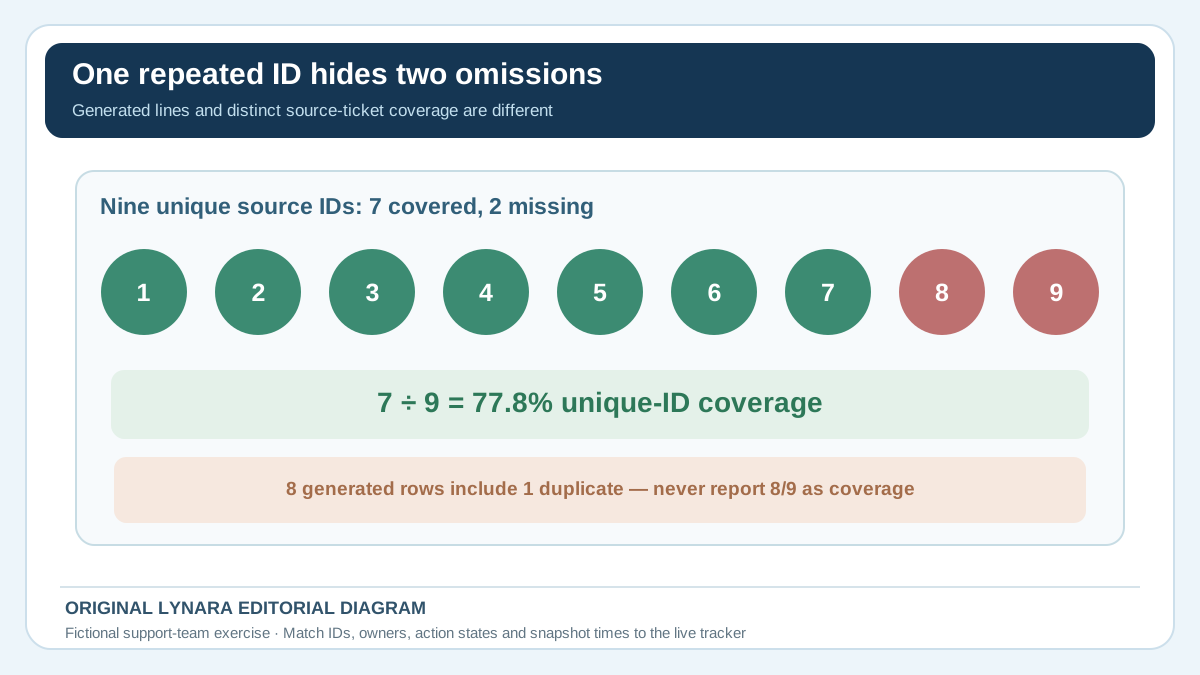
A fictional source snapshot lists nine distinct open ticket IDs. An AI-generated handover contains eight rows, but one ID appears twice. It therefore covers only seven distinct tickets; two are missing. A superficial “eight of nine” claim would report 88.9% coverage. The correct unique-ID coverage is 7 ÷ 9 = 77.8%. Neither figure proves that the states, owners or deadlines are correct. This is a deliberately synthetic example without customer data.
| Audit measure | Example | Required follow-up |
|---|---|---|
| Source open IDs | 9 unique | Lock the snapshot timestamp |
| Generated rows | 8 rows, 1 duplicate | Identify duplicate; do not count it twice |
| Distinct covered IDs | 7 of 9 = 77.8% | Find the 2 missing open tickets |
| Action authority | Not measured | Verify each owner, state and promised deadline |
Keep the approved task tracker as the system of record. The AI Claim Verification Tracker can structure a review of unsupported statements, but it cannot authenticate a live ticket or infer the right owner. Do not share real IDs, customer names or support logs with an unapproved provider. The AI Workflow Suitability Checker helps flag restricted data flows; staff must still approve the final handover. Record both missing IDs and the duplicate in a correction log before the next shift begins.