How to Prepare for an Open-Book Exam: Study and Timing Plan
The book is a reference, not a substitute for understanding the material before the timer starts.
Plan your study sessions
Use Lynara's Revision Schedule Calculator to divide topics across usable days, then the Exam Time Per Question Calculator to explore your examination time budget. These tools do transparent arithmetic; they do not know your instructor's rules or predict the difficulty of the questions.
The surprising problem with an open book
The phrase open book sounds reassuring. You imagine leaving definitions, formulas and chapter notes on the desk, then finding whatever you need. In an untimed conversation, that approach might seem plausible. During a 70-minute exam with interpretation questions, though, every frantic search consumes time that could have been spent explaining an answer. Having access to information is not the same thing as being able to use it. The goal of preparation is to recognize the type of problem, retrieve your main ideas, and know exactly where to check the details that genuinely need checking.
Cornell University's Learning Strategies Center guide to open-book exams makes the distinction clear: permitted materials, exam format and timed conditions matter, and simply collecting more notes can make searching harder. Treat the exam as a reasoning exercise with an available reference shelf. That mindset changes how you spend the last few study days. Instead of rereading every sentence, you practice making decisions about which ideas apply to unfamiliar questions.
First confirm exactly what you can use
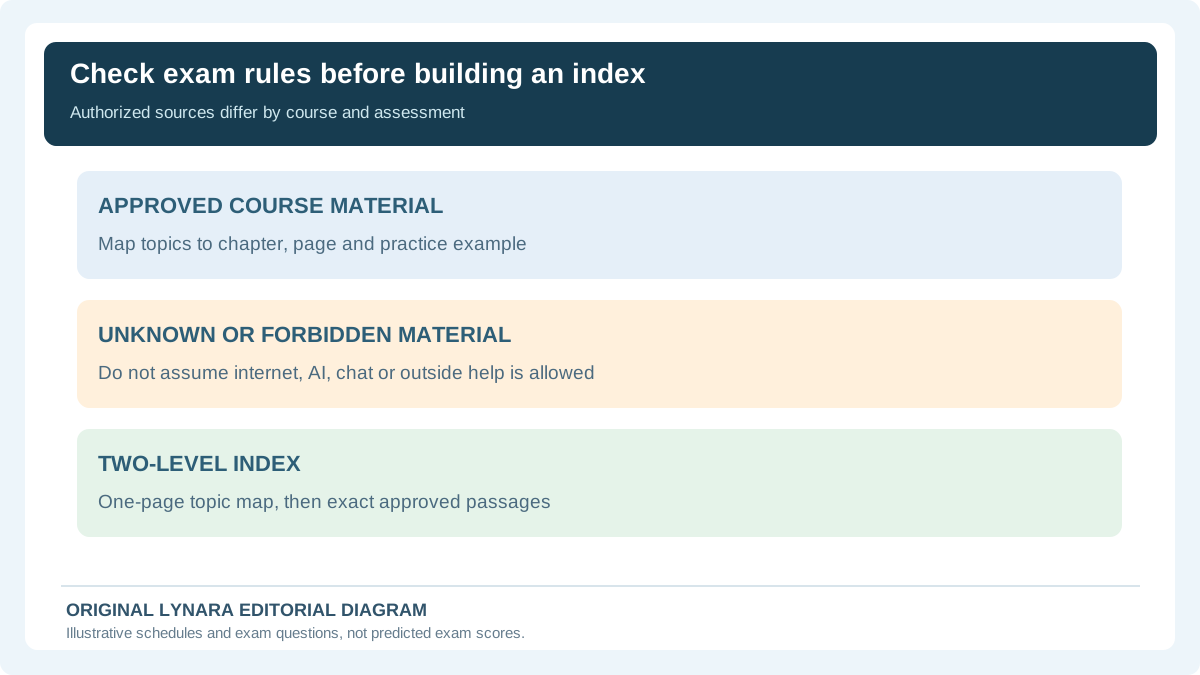
Read the syllabus, instructor announcement and assessment directions. Are printed textbooks permitted, or only an approved digital PDF? Are handwritten notes allowed? Can you search your files, use a calculator or open other browser tabs? Is the internet prohibited? Are communication, tutoring or AI tools expressly forbidden even though the book is open? Don't infer the answer from the course title or a friend's experience. If a rule is ambiguous, ask the instructor before exam day. A permitted reference list is part of the problem setup.
Write a one-page exam brief with the date, duration, question types, topic range, grading weights, materials allowed and accessibility arrangements that apply to you. If the assessment is online, add the technical requirements and any rules about switching windows. If it is in person, verify whether electronic material is actually usable. A beautifully organized digital notebook is worthless when the room allows only paper. Your study plan should match the real conditions instead of the conditions you hope will be offered.
Create a two-level reference index
Think of your study resources as a library. The top level is a one-page topic map: five to ten course themes, each with the best source location. The second level is a detailed section for each theme with a definition, a worked example, common exceptions and a pointer to the relevant book chapter or lecture. The useful part is the link between a likely question and the material that answers it. A list of every page number can become a second textbook that you have to search.
For a fictional introductory economics course, a top-level row might read: Opportunity cost—Week 2 notes, pages 31–37; compare alternatives rather than cash expense alone. Another might read: Elasticity—Week 5 worksheet, example 3; watch the percentage-change denominator. These are invented teaching examples, not a syllabus to copy. A student studying history would index arguments, primary sources and competing interpretations instead. Your index should surface how concepts connect, not just their names. Make it short enough that you can find an entry under pressure.
Practice retrieval before looking anything up
Choose a topic and close the book. On blank paper, explain the central idea, draw a process or solve a small question from memory. Then open the permitted source and compare your attempt. Put a check beside accurate elements, circle gaps and correct mistakes in another color. The method exposes whether you genuinely understand a concept or only recognize it when you see the answer. Cornell's effective study strategies describes retrieval practice and spaced review as active approaches.
For an open-book test, add a second kind of practice: locate a precise supporting reference after you've answered from memory. Your first goal is not to copy the page. It is to check one fact, formula, exception or quotation with minimal searching. Time the lookup. If it takes three minutes to find a key definition, improve the index; if it takes 15 seconds, the organization is working. Not every question needs a citation, but training this decision prevents endless page flipping.
Use application questions, not copied definitions
Imagine you can define confirmation bias perfectly. A test question may instead describe a researcher ignoring inconvenient observations and ask how the study could improve. Reciting the definition alone would not fully answer the question. Prepare by converting key terms into small situations with decisions. For each topic, write: what does the principle mean, when does it apply, what is an example, and what is a tempting but incorrect alternative? Explain why the alternative fails. This is more robust than highlighting a paragraph and hoping the wording appears unchanged on the exam.
For math and statistics courses, reconstruct worked solutions without viewing the steps, then check the assumptions. For literature and history, practice a defensible claim and two pieces of evidence, including how an alternative interpretation might challenge it. For science, distinguish a prediction from a measured result and an observation from a causal claim. Question design should resemble the course's actual expectations. Past quizzes, rubrics and instructor examples are often stronger evidence of task format than generic internet study questions.
Build a realistic three-day plan
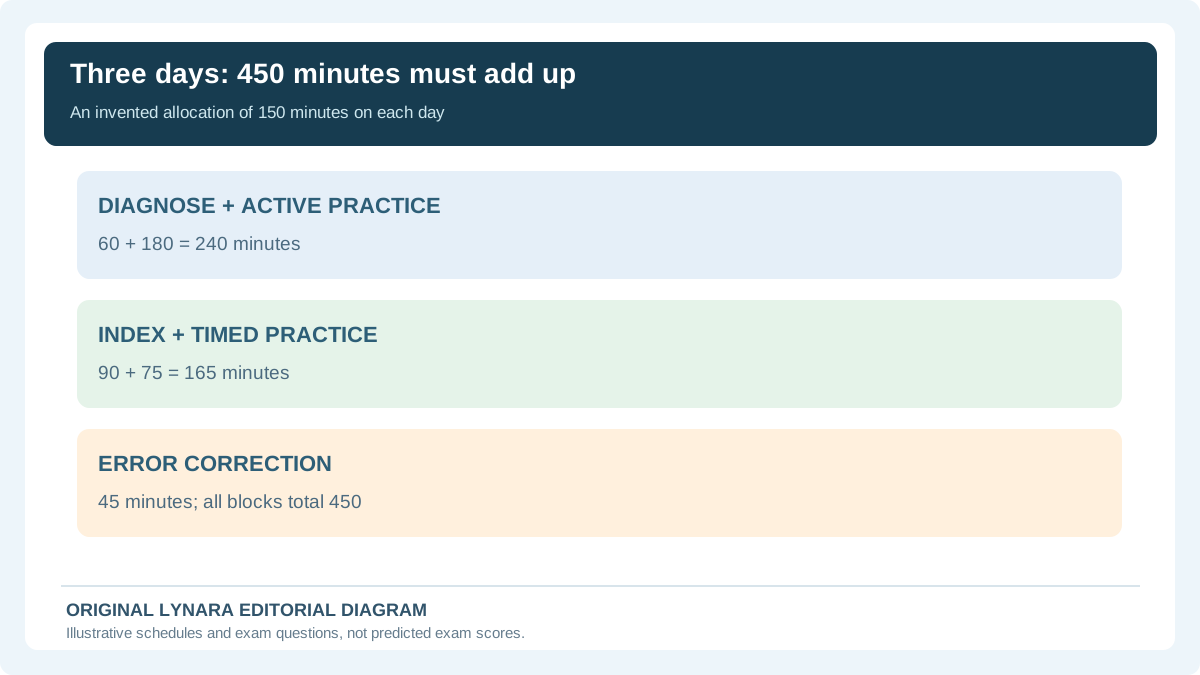
Suppose you have six course topics, three usable study days and 150 minutes per day. The total available time is 450 minutes. You might allocate the first 60 minutes to diagnosing weak topics, 180 minutes across the three days to active practice, 90 minutes to indexing approved references, 75 minutes to one timed mixed set and 45 minutes to correcting errors. Those blocks add to 450 minutes. They are an illustrative schedule, not a scientific optimum. Someone who knows the material well may need less indexing, while a student struggling with basic concepts may need more supported practice.
Enter your actual study minutes, number of topics and remaining days into the Revision Schedule Calculator. Preserve buffer time for unexpected obligations. If the result suggests an unrealistic number of minutes per topic, do not pretend the calculator can manufacture time. Prioritize topics by weight, foundational dependencies and the weaknesses you observed in practice. Be honest about sleep, travel, classes and other assignments. A small plan that can be followed beats an impressive timetable that is abandoned on the first evening.
Calculate the cost of searching during the exam
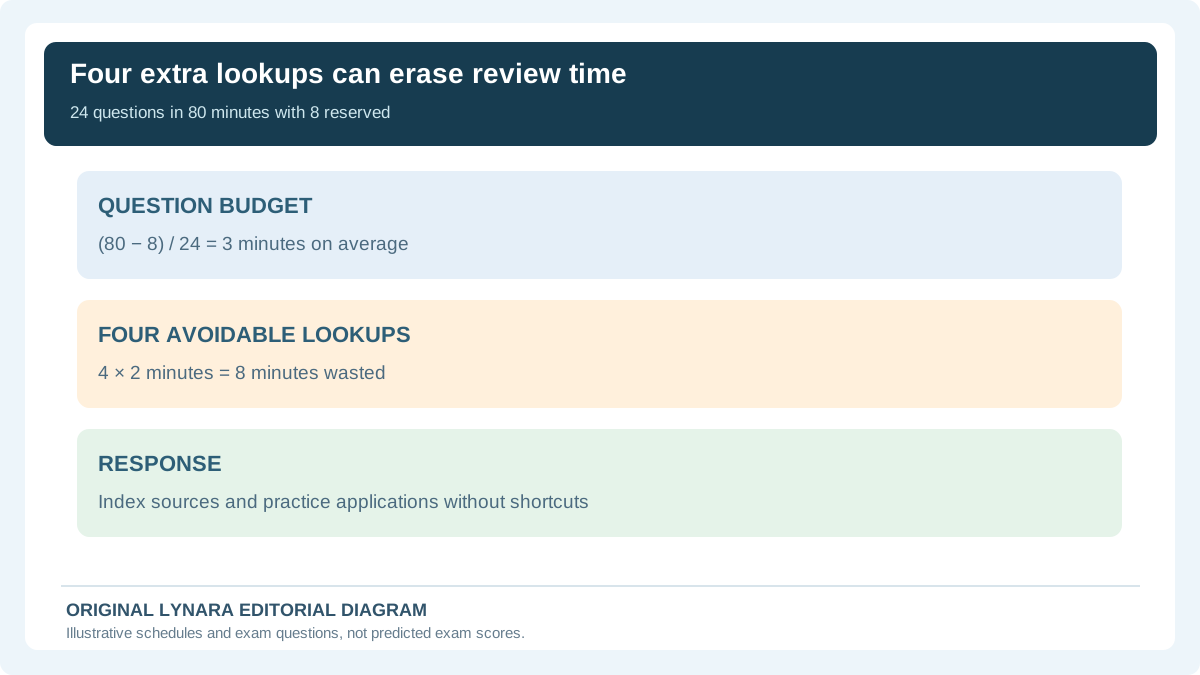
Suppose an exam has 24 questions, lasts 80 minutes and you reserve eight minutes to review your work. That leaves 72 minutes, or an average of three minutes per question. Use the Exam Time Per Question Calculator to test your own exam's numbers. This is an average, not a rule that every question deserves exactly three minutes. A short factual question may take 30 seconds; a multi-step problem may need six minutes. The important insight is that four unnecessary two-minute searches already consume eight minutes—your entire review reserve in this scenario.
During practice, label questions know now, need one check or need a full solve. Answer the first category efficiently, use the index for the second and consciously budget the third. If the real assessment has separate sections or individual timers, those constraints override a single average. Practice using only approved resources; a timed rehearsal with internet search when the exam bans it provides false confidence. Cornell's practice-exam guidance also recommends matching test conditions as closely as practical.
Make the reference material faster, not bigger
Print or prepare bookmarks for key tables and formulas only if the examination permits it. Give files descriptive names and headings that match the course language. A file called Lecture 14 FINAL v2 is harder to search than Week 7—Regression Assumptions. If physical tabs are allowed, use a small number of meaningful labels rather than a rainbow of indistinguishable markers. Do not write a full answer script that is too cumbersome to navigate. A reference aid should minimize searching, not become another task that must be read.
Check that external links or embedded material will be available under exam rules. If your source is a licensed textbook, use the permitted copy rather than distributing copyrighted extracts. Keep the relationship between your notes and source material clear; if you need an exact quotation, identify the page and check it directly. If digital accessibility tools are necessary, confirm the approved setup with the institution in advance. Practical preparation includes both academic knowledge and the logistics of accessing that knowledge.
Be careful with AI summaries and practice questions
An AI assistant may help brainstorm practice prompts when your course policy allows it, but it can invent quotations, oversimplify theories or produce wrong answer keys. Verify every generated factual answer against the instructor's materials or an authoritative source. Do not assume that an open-book designation also permits generative AI during the examination. Keep any disallowed assistance entirely out of the assessment. If your instructor permits AI during preparation but requires disclosure, follow that requirement honestly.
Our AI Claim Verification Tracker can help you record whether a draft claim has been checked; it does not fetch evidence or declare a claim true. The safest study process starts from the course's real documents. If an AI-produced explanation disagrees with the textbook or lecturer, investigate the discrepancy rather than choosing whichever answer sounds more polished. The point of practice is to improve your reasoning, not to produce the prettiest stack of notes.
The night before and the final five minutes
Check the exam brief, permitted materials, charged devices if applicable, location or login details, and any stated time zone. Complete one short retrieval check rather than rebuilding the entire notebook. On the exam, scan directions before answering, notice point values and keep an eye on your time. If you need to look something up, be specific about what you are looking for; stop searching when the required fact is verified. Leave a short review interval if the format allows it. Afterward, note which questions consumed excessive searching so you can improve for the next exam.
A rehearsal that tests understanding and the reference index
An open-book assessment is not permission to search every answer from scratch. A student preparing for an invented introductory economics exam can create a one-page index with “opportunity cost: Week 2 notes, pages 31–37” and “elasticity: Week 5 worksheet, example 3.” Those locations are fictional, not directions for a real course. The actual index must point to permitted editions and authentic page locations. When a practice problem asks for a comparison of two options, try solving it from understanding before searching; use the index to confirm a rule or a numerical definition rather than copying an unrelated textbook paragraph.
| Activity | Minutes | Verification |
|---|---|---|
| Diagnose weak topics | 60 | Use unfamiliar questions and mark errors |
| Active practice | 180 | Retrieve first, check afterward |
| Authorized reference index | 90 | All locations match actual allowed materials |
| Timed mixed questions | 75 | Follow real exam resource restrictions |
| Fix specific errors | 45 | Rework new problems without a hint |
These blocks add to 450 minutes, or 150 minutes on each of three available study days. They are adjustable if the diagnostic shows more need for practice than indexing. Cornell's Learning Strategies Center explains that open-book exams often ask students to apply and analyze material, so understanding and organized approved references matter more than carrying the largest volume of notes. Its practice-exam guidance recommends simulating real permitted conditions.
For a separate fictional exam, 80 minutes minus an eight-minute review interval leaves 72 minutes. At 24 questions this is an average of three minutes per item, not a command to divide time equally across difficult and easy questions. Four unnecessary two-minute searches would consume eight minutes, which is the entire review reserve. Label an unfamiliar question as requiring a source check, navigate directly to the authorized paragraph, then return to solving. If using AI, other websites or communication is prohibited, do not use them during the assessment merely because the exam is open-book.
Record the lookup time and unanswered questions during a rehearsal. The Exam Time Per Question Calculator can check pacing, and the Revision Schedule Calculator can adjust planning assumptions. Neither guarantees an examination score. If course rules are ambiguous, clarify with the instructor in advance rather than inventing a convenient interpretation.
Run a reference-search timing trial before exam day
The earlier 80-minute exam example reserves eight minutes for review and leaves 72 minutes for questions. To test whether your two-level index is genuinely usable, choose four practice questions that require locating an approved reference. Time the lookup without changing the answer or looking at prohibited resources. If the four searches take two minutes each, they consume 8 minutes. If practice and clearer tabs reduce them to 45 seconds each, the same four searches consume 3 minutes, leaving five additional minutes for reasoning or checking. These are invented times for a method demonstration, not a promised performance gain.
| Reference-navigation scenario | Time per lookup | Total lookup time |
|---|---|---|
| Unpracticed index | 2 minutes | 8 minutes |
| Rehearsed index | 45 seconds | 3 minutes |
| Difference | — | 5 minutes |
Record the actual timings and the types of facts that remain hard to locate. Faster lookup is useful only if the answer is still correct and the assessment allows that reference format. Use the Exam Time Per Question Calculator to model your real duration, review reserve and question count rather than copying the example.
How this guide was prepared
Worked times and examples here are fictional planning scenarios. The study-method guidance draws on Cornell's published Learning Strategies Center resources, not a claim that Lynara tested students or can predict exam scores. For calculation transparency, see our methodology.