How to Email a Professor About an Assignment
You don't need a perfect formal speech. You need one clear question, the assignment details and an honest next step.
A useful email should make answering easy
When you need clarification about a homework task or a college assignment, the most helpful email states which class and assignment you mean, the exact uncertainty and what information you have already checked. Most instructors are handling messages from several classes, so a subject line such as “Question about ENG 101 Essay 2 source requirement” is more useful than “Help!!” or an empty subject. Duke University's Academic Resource Center recommends clear subjects, appropriate greetings and concrete context when contacting faculty.
Read the instructions before asking
Open the current syllabus, assignment page and relevant instructor announcements. Sometimes the answer is already written there, and sending an unnecessary message delays your own progress. However, an instruction can genuinely be ambiguous or conflict with another file. When that happens, record the two statements precisely and ask which one governs. The purpose is not to prove the instructor made a mistake; it is to get the next decision you need to do the assignment properly.
Include your course and section
An instructor may teach the same subject several times in one term. Mention your course title or code and section, the assignment name and the due date if relevant. Introduce yourself respectfully without writing a long autobiography. If your institution provides a preferred contact method or office hours, follow it. Indiana University's student email guidance recommends concise purpose, identifying details and brief paragraphs.
Example: clarification about the number of sources
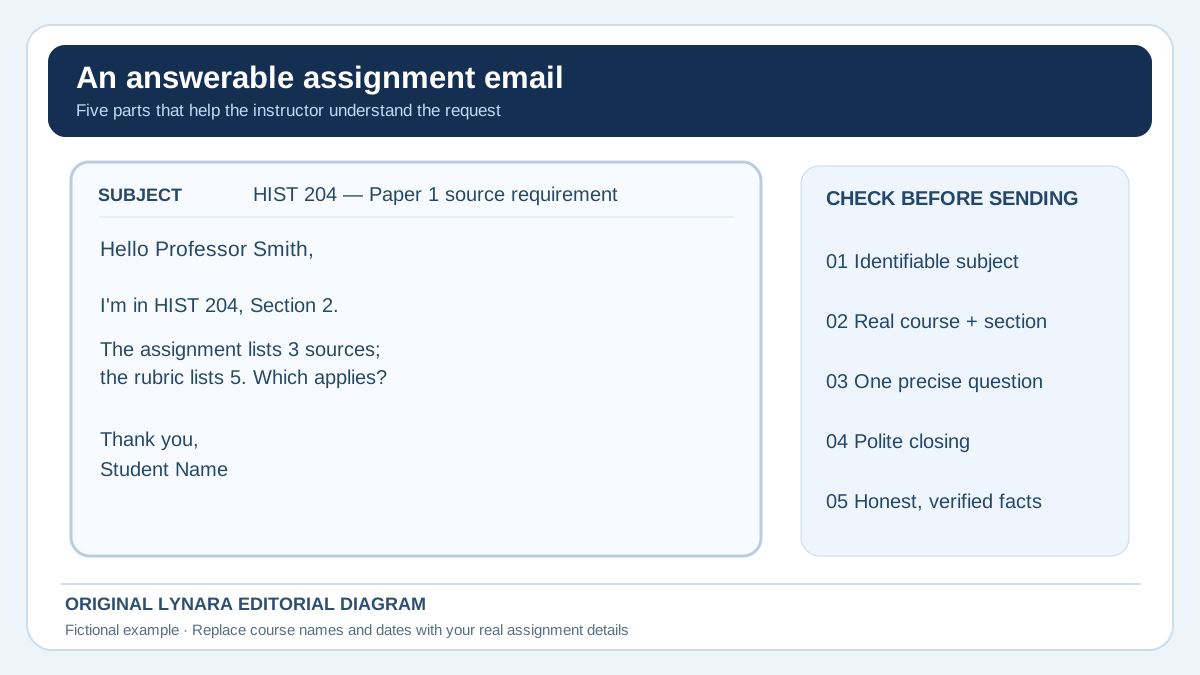
Suppose an assignment page requests three academic references while a newer rubric lists five. A good subject is “HIST 204 — Research Paper 1 source requirement.” The body could say: “Hello Professor Smith, I'm in HIST 204, Section 2. The assignment instructions mention three academic sources, but the rubric lists five. Which number should we follow for Friday's submission? Thank you for clarifying. Best, [Student name].” This is a fictional example; it does not claim to be a real university policy. It asks one concrete, answerable question.
Example: asking for an extension honestly
An extension request should name the assignment, current deadline, proposed new date and whether any portion of the work is finished. If you have a legitimate reason to share, describe it as much as you are comfortable and as school policy requires. Do not invent an emergency or medical claim. A respectful request might be: “I'm requesting an extension for the analysis paper currently due Thursday. Would submitting it by Saturday be possible? I've completed the sources and outline, but need more time to check the calculations. I understand if the original deadline must apply.” A request is not an automatic entitlement to more time.
See how a vague email becomes answerable
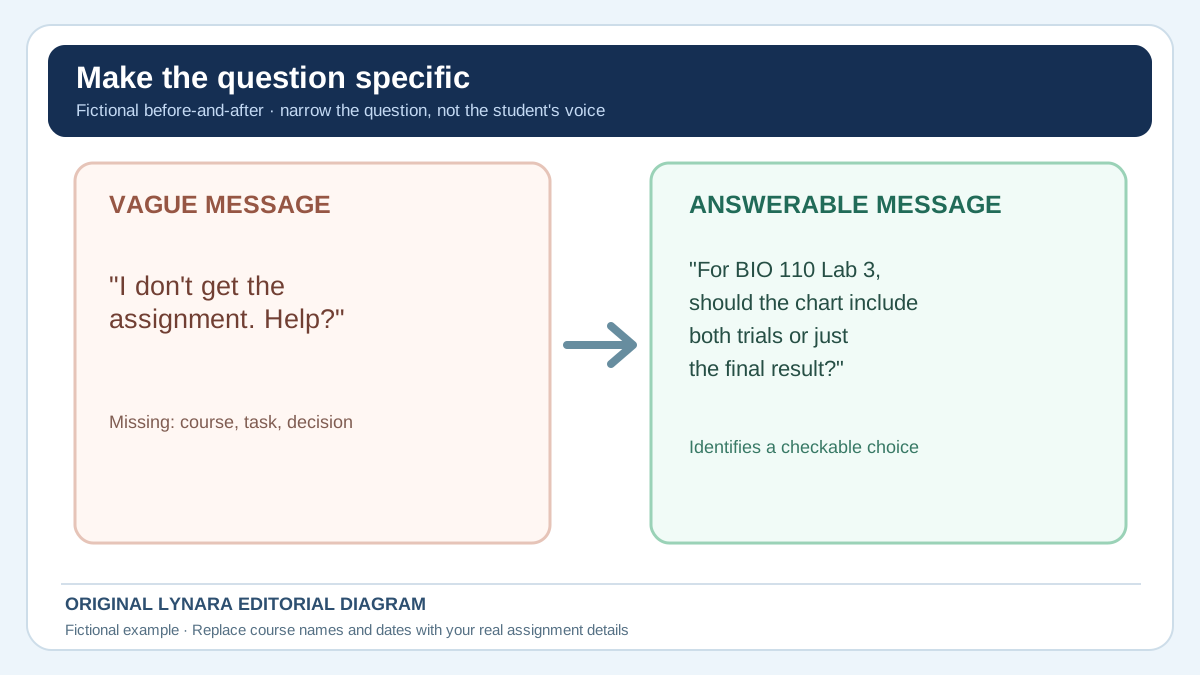
Short emails can still be hard to answer. The difference is usually not formality; it is missing context. Consider these entirely fictional before-and-after examples:
| What the draft says | A clearer version | Why it helps |
|---|---|---|
| “Hi, I don't get the assignment.” | “For BIO 110 Lab 3, does the graph need both trial results or only the final measurement?” | The instructor can answer one identifiable question. |
| “Can you give me more time?” | “Could I submit the ECON 201 reflection on Monday instead of Friday? I can send the completed outline today.” | The request contains dates and a concrete plan, without assuming permission. |
| “Why was my grade bad?” | “On the Essay 2 rubric, could you explain the comment about missing counterevidence in paragraph three?” | It asks about an actionable skill rather than demanding a different mark. |
Keep the message truthful. The course numbers and circumstances above are examples to replace, not details to copy into a real email.
When the assignment is already late
If you missed the deadline, acknowledge it without blaming the professor or fabricating a technical failure. Ask whether late submission is possible under the stated policy, and follow the response. Some systems accept files after the deadline; others require an exception or do not accept late work. Avoid flooding the instructor with repeated messages. A clear first message identifying the course, assignment, missed deadline and requested next step makes an appropriate response easier. Central Georgia Technical College's academic-support FAQ includes examples for extension, late work and assignment clarification.
Asking about feedback is different from grade bargaining
If a returned paper contains comments you do not understand, ask about the actual rubric criterion and a practical learning point. For example, “Could you explain where my analysis did not connect the evidence to the claim in paragraph four?” is more constructive than “Why did you mark me down?” State which assignment and comments you mean. If you need a formal grade appeal, follow the institution's process rather than assuming an email to the professor substitutes for it.
Keep the tone plain and professional
Professional does not mean excessively formal. A short greeting, two or three clear sentences, a specific question and a thank-you are often sufficient. You do not need to add several paragraphs praising the professor or apologizing for existing. Avoid all-capital subjects and urgent language unless the matter is genuinely time-sensitive. Proofread names, dates and course identifiers before sending. A sentence written in your own natural voice is usually better than a generic AI-generated message that invents circumstances or obligations.
When there are several questions
Separate them into numbered questions if they are truly distinct and necessary to complete the same assignment. If the message would become a page of instructions, ask for office hours or a meeting through the course's approved channel. Consider grouping overlapping questions into one clear issue. For example, source-count and allowed source type may be related; questions about scheduling and grades may belong in a separate email. Do not paste the entire assignment into an external service if student data or academic materials are restricted.
Use Lynara tools to prepare—not fabricate—the message
Our AI Assignment Workflow Builder can help plan legitimate next steps based on the user's declared AI permissions; it does not send email or create excuses. The Word and Character Counter can check a long draft when the message needs tightening, and Reading Time Calculator can estimate how demanding a message may be to read. These are supporting tools; a teacher-email guide itself does not need a separate fake “AI email detector.” If AI drafting is not permitted for the assignment, follow the actual restriction.
Common errors that waste everyone's time
A subject of “Question” lacks context. Referring to “the worksheet” without a course name forces the recipient to guess. Sending a screenshot without describing what to look at makes the issue harder to answer. Asking “What do I do?” without mentioning which step is unclear may require several follow-ups. Providing a false account of a deadline or technical issue can undermine trust. Finally, saying “reply immediately” rarely helps. Clarify the actual decision and give the instructor normal professional time to respond.
If you have not heard back, send one useful follow-up
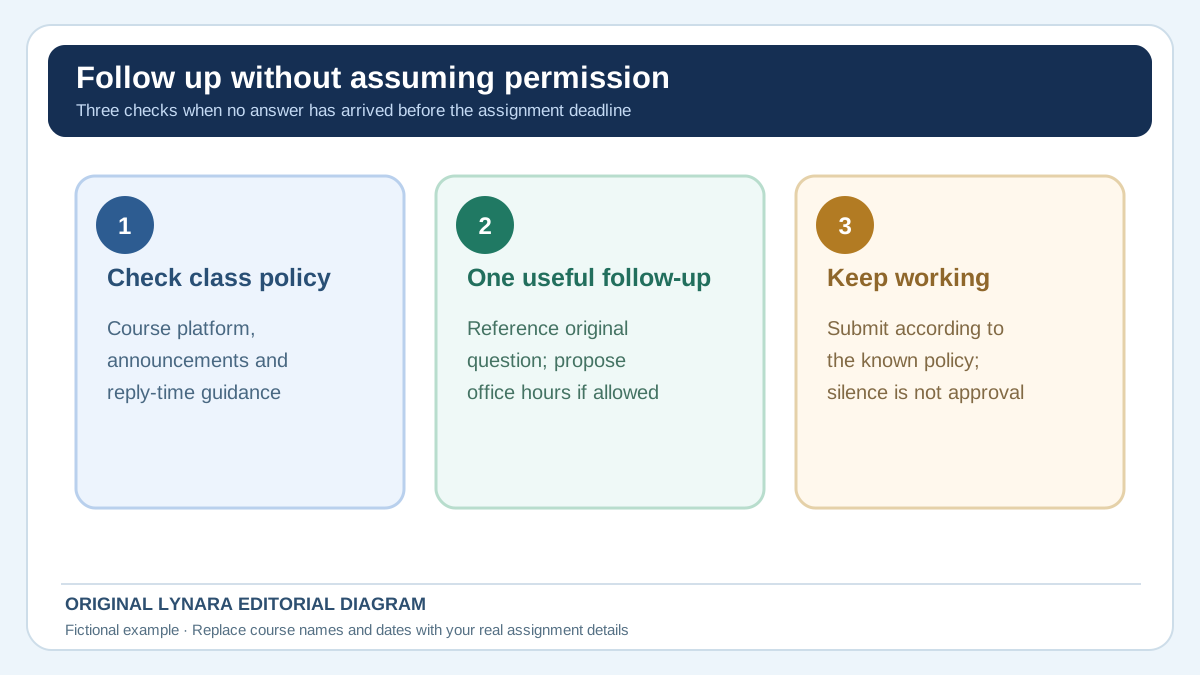
First check your course platform for an announcement or reply in another approved channel. If there is still no answer after an appropriate amount of working time, a polite follow-up can refer to the original message without repeating the whole story. For example:
Subject: Follow-up: CHEM 102 Lab Report 4 citation question
Hello Professor Lee,
I'm following up on my message from Tuesday about whether Lab Report 4 needs citations for the provided dataset. The report is due Friday, and I want to follow the instructions correctly. If it's easier, I can bring the question to office hours.
Thank you,
[Student name] — CHEM 102, Section 3
These names and dates are illustrative. Check the instructor's response-time policy first; do not send several reminders in a single day. If the deadline arrives before a reply, complete the parts you can confirm and follow the published submission policy. Do not treat silence as approval for an extension or a change to the rubric.
What to do if the reply does not resolve the conflict
Sometimes an instructor replies with a link to the same document that raised your question. Read the specific paragraph again and check whether you overlooked a date, exception or separate category of sources. If the conflict remains, reply in the original thread with two short quotations of the conflicting requirements and one neutral sentence about the decision you still need. For example, “The PDF says three peer-reviewed articles, while the rubric says five academic sources. Should I use five peer-reviewed articles for the final submission?” This is more useful than restarting with an emotional account of why the wording is confusing.
If the assignment is due soon and a definitive reply has not arrived, do not assume that the more convenient interpretation is automatically allowed. Check the syllabus or course support channel for a stated procedure, complete the parts of the work that are unambiguous, and keep a dated copy of your original clarification request. If you must choose a reasonable interpretation to finish the work, document what you followed without claiming the instructor endorsed it. An accessibility-related or formally approved accommodation question belongs in the institution's designated process rather than a public group chat. These steps reduce confusion, but the institution's actual policies and any direct instructor instruction take priority.
How to finish with a clear action
Before pressing send, verify that the assignment instructions have been checked, the subject identifies the course and task, the question has one interpretable answer, any requested extension is specific and honest, and your closing identifies you. Use the class's approved contact address instead of guessing an email. If the response changes your plan, update your own study planning tools when available, or use the course calendar, with the real confirmed date. Effective communication is a small, practical study skill: it removes uncertainty without pretending to solve the academic work itself.