Compare Supplier Quotes With AI Without Inventing Prices
Three vendor PDFs can look easy to summarize. The expensive mistakes usually hide in quantity breaks, missing delivery costs, different specifications and facts that the AI filled in itself.
Make the buying decision first, then let AI organize the paperwork
Imagine a small online business ordering branded packaging for its next sales cycle. The owner asks three suppliers for quotations and receives a short email, a multi-page PDF and a spreadsheet. An AI assistant can quickly produce a comparison table. That sounds like a useful time saver until the cheapest row turns out to require a larger minimum order than the business needs, and the assistant quietly replaces an empty shipping field with an estimated amount. The table looks complete. The underlying purchasing decision is not.
The useful role for AI here is clerical: propose a consistent list of fields, flag missing answers and help write follow-up questions. The actual evidence remains the supplier's current written offer, product specification and formally approved terms. The buyer is responsible for deciding whether the items are equivalent and whether a vendor is legitimate. This is an especially important distinction for a one-person company, where the person reviewing the AI output may also be the person approving payment.
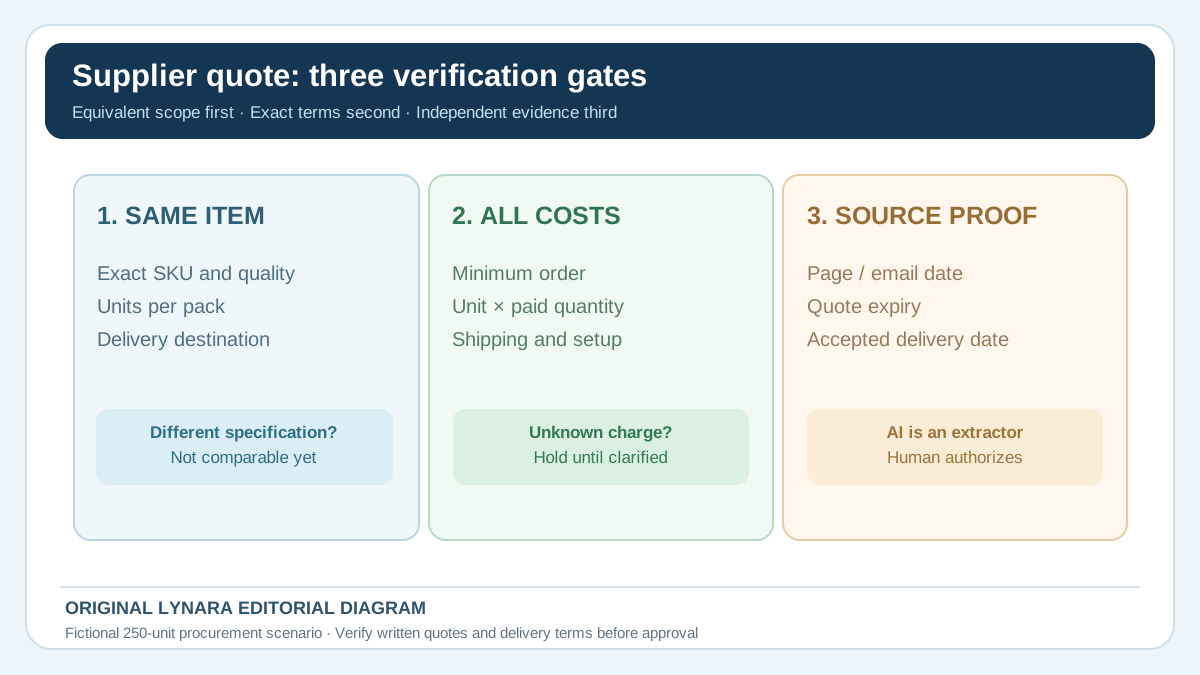
Before you compare anything, write a purchasing brief that says what you need in your own words. Record the required item or service, usable quantity, acceptable substitutions, quality conditions, delivery destination, latest acceptable delivery date and whether you need installation or support. A supplier's quote should be evaluated against that brief. Without it, the assistant may rank three different products instead of three ways to obtain the same one.
Build a source-backed quote table
Create one row per supplier and one column for every decision-changing detail. At minimum, capture the exact item or SKU, quantity, unit of measure, currency, unit price, minimum order quantity, shipping, setup or tooling fees, tax treatment, expected lead time, quote expiry, payment terms, warranty or return conditions and the name of the person who supplied the quote. Keep a final column for the location in the original document: page number, line, email date or attachment name.
Some vendors quote by item, others by pack, pallet or hour. Normalize units only when the contents are genuinely equivalent. A carton containing 48 pieces is not automatically comparable with a box labeled “approximately 50.” Similarly, an offered service rate without a defined scope cannot be translated into a fixed project total by multiplying guessed hours. Mark such rows not comparable yet and ask the supplier for clarification.
Do not ask a language model to invent what an empty cell “probably means.” Use one of three statuses for each field: verified from the quote, clarified directly by the supplier, or still unknown. A conditional discount is not a guaranteed price; a shipping estimate is not an accepted shipping charge; and a listing on a vendor's website is not proof that the specific quoted product will be in stock when you order. If a quote is old, request an updated one before using its prices to approve spending.
For any comparison that will be shown to a manager, attach or retain the source documents. You can use Lynara's AI Claim Verification Tracker to record each AI-generated statement and the original evidence you personally checked. The tracker organizes your verification notes; it does not fetch or authenticate the documents on your behalf.
Worked example: the lowest unit price is not the lowest useful order
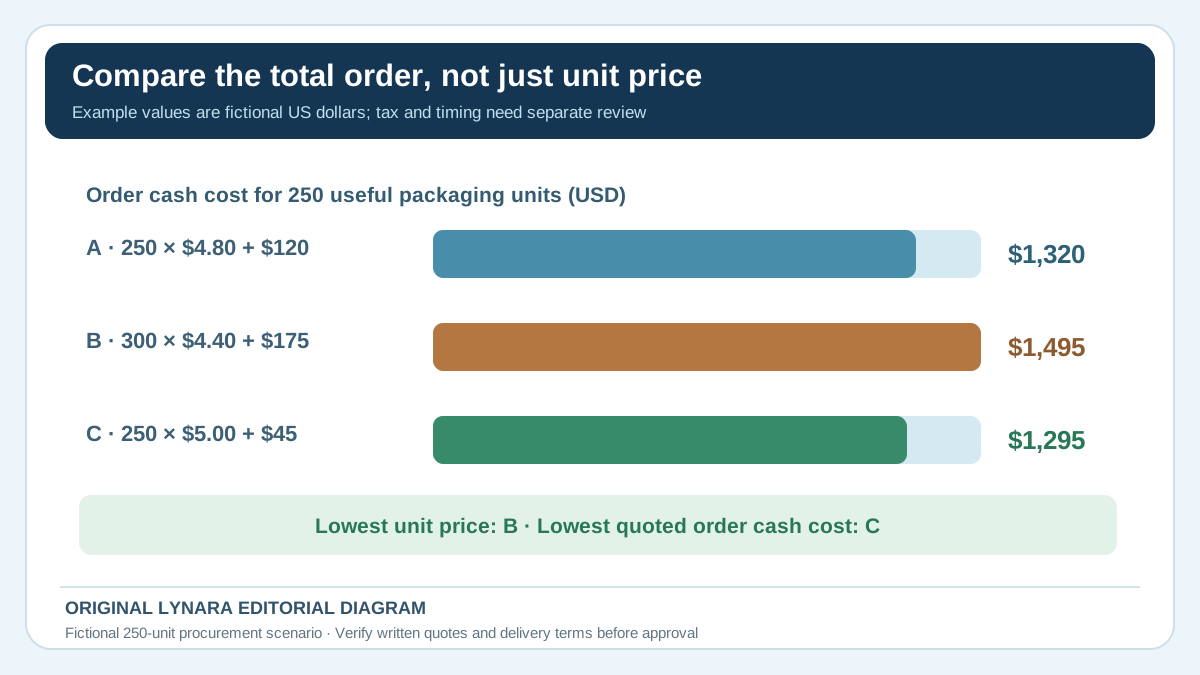
Suppose the business needs 250 usable packaging units. Three fictional suppliers have quoted the same verified specification, and all prices below are illustrative US dollars. Assume tax is excluded from all three quotes, and do not treat these numbers as market rates:
| Fictional supplier | Minimum order | Unit price | Shipping + setup | Order cost |
|---|---|---|---|---|
| A | 250 units | $4.80 | $120 + $0 | $1,320 |
| B | 300 units | $4.40 | $95 + $80 | $1,495 |
| C | 250 units | $5.00 | $0 + $45 | $1,295 |
Supplier A costs 250 × $4.80 + $120 = $1,320. Supplier B advertises the lowest unit price, but the minimum purchase is 300 units: 300 × $4.40 + $95 shipping + $80 setup = $1,495. Supplier C comes to 250 × $5.00 + $45 setup = $1,295. On those deliberately simplified, equivalent-scope assumptions, C has the lowest immediate cash cost—even though its advertised unit price is highest.
If the business cannot use the 50 extra units from B, the immediate order cost divided by the 250 units actually needed is $5.98 per useful unit. That is different from dividing $1,495 by the 300 units purchased (about $4.98 per purchased unit). Both ratios have meanings, but they answer different questions. A fair table should label its denominator instead of hiding it. If those 50 extra units are likely to be used next month, the buyer should model that separately rather than assuming they are either worthless or certain to sell.
The example also assumes all three suppliers can meet the required delivery date, print quality and refund terms. If C's lead time misses an important launch, its $25 cash advantage over A may not outweigh the disruption. Do not invent a financial value for delay unless the business has evidence for that cost. The right conclusion can be “A and C are close on quoted cash cost; confirm delivery and defect handling before choosing.” That's a real decision, not an incomplete answer.
Check the fee that could reverse a close supplier decision
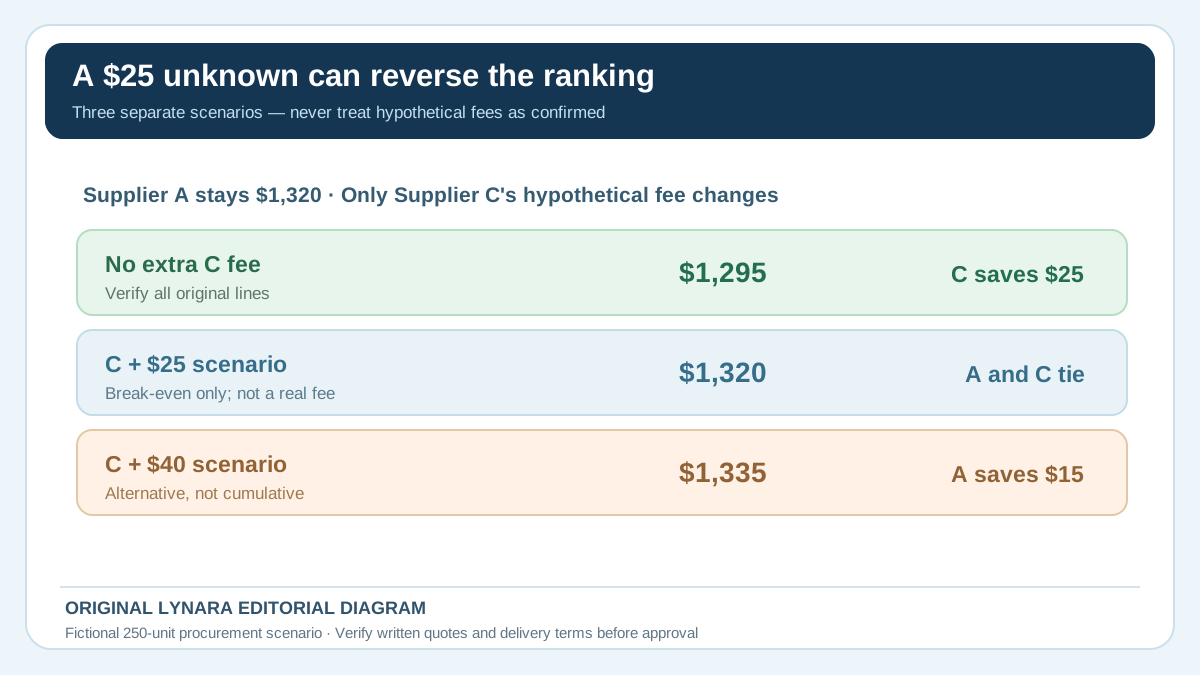
The fictional comparison above leaves Supplier C only $25 cheaper than Supplier A ($1,295 versus $1,320). That small difference makes one unanswered shipping, artwork, rush or handling charge decision-changing. Instead of asking an assistant to guess the missing number, test a few clearly labeled alternatives and request a written answer from the supplier.
| Scenario for C | C total | Cash-cost comparison |
|---|---|---|
| Original verified lines only | $1,295 | C is $25 below A |
| One additional $25 charge | $1,320 | A and C tie |
| One additional $40 charge instead | $1,335 | A is $15 below C |
Check the break-even arithmetic: $1,320 − $1,295 = $25. If a new fee applies only to C, a confirmed extra $25 erases its price advantage; an extra $40 would make C $15 more expensive than A. The two extra-fee rows are alternative possibilities, not charges to add together. If A also changes its freight, lead time or specification, recalculate both totals rather than reusing the old threshold.
This is a sensitivity test, not a claim that C has any undisclosed fee. Record the unanswered term as UNKNOWN until the supplier clarifies it. A final choice still needs equivalent specifications, actual required units, a valid delivery window and approved payment conditions. Enter only verified supplier lines in the Supplier Quote Comparison Checker; a mathematically cheapest row with material terms missing is not a purchase authorization.
Use AI to expose differences, not erase them
A useful prompt is tightly bounded: “Compare only the attached, approved supplier quotes. Extract exact quoted fields into a table; include the document location for every price and condition. Mark missing values UNKNOWN. Do not estimate shipping, taxes, lead times, discounts or quantities. Identify any different specifications or order minimums that prevent a fair comparison. Do not recommend payment or contact a supplier.” A business should run that prompt only in a tool it has approved for the data involved. If vendor documents contain confidential pricing, personal contacts or contract terms, check permissions and retention rules before uploading them. Our AI vendor approval guide covers that decision.
Review the output by sampling easy fields and then deliberately checking the risky ones: decimal places, currencies, one-time fees, shipping and the exact quantity break. A frequent extraction mistake is to treat a pack price as a unit price. Another is to copy the first visible subtotal and miss a later surcharge. Those are precisely the errors that can reverse a purchasing decision while leaving the AI table looking polished.
Have a named person confirm every quote's status. The reviewer should be able to point to the page or email supporting each statement. If the assistant reports that Supplier A offers free delivery but the original quote says only “delivery to be confirmed,” change the table back to unknown and request confirmation. Do not ask the AI to resolve that contradiction by guessing which statement was intended.
Verify the supplier before approving an invoice
A convincing quote does not prove that a vendor is genuine. Unexpected invoice emails, urgent account changes and unfamiliar payment instructions require a separate check. The FTC's small-business scam guide recommends clear purchase and invoice approval procedures and highlights fraudulent invoices as a common risk. Its 2026 small-business invoice advisory specifically describes bills for goods and services that were never ordered.
For a new vendor, have a human verify the business using independently located contact information. Confirm the purchase order, delivery details and payment instructions through an approved channel before any money moves. The comparison table is not an authorization to send a bank transfer. Be especially cautious if a later email asks you to change payment details, even when the branding and signature look familiar. Your company should follow its established controls or professional advice for high-value payments.
After the purchase, retain the approved quote version and record which terms were accepted. This matters when a supplier later sends an invoice with a different price or bills for freight that was supposed to be included. A short decision log—who approved what, when, and from which document—gives staff a clear reference without turning the AI output into the official contract.
A repeatable review for small teams
Keep the process small enough that staff will actually use it. First, write a five-line purchase brief. Second, collect the quotes and check that they are current. Third, extract the same fields into a comparison table with source references. Fourth, calculate realistic order quantities, minimums and explicit fees. Fifth, flag specification differences and unknown values. Sixth, contact suppliers for missing terms through verified channels. Seventh, have the authorized buyer sign off on the final table and store the approved version with the purchasing record.
If you repeat this work every week, time a manual comparison and a supervised AI-assisted comparison before paying for automation. Include the minutes spent rechecking AI extraction errors, securing vendor information and asking the same clarification questions. Use our Business AI ROI Calculator to model that verified review time and software cost separately from purchasing savings. A cheaper quote is not a productivity gain created by AI, and a faster draft is not a financial return until someone measures the whole workflow.
The most valuable output is rarely a dramatic recommendation. It is a short, defensible decision: which offers are truly comparable, what each would cost for the actual required order, which terms still need confirmation, and who has authority to approve a purchase. If AI saves time producing that evidence trail, it earns its place. If it obscures missing facts behind a professional-looking table, manual review remains the better choice.
Check minimum orders and quote totals yourself
Enter the figures into our free Supplier Quote Comparison Checker. The tool calculates the cash cost of buying enough units after minimum orders and explicit fees. Unverified offers remain on hold, so a low computed price never becomes an automatic approval.