AI Homework Helpers: Compare Tools by Actual Task
Some AI tools return complete answers; others help you reach an answer. The most efficient choice depends on whether your task is calculation, explanation, writing or source checking.
The homework question matters more than a popularity ranking
Students look for AI that can do homework because a deadline is close, a question is confusing or a worksheet is repetitive. An answer generator may indeed return a solution quickly. But different tasks make very different demands on accuracy. A numerical algebra problem can often be checked by substituting the answer into the original equation. An essay argument requires reliable evidence, a clear thesis and individual judgment. A science report cannot use a generated result in place of observations. Comparing all AI homework helpers as though they solve the same problem leads to misleading recommendations. A more useful approach asks what the student needs: an answer to check, a hint to get unstuck, a worked method, feedback on their own draft or a way to organize information from provided documents. It also asks what assistance the assignment allows. This is not a claim that students must spend longer than necessary. It is a practical way to avoid wasting time redoing work because an apparently confident AI response was wrong, unsupported or outside the teacher's rules.
Photomath: an identifiable tool for numerical problems
Photomath is designed around recognizing mathematical input and showing solution steps. According to its official product overview, it can analyze photographed mathematical problems, while the input guidance describes correcting a scan when the problem was read incorrectly. That last point is important. A photographed minus sign, fraction bar or exponent can be interpreted incorrectly, so an impressive solution to the wrong expression is still the wrong homework answer. A sensible use is to solve a problem yourself, scan or enter it, and compare intermediate steps. If you get a different result, locate the exact transformation where the two paths disagree. With equations, substitute the candidate solution into the original expression. If the question contains verbal conditions, inequalities or a domain restriction, check them separately. Photomath's availability and advanced features may depend on region and plan; use the current provider documentation for details. The app is not a replacement for understanding the meaning of the problem.
Khanmigo: a tutor that deliberately changes the interaction
Khan Academy describes Khanmigo as an AI tutor that guides learners toward a solution instead of routinely providing direct answers. That can be useful when a student wants to finish an assignment independently but is stalled on the first step. Rather than returning a complete worked answer, a tutoring prompt can ask the learner what operation belongs next or request an explanation of a mistaken assumption. This process may feel slower in the first minute but can prevent repeating the same error on the next question. Khanmigo's eligibility, plan, parental and geographic conditions must be checked in the current provider information. Do not assume a classmate has access because a teacher account does. It is not necessarily the right choice for someone who already solved a problem and only wants to verify the final number; a specialized calculator may be faster for that. Its distinctive value is in guided practice and context, not a magical claim that tutoring always beats other tools or produces a guaranteed exam score.
General chat assistants: flexible, but not authoritative
Conversational AI assistants can explain a concept in several ways, create a practice question, critique a paragraph or reorganize a schedule. That flexibility is attractive, especially for mixed assignments that combine math, writing and research. It is also the source of risk. A chat response can invent a source, misinterpret a screenshot or make an algebraic slip while sounding persuasive. A broad assistant has not checked a teacher's private grading rubric unless the user supplied it accurately, and it should not be assumed to know a school's current policy. To get useful help, specify the subject, grade level, exact question, what you have tried and the kind of response permitted. Ask for the next step or error explanation when the goal is mastery. Ask for a clear provisional solution and a method to verify it when the task explicitly permits using generated answers. If the assistant supplies a citation, find the actual article or textbook page before using it. For homework that includes personal student data, remove identifying information before sharing documents with any outside service.
Three homework tasks, three different kinds of assistance
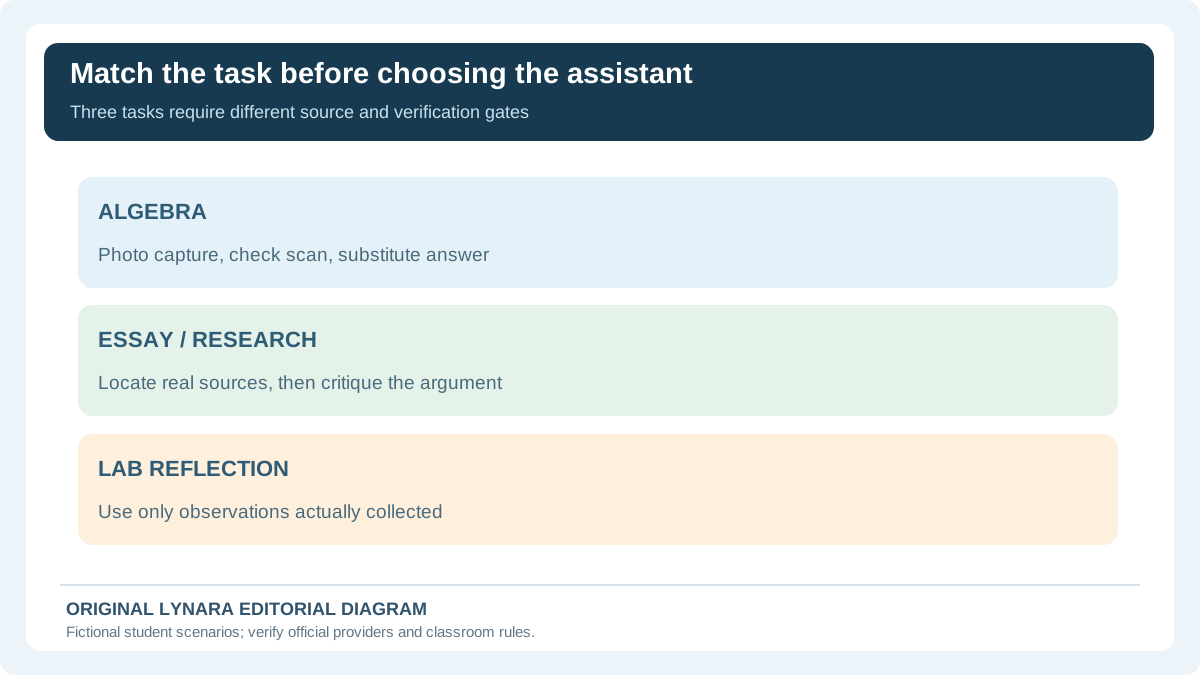
Imagine one student has three assignments due tomorrow: a photographed equation, a paragraph comparing two historical sources, and a short lab reflection. Treating them as interchangeable prompts would be a mistake. For the equation, a photo-based math tool may help transcribe the expression and expose missing steps, but the student must compare the transcription with the original and substitute any candidate answer. For the history paragraph, the priority is locating authentic sources, extracting evidence and checking that opposing claims are represented fairly. A model that produces a polished paragraph without verifiable references has not solved the research problem.
The lab reflection is different again: the student has their own actual observations, and an assistant may help organize an explanation but must not invent measurements or describe an experiment it never witnessed. A simple decision table can record the assignment, permitted use of AI, evidence source, desired kind of help and final verification. For the equation, see our specialized worked math-solver guide, which shows detailed equations, systems and cases with extraneous roots. Keeping those derivations in the specialist article avoids repeating the same algebra lesson in a broad homework-tool comparison.
Writing assignments: feedback and drafting are different
For an essay, AI can suggest possible argument structures, identify where a paragraph lacks evidence or point out unclear transitions. Those are useful tasks, but they do not demonstrate that an article cited by the model exists or that its claim is accurate. A prompt asking the assistant to write a finished 1,500-word essay is not equivalent to a prompt asking it to test whether your thesis addresses the assignment. The second can help the student improve a defensible piece of work with fewer revisions. A practical workflow starts with a thesis in the student's own words. Ask the AI for three possible objections to that thesis, then check which objections are supported by course reading. Draft one paragraph, request feedback on clarity and whether the evidence actually proves the claim, and edit it yourself. If AI-generated text is allowed in the assignment, document that use as required. If it is prohibited, use permitted non-generative references and instructor feedback instead. Our writing tools can help organize text without claiming to certify an essay's factual correctness.
Research questions and the fabricated-reference problem
An assistant that quickly produces five academic-looking references may be worse than a slower search that finds two real, relevant publications. Verify a research citation by locating the source, checking author, publication date, title and DOI or other identifiers, then reading enough to establish that it supports the claim. A DOI is useful for finding and identifying a publication, but a syntactically valid identifier does not prove that the paper is reliable or relevant. When a teacher asks for research-based work, separate gathering sources from writing an answer. Create a short evidence table with a claim, the source that supports it, a quotation or page note where permitted, and the conclusion you draw. Then use AI to challenge gaps in your reasoning rather than to invent the evidence. Lynara's citation generators can format verified metadata. They cannot make a fabricated publication authentic. Verification is often the fastest way to avoid a costly rewrite at submission time.
Homework time saved: account for checking, not just generation
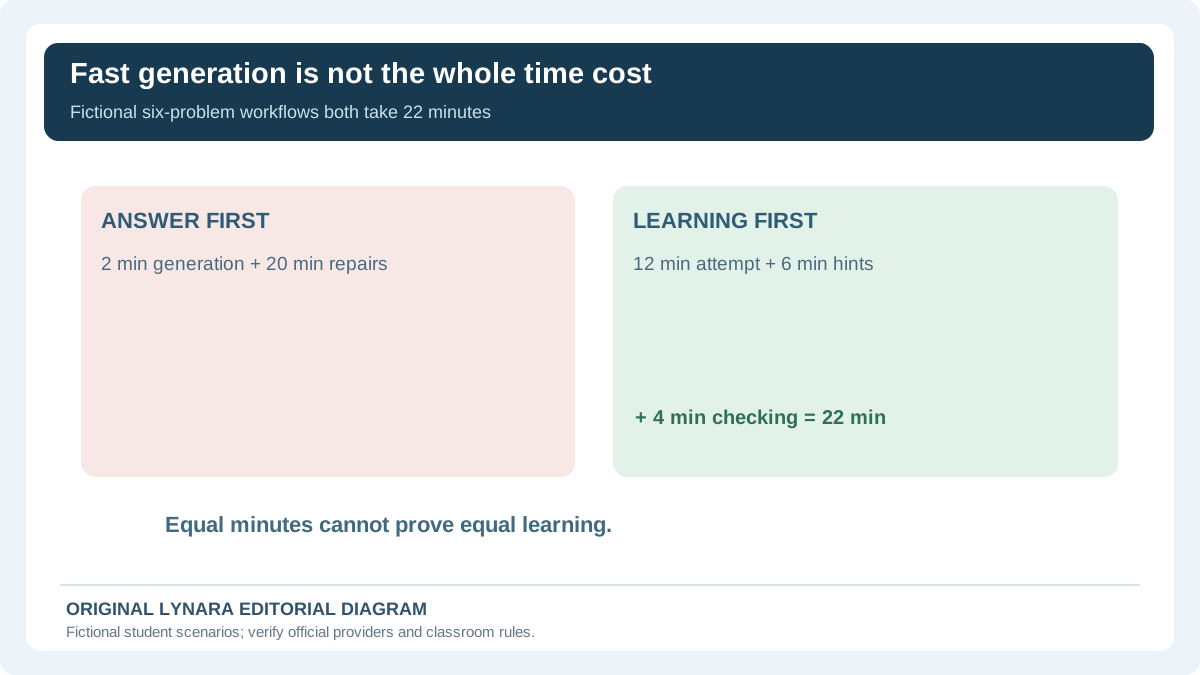
Suppose two hypothetical students face six problems. Student A spends two minutes asking AI for answers to all six, then twenty minutes trying to understand and correct three flawed steps before the assignment is usable: 22 minutes in total. Student B spends twelve minutes attempting the problems, six minutes asking for targeted hints and four minutes checking the results: also 22 minutes. The second workflow may leave more transferable knowledge, but neither time figure comes from a real experiment. The point is to compare the entire process, including checking and correction. If a student genuinely needs an answer as a permitted reference, a short solution with an independent verification step can be efficient. If the question will reappear in a test, spending a few more minutes on the method can save time later. Keep a record of which question types repeatedly cause trouble. One useful question for an AI tutor is 'Show me a similar problem with different numbers after I finish this one.' That tests whether assistance created a reusable skill rather than a single completed worksheet.
Which helper should you choose?
Use a math-specific application when recognizing and checking a supported numerical expression is the core task. Use a tutoring-oriented system when you need guidance without immediately seeing a final answer. Use a general assistant for explanations, draft feedback and cross-subject planning, while verifying factual claims with real sources. Use the school's own library, textbook and assignment instructions when the task requires authoritative evidence or original observations. No product list can replace that match between task and tool. Check age restrictions, availability, payment terms and privacy settings at the provider's current page. Do not upload private classmates' work or confidential school documents without permission. UNESCO's student AI competency framework emphasizes critical judgment and responsible application, which is a useful test for any homework workflow. A tool that produces a fast answer but leaves the student unable to check it is not necessarily the tool that saves the most time across a semester.
Choose the assignment workflow before the assistant
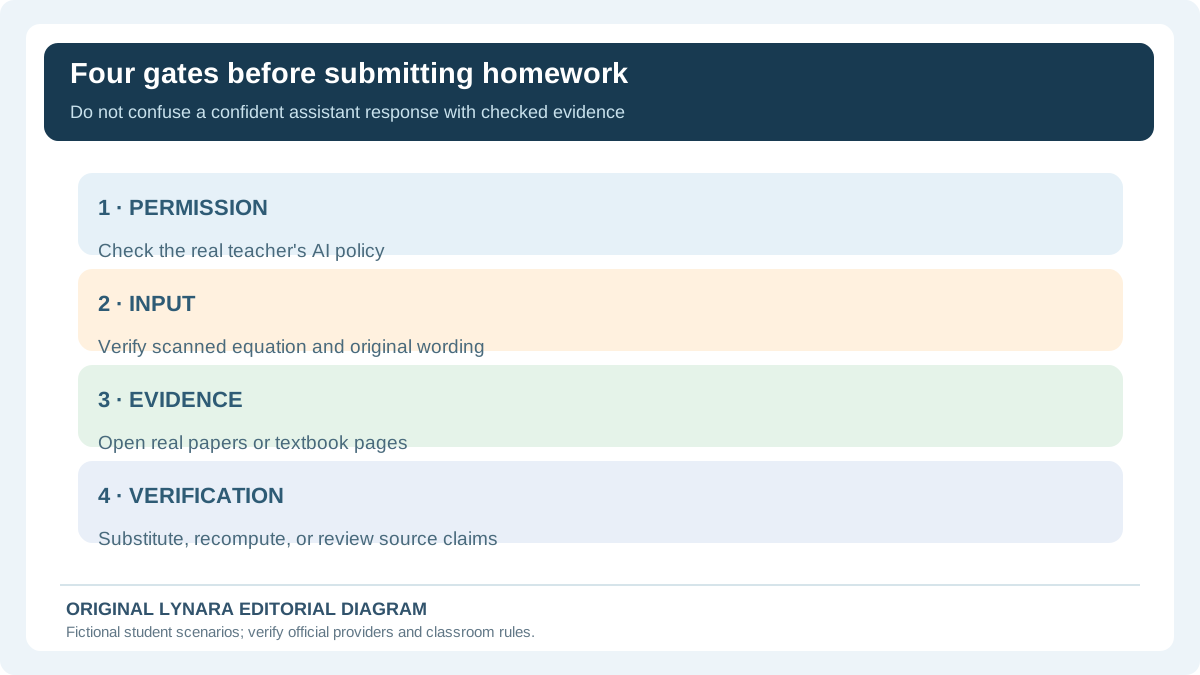
Use our Assignment AI Workflow Builder to record whether AI planning or drafting is permitted and organize genuine source checks. It cannot certify academic compliance or perform the assignment; follow the actual classroom policy.
A concrete tool-selection worksheet for a mixed homework evening
Imagine three assignments due tomorrow: six algebra equations, a comparison of two historical accounts and a lab reflection based on the student's own measurements. The best helper is not the one that produces the most text. For algebra, the immediate need may be input recognition and clear symbolic steps; a photo-oriented solver can help if the scanned expression is checked against the page. A student who needs to learn a method may benefit from a tutor that asks for the next step. For the historical comparison, locating two real, relevant publications matters more than fluent prose. For the lab, no AI system can supply measurements the student never collected.
| Actual difficulty | Appropriate assistance | Human release check |
|---|---|---|
| Algebra input or transformations | Photomath or a supported symbolic checker | Compare input exactly and substitute final answer |
| Stuck on the first reasoning step | Tutoring-oriented hints such as Khanmigo where eligible | Solve a parallel example alone without the hinted answer |
| Essay evidence | Optional outline or critique of the student's own draft | Open the assigned original sources and inspect each claim |
| Science lab reflection | Structure and grammar feedback if permitted | Match every number to actual collected observations |
Do not interpret this table as an empirical ranking. Features, region, age and pricing conditions can change. Photomath's official product explanation says photographed mathematical expressions are processed through its recognition workflow; check that the scan contains the same variables and operators as your assignment. Khan Academy's Khanmigo page describes a guided approach and lists eligibility conditions, which should be checked before recommending the service to a minor or a non-U.S. learner. The provider's claim about its design is not independent evidence of a particular learning gain.
Know when a different tool, or no AI, is the better option
A student may need a textbook definition, feedback from a teacher, or the original data more than another AI answer. For a math problem, first check the course example and attempt the first step. If the issue is reading a photograph, fix the scan and rewrite the expression manually. If the problem is an unknown vocabulary term, use the assigned source rather than asking a model to invent a definition. If you must submit personal observations or original arguments, AI should not fabricate them.
Here is a realistic checking budget, not a claimed result: in a six-question exercise, a student might spend two minutes generating answers and twenty more resolving misread steps. Another might spend twelve minutes attempting, six getting hints and four verifying. Both take 22 minutes—2 + 20 = 12 + 6 + 4. That arithmetic proves neither method improves achievement. A genuine comparison would need repeated independent tests, measured correction time and comparable problems.
Ask the assistant to show where a conclusion came from and be willing to reject its response. For a cited article, open the publication; for a number, recompute the original; for a hint, solve a new example without seeing the answer. See Lynara's verified math-step guide and assignment permission planner for specialized checks. The UNESCO AI competency framework for students emphasizes critical appraisal and responsible use, not blind compliance with a generated solution.
Editorial context
Specific product features are attributed to the official provider sources linked in the text. Any example time budgets, grades and outcomes are hypothetical and do not claim real test results. Check your institution's rules, real source material and applicable privacy requirements. See our editorial policy.