AI Invoice Follow-Ups: Check Payment Facts Before Sending
A reminder that sounds professional can still be wrong. Check the ledger first, let AI help with wording second, and approve the message yourself.
Try the companion invoice checker
Before preparing a message, use the free B2B Invoice Follow-up Checker to reconcile entered payment and credit amounts, flag an unverified or disputed record, and see whether a human-reviewed reminder draft is appropriate. It never connects to your bookkeeping or sends email.
The invoice that looks overdue but has already been paid
A design studio finishes a small project for another business. The agreed invoice is due at the end of the month. A few days later, somebody asks an AI assistant to write a polite payment reminder from a spreadsheet of unpaid invoices. The draft looks reasonable: a friendly opening, the invoice number, a total and a line requesting payment. But the customer paid that morning and the bookkeeping system has not yet matched the deposit. Sending the message as written makes the studio look disorganized and may trigger unnecessary back-and-forth.
This is why AI should be treated as a writing assistant, not the source of truth for accounts receivable. The source of truth is the business's approved invoice and current payment records, including any credits, disputes or agreed changes. The workflow below is for routine business-to-business invoices or freelancer-client invoices for legitimate, agreed work. It is not advice on consumer debt collection, threats of legal action or automatically imposing late fees. Payment rights and communication rules depend on the agreement, transaction and jurisdiction; unusual situations belong with an authorized manager or qualified adviser.
Decide what the AI may and may not do
The narrow, useful task is to turn a verified reminder record into clear, courteous language. The AI may rephrase an opening line, simplify a sentence or prepare two tone options for an account manager to choose from. It should not decide that an invoice is overdue, calculate penalties without an approved basis, move a due date, promise a discount or choose whether a disputed account should receive another demand. Those are account and business decisions. Keeping that boundary clear helps a tiny team use AI without giving the model authority it does not have.
For each proposed send, prepare a minimal set of approved fields: client business name, account contact channel, invoice identifier, original issue date, agreed due date, amount invoiced, confirmed payments and credits, current balance, last contact and any exception status. You might also need purchase-order reference and the agreed service description. Do not feed an entire client folder to a general-purpose model just to produce three sentences. Before selecting a vendor for any client information, follow your organization's data rules and the procurement checks in our AI vendor review guide.
Reconcile the account before writing the reminder
Review the invoice record against bank receipts or the actual payment processor, and check whether a receipt is pending matching. Look for partial payments, credit notes, corrected invoices, a customer query and any negotiated extension. A status flag saying “unpaid” is not sufficient if it comes from a stale export. Confirm the agreed due date from the invoice and relevant contract, not from a model's assumption that every business uses net thirty terms. Record the time of the status check, because payment data changes.
Use a simple gate: if the current balance cannot be confirmed, do not generate a send-ready message. If the client has disputed the amount, route the case to a person who can investigate the discrepancy. If the contact email comes from an old address book and has never been used for billing, verify it against an approved business channel. If payment details have changed, confirm them through an established independent process; an AI-drafted email is not a safe place to introduce unexpected bank instructions. The FTC's small-business scam guidance explains why invoice and payment verification matters.
Worked example: the balance is not the original invoice total
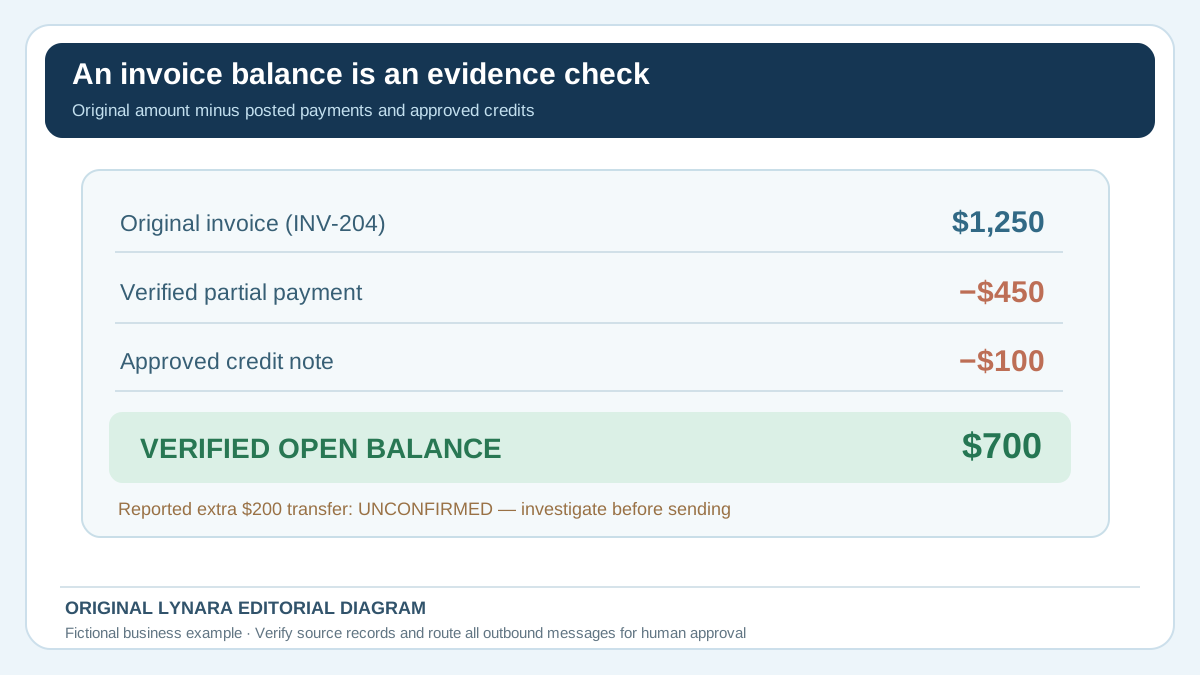
Take a fictional business invoice for $1,250. The customer made a verified partial payment of $450. An agreed credit note reduced the invoice by another $100. The current arithmetic balance is $1,250 − $450 − $100 = $700, assuming there are no other adjustments or pending payments. A draft that asks for $1,250 would overstate the balance by $550. A draft that requests the original amount merely because it was copied from the PDF is not acceptable.
Now imagine the customer says an additional $200 bank transfer is in flight but it has not been confirmed. Do not quietly subtract or reject that claim as if the model had verified it. Mark the transfer as customer-reported; pending reconciliation and have a person decide whether to pause the reminder. If payment has arrived, update the ledger and stop the send. If it has not, the business can follow its approved, non-threatening communication policy while checking the evidence. The example is deliberately about reconciling an account, not generating a legal demand.
A prompt designed to reveal missing facts
A safer instruction starts like this: Draft one short, courteous B2B invoice reminder using only these approved fields. State the invoice reference, verified open balance and agreed due date exactly as provided. Do not invent late fees, penalties, settlement offers, purchase terms or prior conversations. If any field is marked disputed, pending or unknown, return NEEDS HUMAN REVIEW instead of a send-ready email. Do not add payment-account changes or threats. Provide a subject line that accurately describes the transaction. A human must still check every output against the ledger.
Why bother with a constrained prompt if a person must review it? Because it reduces the number of ways the tool can wander into unsupported claims and makes a draft easier to audit. But it does not guarantee compliance or accuracy. Models can swap invoice digits, drop a credit, imply a deadline never agreed or add an aggressive sentence while trying to sound persuasive. If the instruction routinely produces incorrect balances, turn off that use case until the input and review process are fixed. A good manual template may be faster and safer for a business with only a few overdue invoices per month.
Make the message clear without damaging the relationship
A routine reminder can be short: identify the invoice, say the current approved balance and due date, invite the recipient to confirm payment or ask a billing question, and give a known contact channel. The tone can be calm even when payment is late. A useful sentence might be: Our records currently show a $700 open balance for invoice INV-204, originally due October 10. If you have already sent payment, please let our billing team know so we can reconcile the account. These details are entirely fictional and are not a message to any real client.
Do not exaggerate certainty. “Our records currently show” acknowledges a verified ledger snapshot without asserting that no unprocessed payment exists. Avoid “final notice,” “your account will be closed tomorrow,” “we will charge a penalty” or similar language unless the facts, agreement and authorized policy justify the specific statement and a qualified person approves it. Do not shame the recipient or make the message public. Keep transactional billing communication separate from promotional offers. The FTC's CAN-SPAM business guidance explains how a message's primary purpose affects rules for commercial and transactional email; businesses should not assume that attaching an advertisement to a billing reminder has no implications.
Build a small exception queue
Before any batch of messages leaves the business, separate records into ready for human approval and needs investigation. Reasons for investigation might include a disputed deliverable, a missing purchase order, a payment-in-transit claim, a changed legal entity, a bounced address, an account with credits or a bill issued to the wrong customer. The AI does not need to decide which dispute is valid. It can help format the exception list from preapproved status flags so the right person sees the issue, provided the team checks that no record has vanished from the output.
Assign each exception an owner and next step. If the client says the service was not completed, a project manager should compare the actual signed scope and delivery evidence. If the amount changed after a credit note, a bookkeeper should reconcile the numbers. If the contract terms themselves are disputed, the business may need specialist advice. Our AI Workflow Suitability Checker can help a team document where human approval belongs, but it does not assess legal rights, read the business's ledger or send messages. Treat its output as a planning aid, not an authorization.
Try a ten-record pilot instead of automating a thousand sends
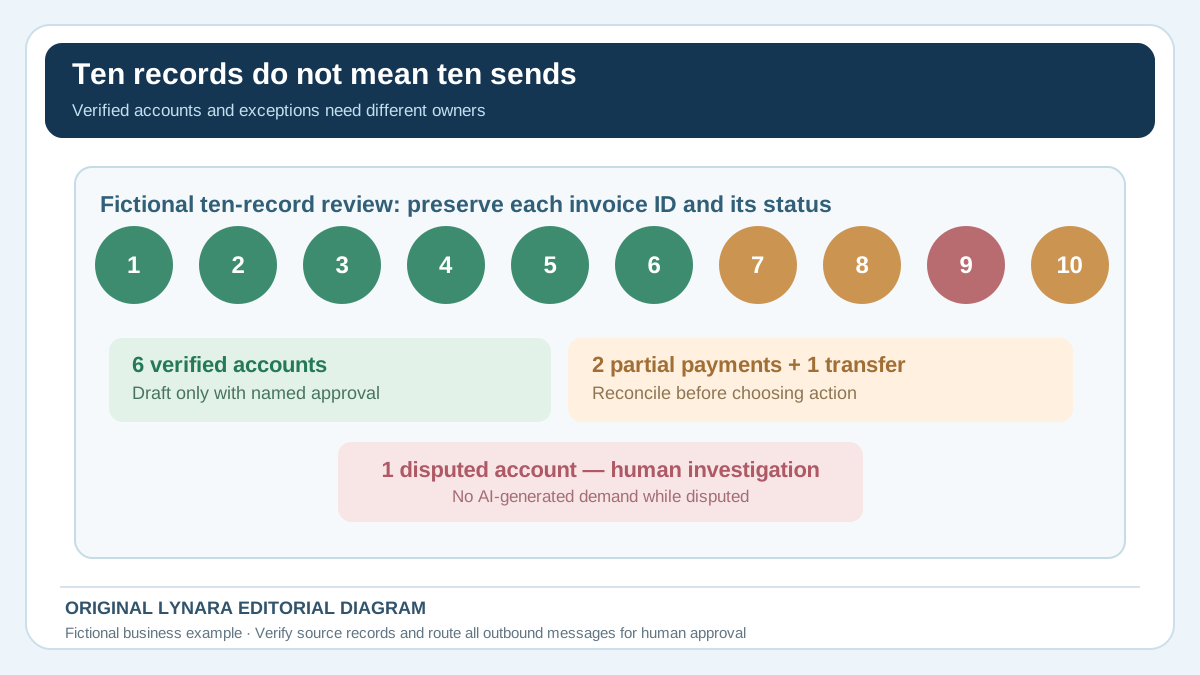
Choose a small, permissioned sample of ordinary invoice records and deliberately include difficult cases. In a fictional ten-record test, six accounts may have clean verified balances, two may have partial payments, one may be disputed and one may have an unconfirmed transfer. The correct output is not necessarily ten reminder messages. It may be six or seven candidate drafts plus several records routed for investigation, depending on the approved policy. Count the unique invoice IDs in the input and the output to make sure no record has been duplicated or omitted.
For each candidate draft, the reviewer checks invoice identifier, client identity, due date, verified balance, any link or payment instructions, tone and recipient. Record every correction. If the model produces an unsupported fee or states that a disputed invoice is unquestionably payable, mark that as a serious error. Don't average it away as just another typo. Retain a traceable approved copy of what was sent through normal business systems, with appropriate access controls, so staff can answer customer questions later.
Calculate whether AI saves time at all
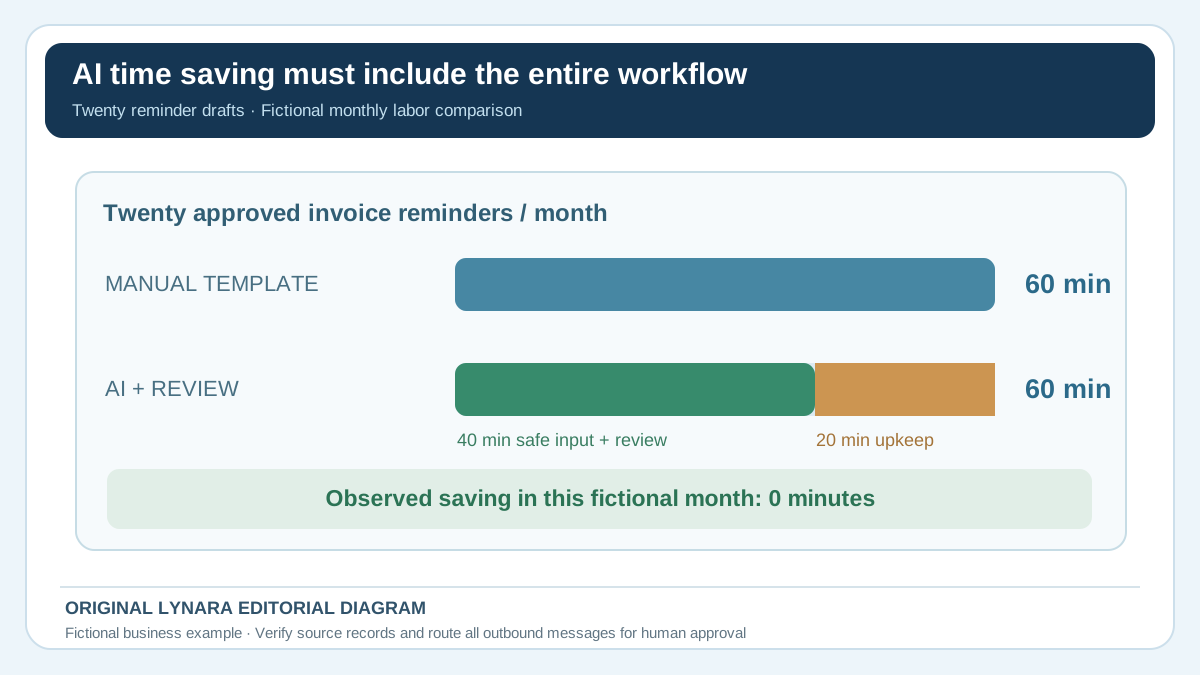
Suppose a fictional freelance studio sends twenty approved reminders in a month. A manual template takes three minutes per message, so the writing portion takes 60 minutes. With AI, preparing the safe data and reviewing the draft might take two minutes per message, or 40 minutes, plus twenty minutes spent maintaining prompts and correcting exceptions. The result is also 60 minutes. There is no labor saving in that hypothetical month, before considering any provider cost or privacy review.
With a cleaner ledger export and fewer errors, the process might improve. But use observed times, not wishful estimates, and include corrections, failed messages, consent or compliance reviews, and staff training. The Business AI ROI Calculator can help compare actual manual and assisted minutes. If a template gives equal speed with fewer risks, keep the template. The purpose is to get paid accurately and maintain trust, not to justify using a model in every step of the accounting process.
What if the customer is an individual?
Pause before reusing this B2B workflow for a consumer, medical bill, personal loan or other sensitive debt. The legal framework and appropriate communication can be different. In the US, the Consumer Financial Protection Bureau explains that the federal Fair Debt Collection Practices Act addresses specified consumer debts and generally does not cover business debts or the original creditor in the same way. That distinction does not mean businesses can ignore other laws or local requirements. It means a generic AI-generated “collections” script is a poor foundation for deciding who may contact whom, how often or with what language.
This article intentionally avoids recommending a contact frequency, interest rate, penalty or legal escalation timeline. Those require the particular agreement, applicable law, customer type and company policy. If you have a consumer account, a threatened dispute, an insolvency issue or a regulated industry, seek appropriate professional review and use a specialized approved process. An automated system should never send intimidating statements merely because the account is marked overdue in a spreadsheet.
A five-minute pre-send checklist
Before approving any draft, open the current invoice record and check its customer, identifier, due date, agreed terms, original amount, posted payments, credits and remaining verified balance. Look for disputes or extensions, and confirm the recipient channel. Read the AI output for facts that were not present in those records: fees, promises, dates, bank details and supposed prior conversations. Verify any links independently. If a required fact is missing, stop and assign the record to a person instead of trying to prompt the uncertainty away.
Finally, ask whether the reminder actually makes the recipient's next action easy: a clear reference, accurate status and a real billing contact. Keep a human approval log and review any replies to correct the account promptly. Our AI Claim Verification Tracker can organize factual claims during review, but it cannot independently see a payment or certify compliance. The invoice amounts, dates, client situations and time estimates in this article are invented teaching examples. The broader principle is simple: let AI improve the sentence only after a human-controlled system has established the truth.