AI English Roleplay for Students: A 6-Turn Practice Guide
Work through six learner turns, make the AI wait for your response, and check its feedback against trusted examples. This is practice, not an official language test.
Interactive companion
Choose a student scenario, approximate level and correction schedule. Generate a bounded prompt without uploading a draft or creating a fake language score.
A roleplay is more useful when it imitates a real student conversation
Students do not need a generic request to speak English every time they open an AI assistant. A specific scenario gives the practice a purpose. Asking a professor to clarify a deadline, coordinating a group project or asking a supervisor for feedback all require different vocabulary and politeness. A useful session starts with one objective and an exchange in which the learner must respond rather than read a long AI monologue. The assistant should wait for the student's words instead of automatically writing both sides of the conversation. This creates an opportunity to practice questioning, clarification and turn-taking, even though the exercise remains simulated rather than a real interaction with a teacher. The AI English Conversation Roleplay Builder produces a scenario-based instruction that can be copied into another permitted AI service. It does not connect to an AI model itself. Unlike a generic homework prompt, it focuses on a sequence of learner turns, realistic interaction and a self-check after the session. That distinction makes it useful for practicing language, not for delegating academic work.
What A1, A2, B1, B2 and C1 actually mean
The Common European Framework of Reference for Languages, or CEFR, organizes communicative activities and competence into broad reference levels. Its Council of Europe descriptors describe things learners may be able to do in interaction, comprehension and other areas. Selecting A1–A2 in a prompt should ask the conversation partner to use familiar, short wording and manageable questions. Choosing B1–B2 can lead to broader follow-up questions and more independent explanations. C1 practice can include more nuanced discussion and appropriate register. Those settings do not diagnose the student's true level. A learner may read at B2 but struggle with spontaneous conversation, or understand technical writing while finding polite requests difficult. The builder uses ranges to adjust the requested complexity, not to issue a CEFR score. An official level assessment involves appropriate evidence and assessment methods beyond a few generated replies. The Council of Europe's CEFR introduction also makes clear that the framework does not itself certify a provider's examination or score. The British Council's level-organized speaking resources offer structured material students can use to compare useful phrases and interaction patterns independently.
Office hours: practice asking one clear question
Imagine a student who understands most of an assignment but does not know whether its bibliography should be annotated. A roleplay can start with: I have a question about the sources for Friday's report. Does the bibliography need short explanations? The simulated professor can ask what the student has already understood, and the learner practises a follow-up without pretending that the fictional teacher gave real permission. The goal is to make the real question clear before speaking to an actual instructor. The prompt should explicitly prohibit inventing actual instructor decisions, grades, deadlines or extensions. Those remain matters for the real course. If the student gets stuck, they can ask for one short example sentence and then try another response. Practicing a realistic exchange is more effective as a learning task than repeatedly copying a polished AI-generated email. The final outcome should be greater readiness to ask the real question, not a transcript misrepresented as communication with the teacher.
Group projects: practice polite disagreement
A group project conversation may require the student to say that a source needs checking, request a file by a deadline or disagree about a proposed slide. An AI roleplay can rehearse expressions such as Could we check that result against the original paper? or I see your point, but this chart may need a clearer label. The simulated partner can respond with a challenge that requires another thoughtful reply. This is a different language skill from filling a grammar worksheet. Students should choose a specific desired behavior, such as asking a follow-up question instead of silently agreeing. A short sequence of six turns may provide enough variety for an initial practice session without becoming exhausting. The number of turns is a planning choice, not a validated training dose. For coordinating actual team responsibilities, our group assignment guide covers role ownership and verification. Language practice should not be confused with assigning real classmates tasks without their consent.
Internships: rehearse requests without making up experience
An internship scenario can involve asking a supervisor to explain a task, reporting an obstacle or clarifying an expected format. A student may need concise, respectful language rather than an elaborate speech. A realistic prompt could direct the partner to ask what the student has tried, then provide one follow-up question at a time. The student can practice saying I understand the objective, but could you show me the required file format? and other useful forms. The assistant should not invent job qualifications, safety approvals or completed work on the student's behalf. An actual technical task may require direct supervision and onsite instructions. Language practice cannot substitute for those. When the learner supplies a goal, keep it general and avoid uploading confidential workplace information. The aim is to practice how to ask a legitimate question clearly and politely, not to rehearse a false account of experience for a real interview or evaluation.
Choose correction timing deliberately
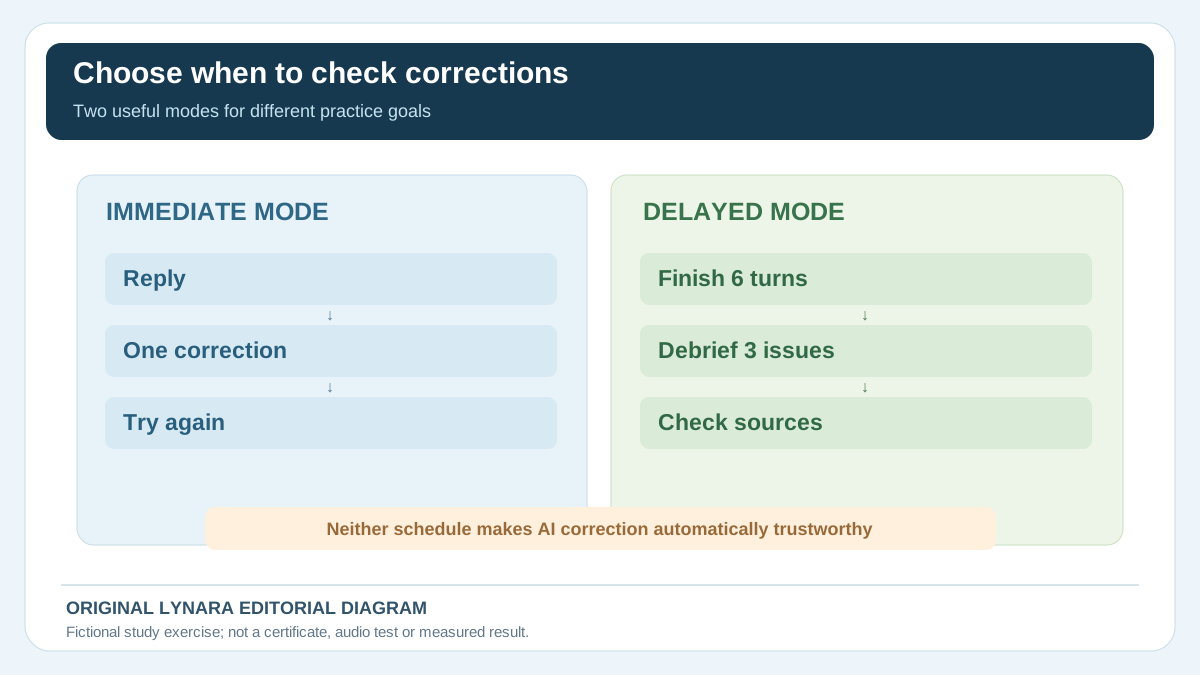
Some students want a quick correction after every response. That can help notice a repeated grammar pattern, but it may interrupt the flow of a conversation. Others prefer to finish a practice sequence and review three or four key issues afterward. The better choice depends on the learner's goal and what they can productively act on. For improving question forms, one correction at a time may be useful. For practicing continued conversation, a short debrief after the exchange may better preserve the experience of taking turns. The builder offers both modes. Its prompt asks for no more than one short correction after a reply in the immediate mode or a grouped correction list at the end. It also encourages the learner to retry phrasing in their own words. A model's correction is not automatically correct: unusual conversational language, dialects and context can produce debatable suggestions. When a change matters, compare it with a trusted language reference or a teacher's explanation instead of treating the model as an infallible grammar authority.
Typing a conversation cannot measure your pronunciation
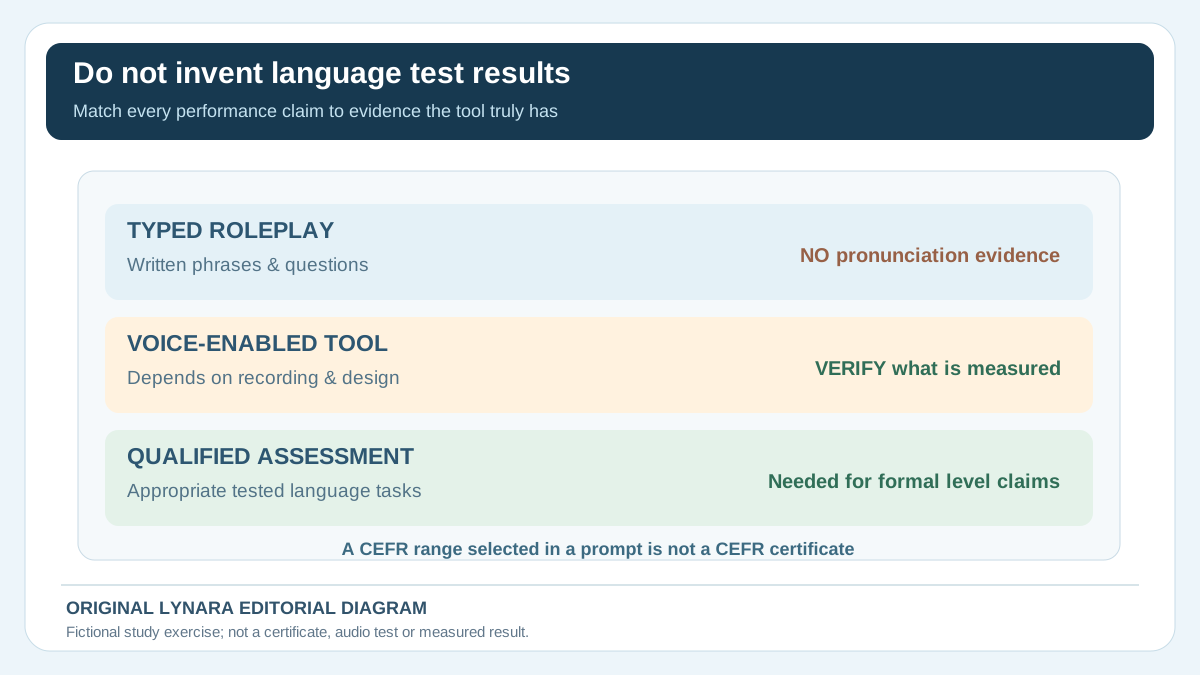
A textual model may correct word choice, suggest sentence structure and help the learner write a more natural reply. If only typed messages are exchanged, the system has not heard how the student pronounces vowels, stresses words or manages connected speech. Claims such as your pronunciation is 93 percent accurate would be baseless under those conditions. Even when a separate service offers voice capabilities, the learner should check what is actually recorded and what feedback the service is designed to provide. The Lynara prompt builder never accesses the microphone or analyzes audio. It explicitly tells the chosen AI assistant not to claim it measured pronunciation from text alone. For real pronunciation practice, students may supplement typed roleplays with authentic audio lessons, listening discrimination tasks and feedback from qualified speakers or teachers. The British Council listening resources include level-organized recordings that can provide a more grounded reference than text-only performance claims.
A worked six-turn practice plan
Imagine a learner practicing a group-project conversation at an approximate A2 level. The goal is to ask two relevant questions and handle one polite disagreement. They select six learner turns and delayed corrections. The simulated partner opens by saying the group must finish the slides by Thursday and asks what the learner can do. The learner offers a task, asks which source to use and later responds when the partner wants to shorten the evidence section. The precise generated replies will vary by service, so this article does not reproduce a fictitious universal result. The learner's after-session checklist can include whether they asked a question that moved the conversation forward, whether they requested clarification when unsure and whether their tone was appropriate. A six-turn sequence is not enough to establish a CEFR level or guarantee fluency gains. It is enough to create a repeatable exercise. The next day, the learner can change the scenario and practice the same skill with different wording rather than memorizing one exact AI dialogue.
A repeatable six-turn script with a reviewable result
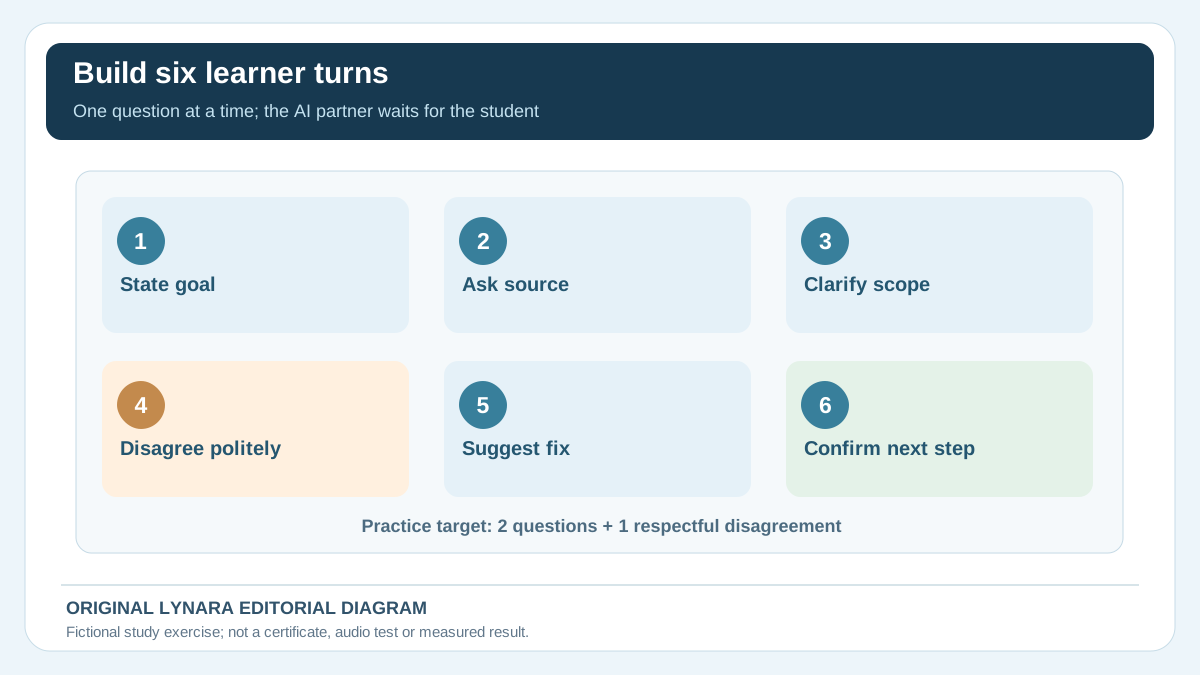
Use a fictional university group project. You are responsible for describing the evidence behind one chart; your simulated partner wants to remove the data source to save space. Tell the assistant: Act as an A2-friendly classmate discussing six slides. Give one short question or objection at a time, wait for my answer, and do not write my response for me. Use six learner turns. I need to ask two clarifying questions and disagree politely once. Give me corrections only at the end. Do not invent an actual instructor decision or official language level. This instruction describes a practice setting rather than claiming that the tool is a real classmate.
| Learner turn | Communicative action to attempt | After-turn check |
|---|---|---|
| 1 | Say what the presentation needs to explain | One clear goal in your own words |
| 2 | Ask which original source supports the chart | Question one asks for real evidence |
| 3 | Clarify whether the source can be included in a note | Question two is specific and answerable |
| 4 | Disagree politely with removing the source | State a reason without inventing facts |
| 5 | Propose a shorter accurate label or citation | Offer an actionable alternative |
| 6 | Confirm what you will check with the actual group | Do not treat the simulated partner as authority |
The exercise has six learner responses. Two should contain questions and one should contain a respectful disagreement. That means these three targets describe three kinds of behavior within six turns, not three additional AI messages. A simple notebook could mark each behavior as attempted, not attempted or needs correction. A learner who asks two questions has completed that specific rehearsal goal; it does not follow that their English is B1, B2 or any other certified level.
When the session ends, compare the suggested corrections with a real lesson, teacher or the British Council speaking examples. If an AI proposes changing “Could we check the original chart?” to a more awkward sentence, do not assume the new version is correct merely because the assistant used a confident tone. Ask for an explanation, compare it against the reference and keep the phrasing that conveys the intended meaning.
A small practice log that does not pretend to measure fluency
For a fictional week, plan four roleplays of six learner turns each. The plan contains 24 attempted learner turns in total, assuming every planned practice actually happens. Do not count the AI partner's messages as student speaking practice. The learner may use the same two questions and one disagreement target in each session, but should vary the scenario and wording to avoid rehearsing only one memorized answer.
Keep six columns: session date, scenario, whether six turns were completed, number of relevant clarifying questions, one verified correction and next real-world communication task. Avoid uploading genuine classmates' transcripts or private internship material to fill the log. If a student completes four sessions, the log can show effort and the kinds of phrases rehearsed, but it cannot establish a verified increase in speaking proficiency. A text-only exercise should be described as written conversation rehearsal, not a listening or pronunciation test.
Use a decision gate at the end: Repeat when the learner could not independently ask the intended questions; Revise when the model's suggested correction is disputed or unverified; Try with a person when the written rehearsal is clear enough to take into a real, permitted conversation. Real-world teachers, classmates, supervisors and school rules remain authoritative for actual deadlines, grades and work instructions.
Measure progress by reusable behaviors, not artificial grades
A simple progress notebook might record the date, situation, target skill, one successful expression, a repeated difficulty and the next practice question. After a few sessions, a student can compare whether they initiate more relevant questions or need fewer prompts to keep the conversation going. These are personal observations about practice, not controlled measurements of language acquisition. An AI assistant may generate a reassuring score even when it lacks a valid assessment rubric. A learner can compare useful expressions with trusted examples or seek feedback from teachers, tutors and conversation partners. The CEFR descriptor resources can help frame appropriate communicative goals, but the tool's selection of a level range should never appear as a certificate. When possible, rehearse similar language in an actual discussion with another person. The real ability to clarify, negotiate and respond matters more than completing a particular number of AI turns.
Privacy, permitted use and a practical routine
A language roleplay prompt often needs very little personal data. The student can describe a fictional assignment, an unnamed professor or a generic internship without sending real grades, emails, names or private institutional documents. They should also follow the privacy practices and terms of whichever external AI service receives the copied prompt. The Lynara builder processes the options locally in the browser, and only the student decides whether to copy its output elsewhere. For a repeatable routine, choose one student situation and target skill, select a range appropriate for the practice, write a specific goal and request a handful of responses. Start the conversation, answer in your own words, record one or two meaningful corrections, then check uncertain grammar or facts independently. Read the AI versus human student-task guide if you are unsure what AI can reasonably assist with. The practical purpose is to rehearse genuine communication, not automate classroom work or claim a proficiency result that was never measured.
Sources and limitations
Our reference levels and learning examples are informed by the Council of Europe CEFR and the British Council's independent speaking and listening resources. No speech analysis, voice recording, language testing or measurable learner outcomes are claimed. Review the editorial policy.