AI Exam Preparation: Mock Tests, Error Logs and Review
A useful exam-preparation assistant helps expose mistakes early. It cannot know your private exam or replace practice under test conditions.
Start from the assessment, not a model-generated syllabus
Before creating practice questions, identify what the actual assessment covers: learning objectives, previous class assignments, required problem types, timing and any permitted reference materials. An AI assistant might produce an elegant list of topics that have little connection to the course. A real syllabus and teacher-provided materials should provide the boundaries. If the test emphasizes interpretation of graphs, a large set of memorized definitions will not be adequate preparation. Conversely, practicing advanced material that is outside the syllabus may waste limited time. Keep the available study window realistic. This article describes a specific two-week diagnostic and mock-test workflow, rather than the general seven-hour planning method in our study-time guide. The distinctive aim here is to make the practice resemble assessment conditions and to collect evidence about errors as the exam approaches.
Run a diagnostic with questions you have not seen
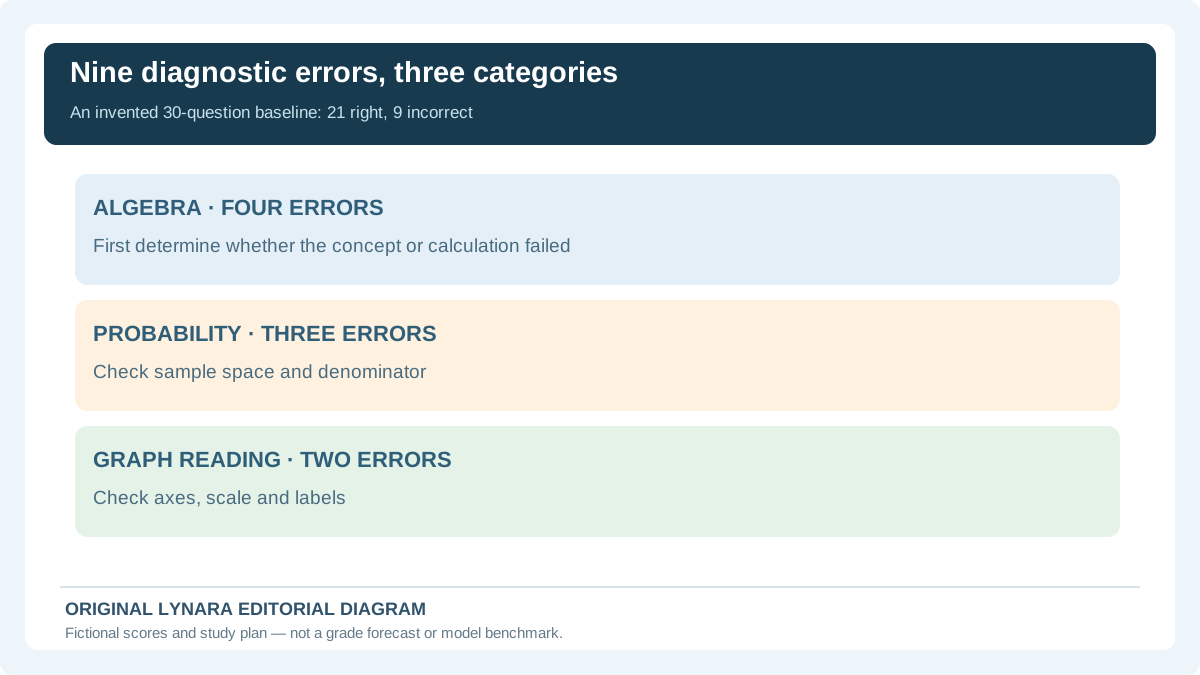
A diagnostic is useful when it reveals which skills fail without help. The 2019 review of retrieval practice in real classrooms discusses when testing can support learning, while stressing that task design and evidence still matter; this fictional schedule is not a measured classroom intervention. Suppose a student prepares thirty questions across algebra, probability and graph reading and answers twenty-one correctly. That is 21 divided by 30, or 70 percent. Of the nine missed questions, four concern algebra, three probability and two graphs. These invented results do not establish a school grade or predict the final examination. They provide a tentative breakdown of weakness. Note which mistakes came from missing concepts, calculation slips and misreading the wording. A single thirty-question test is not a perfect measure: question difficulty and topic weighting matter. But it is a better basis for planning than asking AI to guess what the student probably finds difficult. Where possible, choose practice questions from reliable course sources and use AI to create additional variants after the underlying solutions have been checked.
Use AI to build a controlled question bank
A question bank should organize problems by topic, type and difficulty. Ask an assistant to create a limited number of new exercises that match verified learning objectives rather than generating hundreds of unreviewed items. For every created question, check that there is a clear answer and that the answer key does not contain a mathematical or factual error. If the topic is history, inspect citations and distinguish contested interpretations from settled dates. If the topic is statistics, verify numerical results independently and confirm any model assumptions. Number the questions so an error can be traced later. A bank becomes valuable when the student can select unseen questions at the right difficulty for a targeted session. Repeating the same easy prompts can create an illusion of progress. It is better to have twenty verified, varied questions than two hundred dubious ones that were generated rapidly and never checked.
Build a two-week sequence from the diagnostic
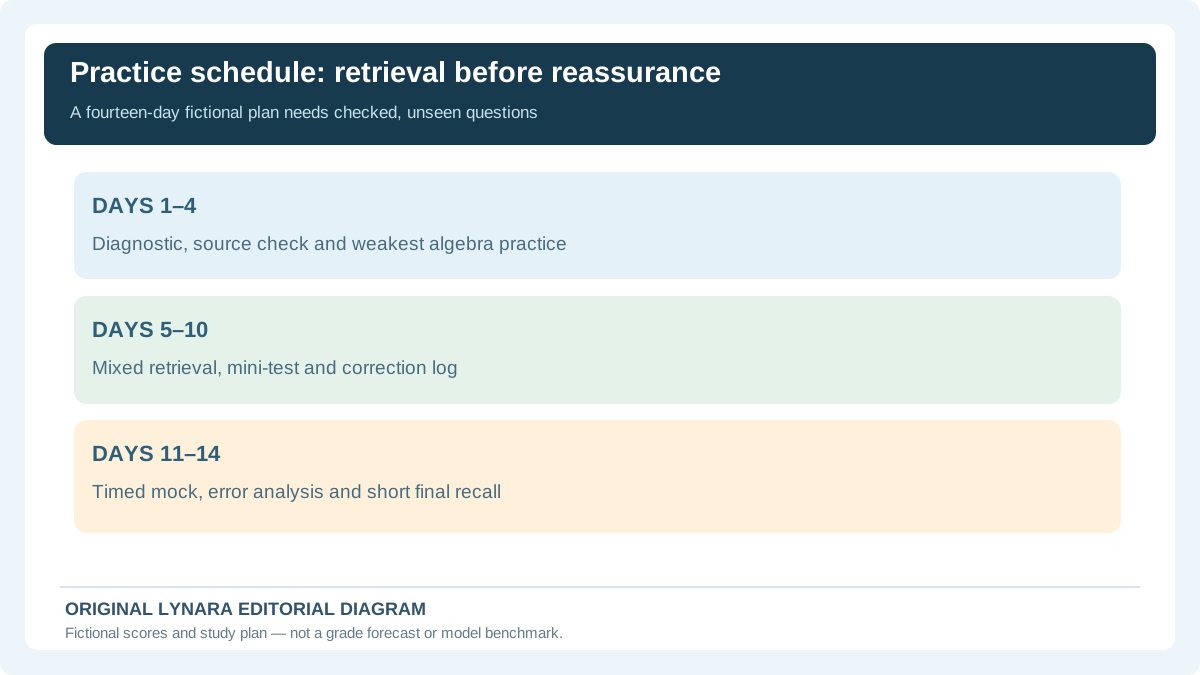
An illustrative schedule can begin with a diagnostic on day one. Days two through four emphasize the weakest algebra subskills while preserving short reviews of probability and graphs. Day five mixes all three topics to prevent recognition from one repeated pattern. Day six offers a timed mini-test; day seven reviews its errors. The second week can emphasize unseen mixed problems on days eight through ten, a full timed mock test on day eleven, detailed corrections on day twelve and selective review on days thirteen and fourteen. This is a model sequence, not a guarantee of improvement or a medical recommendation about study intensity. Adjust for available days, exam length and fatigue. Do not schedule an exhausting all-night session simply to fit the plan. AI can draft reminders and allocate practice sets, but the student should check whether the time slots are genuine and whether breaks and recovery time remain possible.
A timed mock test is more than a long quiz
A mock should resemble the actual exam in meaningful ways: time limit, question formats, permitted tools, mixed topics and the requirement to finish without immediate feedback. Asking an AI to provide hints after every question may be useful for tutoring but defeats a simulation intended to test independent performance. Prepare verified questions in advance and hide solutions. Complete the mock under a sensible approximation of the assessment conditions, then mark it according to an explicit scheme. If the marking criteria are ambiguous, do not treat an AI-grader's verdict as definitive. A student can ask the assistant to suggest partial-credit considerations, but authoritative rubrics and instructor guidance take precedence. Record both the score and the distribution of error types. A score that improves because familiar questions were reused is weaker evidence than improvement on genuinely unseen but comparable problems.
Turn mistakes into next actions
An error log should identify the original question, topic, student's attempted reasoning, verified correction and a future review date. It can include a cause such as knowledge gap, algebraic slip, reading error or time pressure. An AI assistant can help classify a mistake if the student supplies the genuine attempt, but it should not silently rewrite the record as though the mistake never happened. Consider a student who consistently forgets to apply multiplication across brackets. The next action is a short practice set on distributing coefficients, not another summary of the entire course. If a student confuses mean and median, work through an asymmetric dataset and explain why the measures differ. Once an error is corrected, revisit it using new numbers. For a repeatable way to attempt answers without notes before viewing a solution, see our AI study assistants and active recall guide; the mock-test error log and retrieval practice serve different stages of the same learning task. The target is transfer: can the student independently apply the correction when the wording changes? That answer matters more than how attractive the error log looks.
A worked score analysis that avoids misleading improvement claims
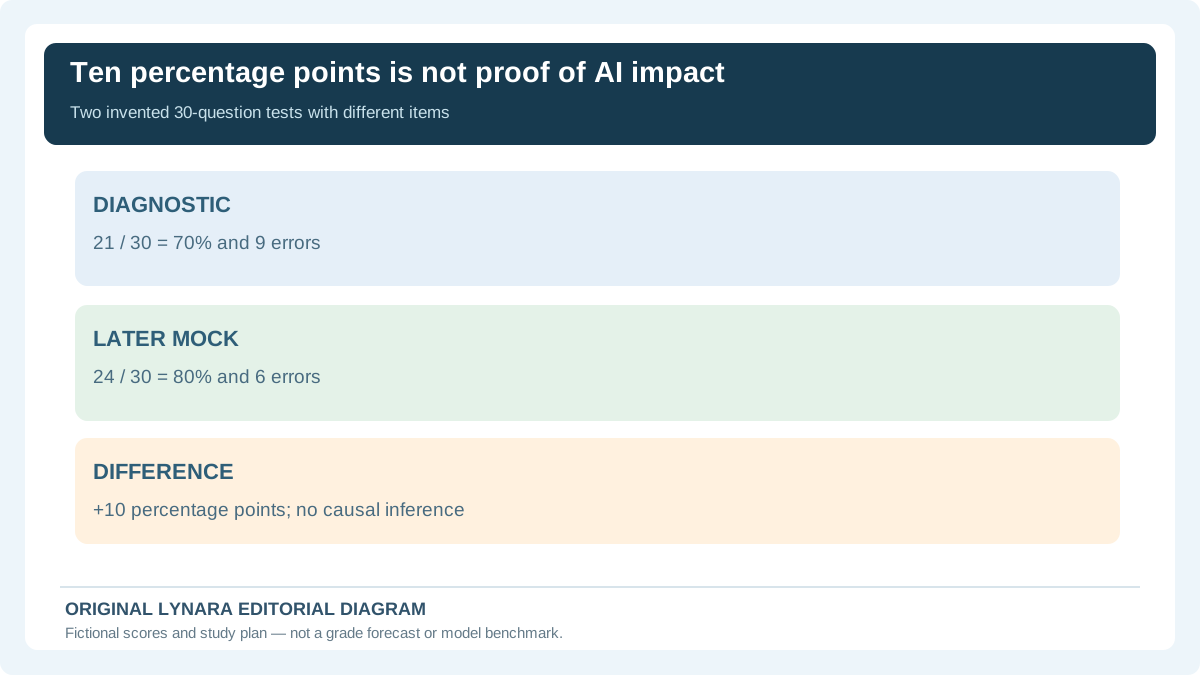
Suppose the initial thirty-question diagnostic produces twenty-one correct answers. A later verified mock with thirty different but comparably weighted questions yields twenty-four correct, or 80 percent. The difference is ten percentage points. It does not establish that AI caused the improvement, that every topic improved or that the real exam will produce 80 percent. Break down the second test. For example, algebra errors might fall from four to one while probability errors remain at three and graph errors remain at two. The second mock then contains one plus three plus two, or six errors, consistent with twenty-four correct answers out of thirty. Check the topic totals against the marked paper before drawing conclusions: an appealing percentage is not useful if its underlying categories do not add up. This arithmetic discipline prevents vague progress stories from hiding contradictory category totals. The next sessions should focus on verified patterns, not an ungrounded percentage prediction.
Check sources and avoid invented exam questions presented as official
A generative assistant does not have legitimate access to a teacher's private future examination simply because it can make plausible-looking questions. Do not ask it to impersonate an official paper or claim that a generated problem is guaranteed to appear. For standardized examinations, use the official provider's published sample material to establish format and rules. AI-created variants are supplemental practice, not authenticated past questions. If a model cites a textbook chapter or paper in a solution, find the original source before trusting it. Do not upload restricted assessment content, school records or classmates' personal information to external tools without permission. A responsible workflow respects the institution's academic-integrity policies while helping a student prepare better. The strongest value of AI here is generating additional opportunities to practice and explain mistakes, not pretending to possess secret examination content.
What to do in the final days
The last days should follow the evidence from the latest mock. Revisit recurring errors, verify core formulas or concepts and complete some short unseen questions rather than commissioning another massive summary. Keep any final study plan realistic and avoid confusing more hours with greater mastery. If the latest test shows that calculations are sound but questions are misread under time pressure, practice reading instructions and allocating time. If conceptual explanations are weak, focus on reconstructing the relevant ideas without notes. Use our AI study tools to organize sessions and the statistics calculators where appropriate to independently verify numerical exercises. The test of a useful assistant is whether the learner can work without it when the examination begins. Finish with a clear list of known strengths, remaining gaps and the next attainable practice task.
Score the practice test separately from learning
For a practice test with known correct-answer counts, use our Test Grade Calculator for a transparent percentage. A simulated score is a study signal, not proof of mastery or a forecast for the official exam. Record the mistakes and independently retry the questions.
Make the error log lead to a testable next action
Suppose the first thirty-question quiz yields twenty-one correct answers and nine mistakes. Merely highlighting every incorrect question is not a plan. Sort the nine errors by the specific rule needed to repair them: four algebra mistakes, three probability mistakes and two graph interpretation mistakes. For each one, preserve the question ID, checked correct answer, why the first answer failed, a source from the actual course and a new practice task that is not identical. For example, a probability mistake caused by using the wrong denominator should generate a new denominator exercise, not five more variations of the already-solved question.
| Original error | Cause to verify | Independent follow-up |
|---|---|---|
| Algebra equation solved incorrectly | Distribution or sign mistake | Work a different bracket problem without a hint |
| Probability question wrong | Incorrect event count or denominator | Construct a new sample space and show the fraction |
| Graph comparison wrong | Misread unit or axis baseline | Explain an unfamiliar chart using actual labels |
| Unsupported AI answer | Generated item or key conflicts with course source | Correct or discard the practice item before reuse |
Research synthesized by Dunlosky and colleagues (2013) identifies practice testing and distributed practice among the more broadly supported study techniques. The review does not validate a particular AI assistant or guarantee that the fourteen-day example works better for every student. Use it to favor genuine retrieval and spacing over passive reading, while verifying each practice item's answer against an independent reliable course source.
The second mock might contain twenty-four correct answers out of thirty, so the percentage changes from 70 to 80. That is ten percentage points, not a ten percent relative increase and not proof that a chatbot caused improvement. If the later test has more familiar or easier questions, its percentage may be incomparable. The algebra/probability/graph error categories must add to the total incorrectly answered items before the student decides where to spend further effort. Use Lynara's Test Grade Calculator for transparent scores and the active recall guide for hint-free follow-up.
Do not claim that invented AI questions are official exam material. Check the professor's assessment rules and do not upload restricted test papers or a classmate's records to unapproved tools. A well-designed practice session ends with a new question answered without the assistant and an honest status: mastered, needs practice or unresolved.
Turn the score change into a topic-level retest plan
The worked 30-question example above can be audited as an error ledger rather than a single headline percentage. On the first diagnostic, four algebra, three probability and two chart-reading errors total nine mistakes, so 21 of 30 are correct. On the later mock, one algebra, three probability and two chart-reading errors total six mistakes, so 24 of 30 are correct. The overall change is 70% to 80%, or ten percentage points; the three fewer mistakes in this hypothetical breakdown all come from algebra.
| Topic | First mock errors | Second mock errors | Next independent check |
|---|---|---|---|
| Algebra | 4 | 1 | Retry unseen problems with changed coefficients. |
| Probability | 3 | 3 | Practice denominators and conditional wording. |
| Chart reading | 2 | 2 | Recheck scales and units on unfamiliar plots. |
| Total | 9 | 6 | Verify both papers and comparable topic coverage. |
Counts alone do not establish improvement by topic unless the tests contain comparable opportunities, difficulty and marking rules. Do not claim that AI caused the change. Use the Test Grade Calculator to verify arithmetic, then keep a separate record of genuinely unseen retests and corrections.
Editorial limitations
Worked examples are illustrative and do not predict grades or claim hands-on performance tests. Verify calculations, teacher instructions, citations, privacy rules and current service features before applying this guidance. See the editorial policy.