AI Study Assistants and Active Recall: A 7-Day Plan
A source-backed revision plan that keeps independent recall first and AI-generated explanations second. Worked examples are fictional, not measured learning results.
Where AI helps and where it quietly gets in the way
An AI study assistant can turn a rough set of notes into questions, explain an unfamiliar term in different words, or help organize a revision schedule. Those are useful forms of support. But the assistant can also make the work feel easier than it is by producing neat summaries, answering every question immediately, and giving the learner the impression of mastery. Recognition and retrieval are not the same process: following an explanation while reading it is easier than reconstructing an answer from memory on an exam. McDermott's 2021 research review on retrieval practice describes how actively recalling studied material can aid later retention; it does not establish that every AI-generated question is correct.
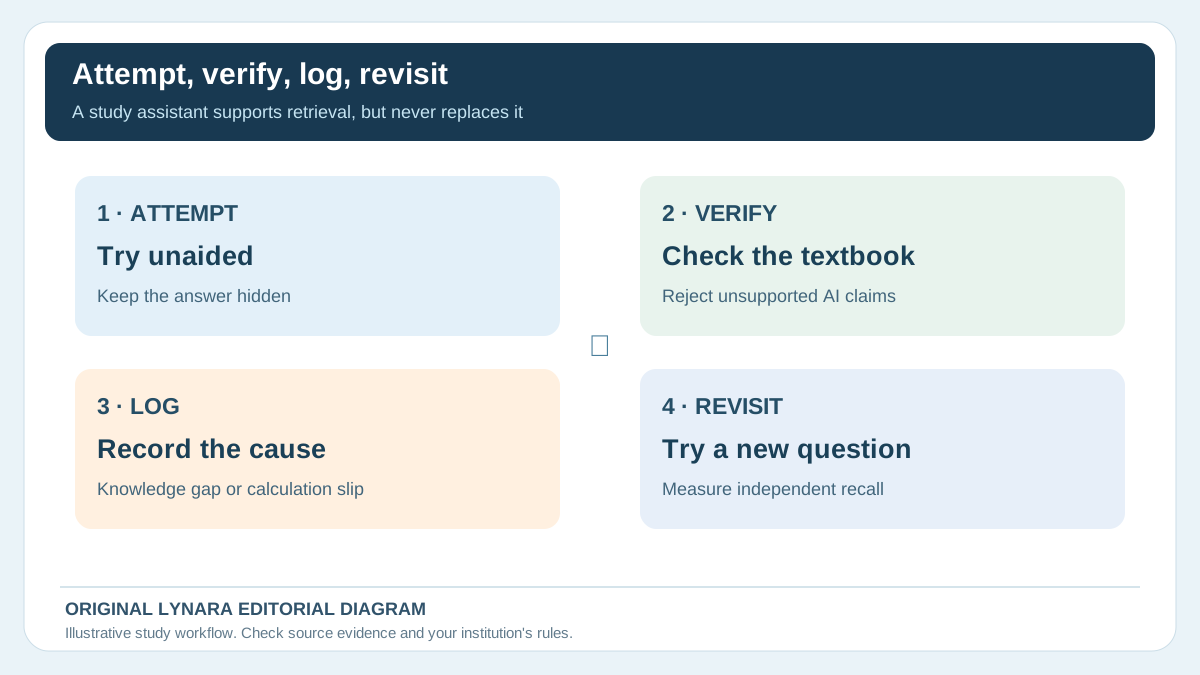
The most productive approach makes the student do the difficult thinking before asking the AI to help. Attempt a question without notes, identify what is missing, and then request a focused explanation or a parallel problem. A smooth response should not be treated as proof that the explanation is accurate. When the subject has a definite rule, definition, or numerical result, compare it with course materials and independently check the arithmetic. The assistant can help build practice opportunities; it cannot sit the examination for you.
Research support is strongest for the learning methods, not for any particular AI product. The Dunlosky and colleagues' 2013 review assessed practice testing and distributed practice favorably. That does not mean every generated quiz is reliable or that a seven-day schedule guarantees a score increase. The source text, answer key and learner's unaided response still need to agree.
Choose the role: tutor, question writer, editor or planner
A tutor role is appropriate when a concept needs explanation. Ask for one step, not the full solution, so you can finish the reasoning yourself. A question-writer role is useful after a topic has been taught: it can create short-answer prompts and ask you to explain a process in your own words. An editor role can identify ambiguities in a response you wrote, but should not secretly replace your work with an answer you cannot defend. A planner role can help distribute limited study time across topics and obligations.
These roles require different instructions. For tutoring, say what you have attempted and where you became stuck. For retrieval practice, ask the system not to show answers until you respond. For writing feedback, request comments on argument structure rather than a complete replacement essay. For planning, provide actual available hours and exam dates rather than asking for a generic ideal timetable. A single vague request such as 'help me study biology' leaves the assistant guessing what would be useful and encourages shallow interaction.
A worked seven-day revision plan
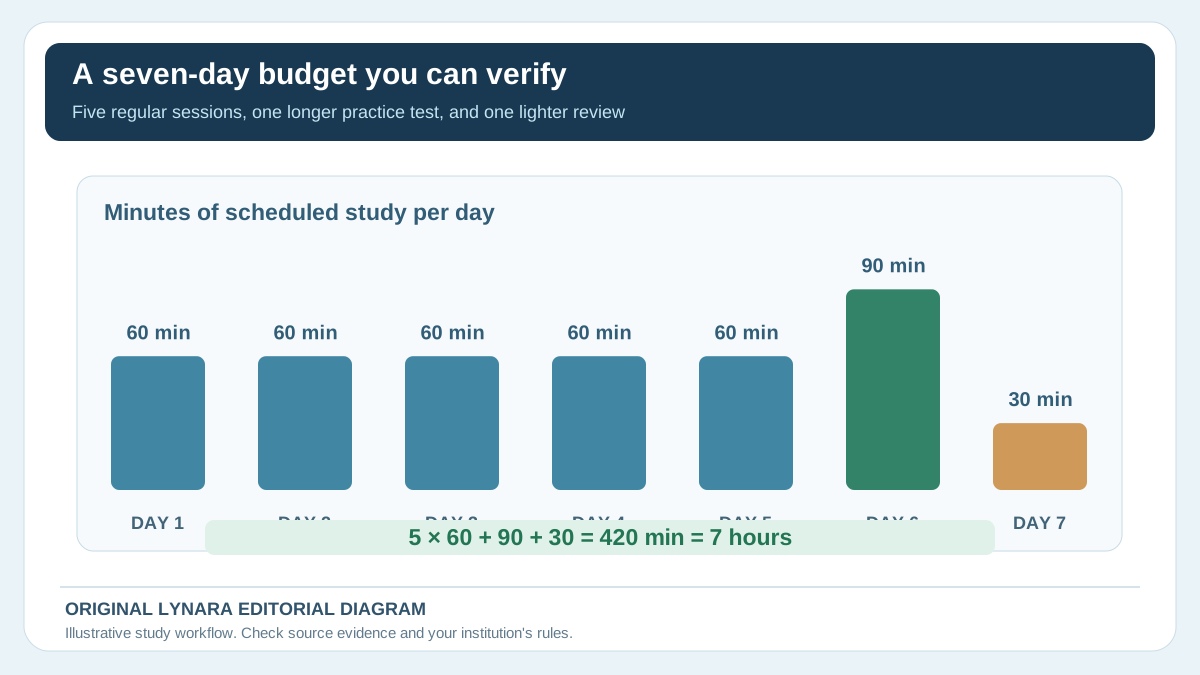
Consider a student revising four topics for a test next week: cell structure, transport, enzymes, and experimental method. Suppose they have 60 minutes available on five days, 90 minutes on one day, and 30 minutes on the final day. That is 420 minutes, or seven hours, of active work. This is an illustrative planning budget, not a prescription for every learner. On day one, they can attempt a short baseline quiz across all four topics and note the errors before opening any explanation.
On days two and three, the student might spend the first twenty minutes recalling yesterday's material from memory, the next twenty minutes on the weakest topic, and the final twenty minutes solving or explaining questions with no notes. On day four, mix questions from different topics rather than repeating a single pattern. On day five, reproduce two diagrams from memory, then check every label against a textbook. Day six's longer session allows a realistic timed mini-test and analysis of errors. Day seven is for light retrieval and reviewing the error log rather than frantically asking an AI to rewrite the entire course.
Write the seven daily budgets into a calendar before generating study materials: Days 1–5 get 60 minutes each, Day 6 gets 90, and Day 7 gets 30. That totals 300 + 90 + 30 = 420 minutes. Place the most difficult independent problems early in sessions, take reasonable breaks as needed, and adjust for accessibility or other demands. A longer session is not automatically a more effective one if the student is exhausted.
Turn generated questions into genuine retrieval practice
A multiple-choice question is quick to answer but can be guessed. When possible, use short free-response questions that require definitions, distinctions, or reasoning steps before seeing the solution. For example, instead of choosing which of four terms describes diffusion, explain in a sentence why a specific transport mechanism is passive, then compare your description with the course definition. Follow with a new example to check whether you can apply the rule rather than merely repeat the word.
An assistant can create these prompts in seconds, but students still need to inspect them. The generated answer key may use an unsupported definition or mark a valid alternative response wrong. Ask the assistant to identify the source section or learning objective behind each question; if it cannot be verified, remove the question from the practice set. Keep a record of which questions were answered without notes, which needed a hint, and which were guessed. This is more informative than counting the number of questions the model produced.
Quality-check a twelve-question AI quiz before studying from it
Give the assistant twelve clearly numbered prompts derived only from the course objectives you supply, with no answer key displayed until you have responded. Before attempting them, a student or instructor should compare each prompt against the actual lesson or approved readings. A question with an invented laboratory result, an undefined term or a missing diagram is not automatically a useful test just because it looks polished. Do not ask the model to fabricate a textbook chapter citation. Record the exact page or learning objective supporting each accepted question.
| Decision | Count | What happens next |
|---|---|---|
| Verified and usable | 8 | Attempt independently; reveal source-checked answers afterward |
| Ambiguous or missing information | 2 | Rewrite against the assigned material before practicing |
| Incorrect answer key | 1 | Discard the answer key and repair the source-based explanation |
| Outside course scope | 1 | Exclude from the examined study set |
| Total original questions | 12 | Only 8 are approved without correction |
In this invented example, only eight of the twelve first-pass prompts are ready to use; 8 ÷ 12 = 66.7% initial usable coverage in that one fictional worksheet. This is not an accuracy rate for an AI study assistant. After fixing the other four prompts, recheck them independently rather than assuming an edit makes them correct. The student then attempts the approved questions without notes and marks each outcome as correct unaided, correct after a hint or needs relearning. A hint-assisted response is useful progress, but should not be counted as fully unaided recall.
For follow-up, assign one next action per observed error: relearn an incorrect definition, practice a calculation from scratch, explain a reasoning step aloud, or revisit a forgotten concept after an interval. Save the question ID, course reference and review date in the error log. Before a graded assignment, check the institution's permitted-use policy. The point of this worksheet is to keep the student—not the model—as the owner of what was learned and verified.
Use flashcards for facts, not as a substitute for reasoning
Flashcards work well for compact information: terms, formulas, symbols, small diagrams, or short cause-and-effect relationships. A card that asks for a complete chapter summary is difficult to grade and easy to answer vaguely. Split broad topics into meaningful retrieval prompts, but avoid fragmenting every sentence into tiny facts that lose their context. For a statistics course, one card could ask when to use a sample rather than population standard deviation, while a separate worked problem checks the calculation.
An AI assistant may propose cards from a document, and a human should delete weak cards. Look for duplicates, incorrect statements, undefined abbreviations and questions whose answers appear in the question. A good deck represents material you are actually responsible for learning. Add examples from classes or assigned practice, not invented claims presented as teacher-approved content. A smaller, checked deck reviewed consistently can be more useful than hundreds of automatically generated cards that were never tested.
An error log is the missing link in many AI workflows
A student may ask dozens of questions and receive dozens of convincing explanations without recording the underlying difficulties. An error log makes progress visible. A simple entry has the date, topic, question type, original mistaken answer, corrected reasoning and a future review date. Distinguish a knowledge gap from a calculation slip and from reading the prompt too quickly. Those causes call for different practice. An AI assistant can help categorize errors, but only if the student supplies an accurate account of what went wrong.
Consider a learner who repeatedly confuses mean and median. The useful next step is not a longer generic summary of statistics. They could calculate both values for a small asymmetric dataset, explain when the median changes less, and check the result with a calculator. Later, repeat the task with different numbers without looking at the previous answer. Lynara's statistics calculators can verify a calculation after the student has attempted it. The goal is to strengthen independent performance, not accumulate attractive generated notes.
A numerical case: knowing when an answer is unreachable
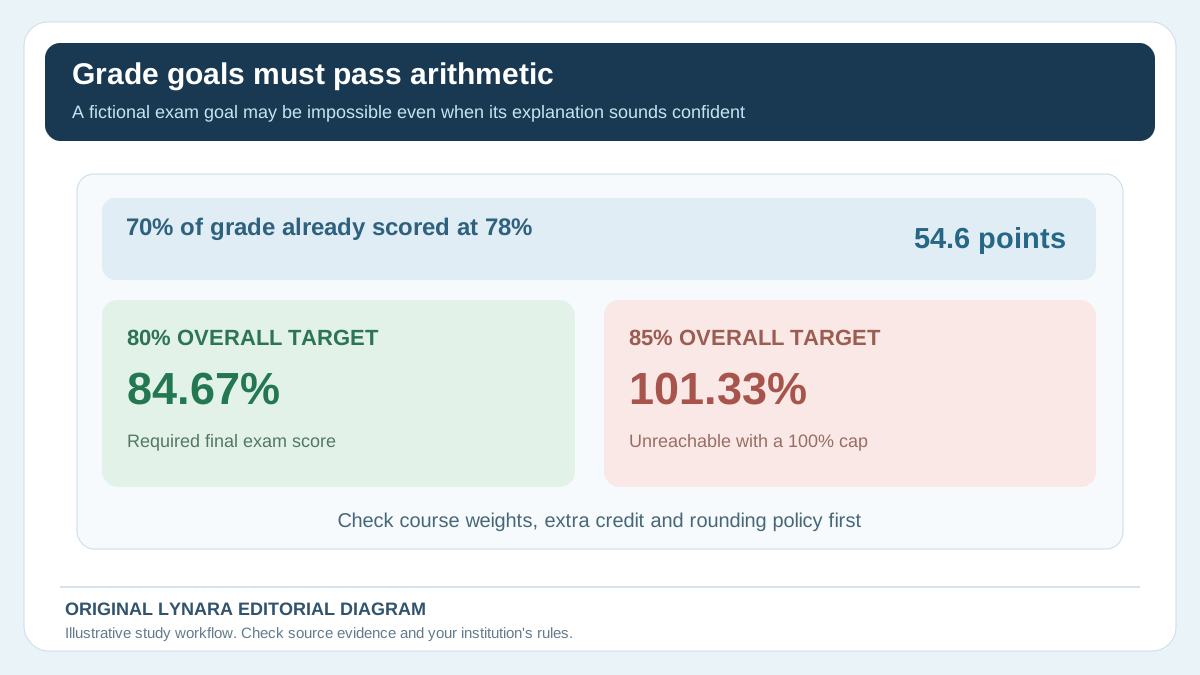
Suppose a course has completed 70 percent of its grading weight and the student's average on that portion is 78 percent. The final exam counts for the remaining 30 percent. The current contribution is 0.70 times 78, or 54.6 percentage points. To finish with an 80 percent overall grade, the student needs (80 - 54.6) divided by 0.30, approximately 84.67 percent on the final. A goal of 85 percent overall would require (85 − 54.6) ÷ 0.30 = 101.33 percent on the exam and is mathematically unreachable under the stated weights.
An AI tutor may explain this clearly, but you should verify that the model used the correct grading policy, the correct category weights and no hidden extra-credit assumption. Calculate the numbers yourself first, then use the Final Grade Calculator to check the scenario. This worked example illustrates a strong use of AI support: interpreting the result and selecting a realistic study target after the mathematics has been validated. It does not mean the assistant knows the institution's special grading rules.
Why citation, privacy and academic rules still matter
A study assistant can invent journal citations, misquote a chapter and produce plausible-looking explanations for concepts it has misunderstood. Never put a generated reference directly into an assignment without verifying the original publication and all required fields. When asking for a source, request enough detail to locate the actual work, then inspect it yourself. Lynara's citation tools can format known source metadata, but formatting does not certify that a publication exists or supports a claim.
Privacy matters too. Avoid uploading classmates' private records, confidential assessment material, identifiable student data or copyrighted documents when you do not have permission. Read the institution's AI policy and the provider's conditions, especially when using a managed school account. It may be permissible to ask for practice questions while impermissible to have a model complete a graded assessment. A useful assistant supports learning within those boundaries instead of helping conceal work the student did not do.
How to judge whether the method is working
Measure independent performance rather than the amount of AI content produced. A short baseline quiz on day one and a similar, unseen quiz near day seven can reveal whether factual recall and reasoning are improving. Track errors by topic, not just a single percentage. If the student scores better only when viewing the assistant's previous explanations, they have not demonstrated the same improvement as answering new questions unaided. Time spent is a planning input, not a learning result.
Another check is whether the student can explain a concept to someone else without using jargon copied from an AI response. If they cannot defend a statement or solve a slightly altered problem, return to the source, practice the underlying steps and ask for a different example. Use the study hub for scheduling and question-building workflows, and the guide library for topic-specific methods. Choose tools that reduce friction around practicing; do not let them remove the practicing itself.
A sustainable routine after the first week
At the end of the trial week, keep whatever genuinely helped and remove what created extra work. Perhaps the assistant was excellent at generating initial recall prompts but poor at grading nuanced free-response answers. Keep the prompt-writing role and verify answers with class materials. Perhaps it overproduced flashcards, creating more review obligations than the learner could sustain. Reduce the deck to the facts and concepts that matter most. A study system improves when it responds to evidence rather than advertising.
The practical principle is simple: attempt, check, correct, revisit. AI can support any of those stages, but should never quietly reverse their order so the student reads a solution before thinking. The aim is to leave a study session with more knowledge accessible from memory, not merely a better-looking document. This article provides a suggested educational workflow rather than a claim that one provider or study method produces a guaranteed test-score improvement for every learner.
Editorial limitations
The revision schedule and grade case are illustrative worked scenarios. No real student assessment or score improvement is claimed. Confirm academic rules, privacy obligations and cited facts independently. See Lynara's editorial policy.