Study More Efficiently With AI: A 7-Hour Weekly Plan
Studying less can be sensible when you remove low-value work. This worked schedule shows where AI can save administration time without removing retrieval, practice and error correction.
The time you can reduce is not always learning time
Many students spend substantial time copying notes, reformatting documents, finding assignments and deciding what to study next. Some of those activities support understanding, but some are administrative. AI tools can reduce repetitive sorting and produce draft study prompts quickly. That does not mean the same amount of memory or reasoning can be acquired in every subject with half the independent practice. A faster workflow preserves the difficult parts that actually reveal whether the learner knows the material. The realistic target is to spend less time choosing tasks and more of the available time on the right tasks. For example, rather than requesting a 3,000-word summary of a chapter and passively reading it, ask for ten short questions mapped to the chapter's learning objectives. Attempt the questions without notes, then focus on the topics you missed. If the generated questions are inaccurate, remove them. The method is efficient because it directs effort toward demonstrated gaps, not because a model has secretly absorbed information on the student's behalf.
Start with a baseline before building a timetable
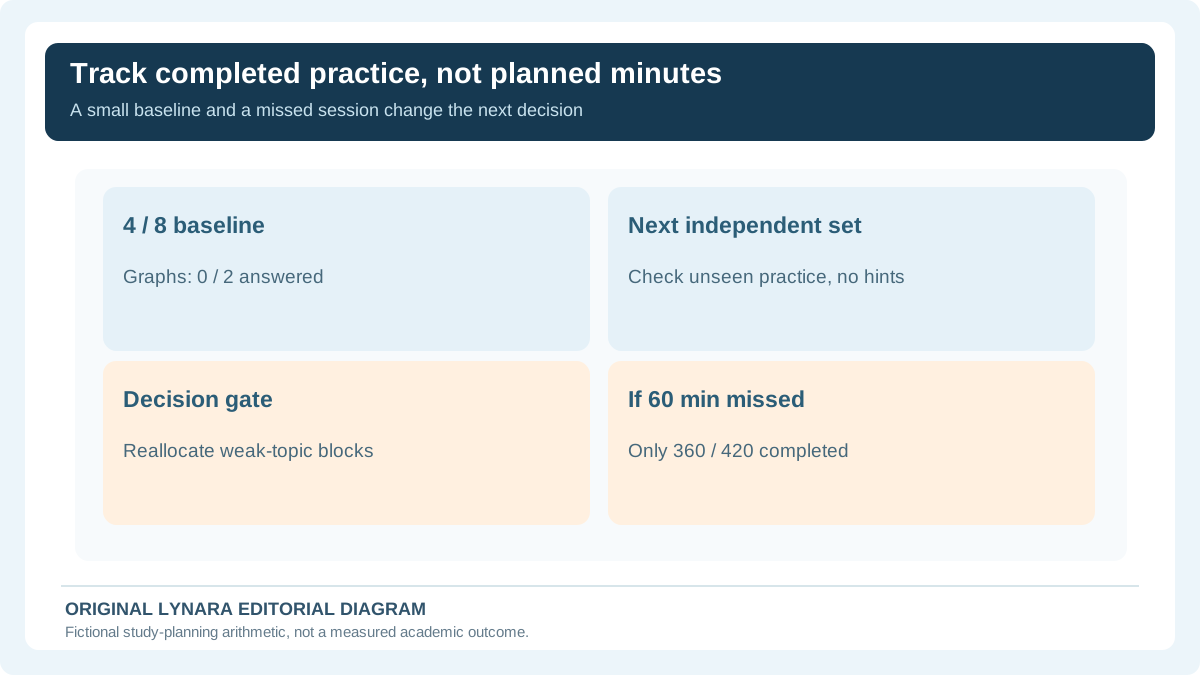
Imagine a student has an exam in seven days covering fractions, linear equations, graphs and probability. They have seven hours available across the week. Before asking an assistant to write a polished schedule, they attempt a small baseline test with two unfamiliar questions per topic. Suppose they solve both fraction questions, one linear-equation question, neither graph question and one probability question. That is four correct out of eight, with the largest observed difficulty in graphs. The baseline is illustrative and too short to serve as a formal assessment, but it is enough to make a tentative study plan. Instead of dividing every hour equally, the student can reserve more time for graphs and equations while retaining brief practice in the stronger topics. Ask an AI planner to suggest a distribution based on the available calendar, but inspect whether it includes practice and breaks rather than hours of passive summaries. The plan is provisional: after two sessions, the student should review new errors and redistribute time if the weakest topics change. Scheduling is an input to learning, not evidence that the material has been mastered.
The seven-hour weekly allocation
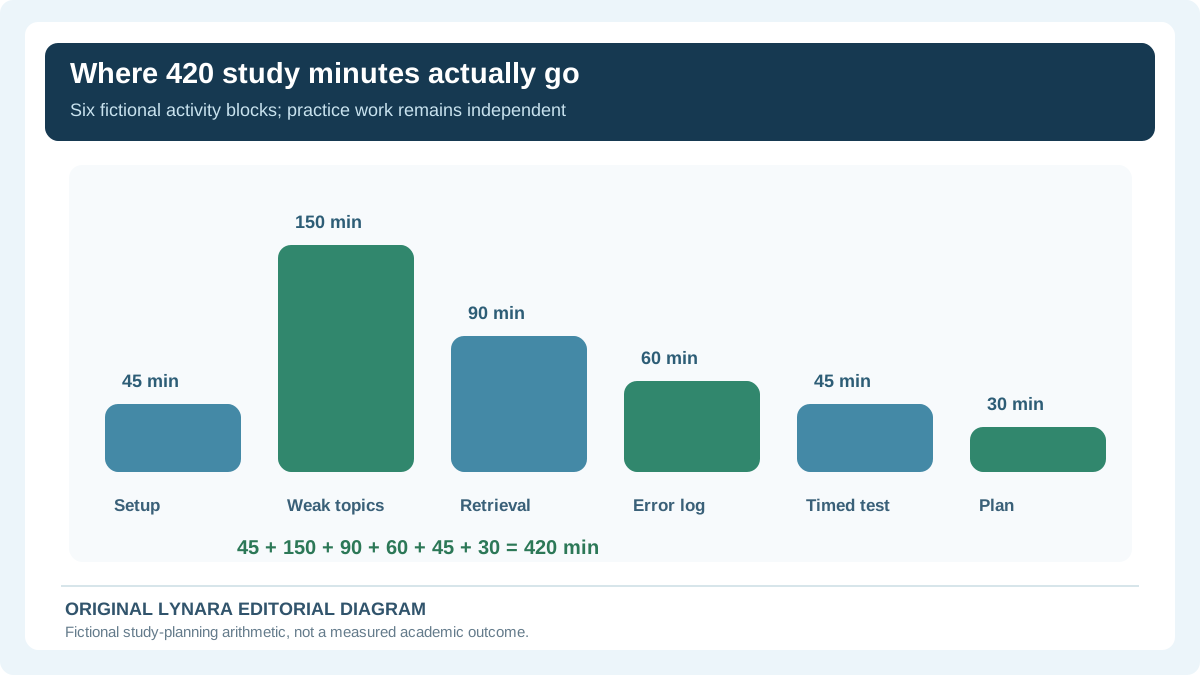
A practical example is 420 active minutes of study, spread across usable days. Assign 45 minutes for the baseline and setup, 150 minutes for weak-topic problem solving, 90 minutes for mixed retrieval, 60 minutes for reviewing mistakes, 45 minutes for a timed practice set and 30 minutes for final retrieval and planning. The sum is 45 + 150 + 90 + 60 + 45 + 30 = 420 minutes. Breaks and travel are additional time unless explicitly counted. This is a scenario to adapt, not a scientifically established optimum. For a learner with little uninterrupted time, the same work can be scheduled as five sixty-minute sessions, one ninety-minute session and a final thirty-minute session. Those durations also total 420 minutes. If only 360 minutes are realistically available, remove or scale a planned task deliberately instead of quietly pretending the week still contains seven study hours. Lynara's study planning tools can help translate the total into actual usable dates. The main constraint is honest accounting of time.
Batch the repetitive setup work into a short preparation block
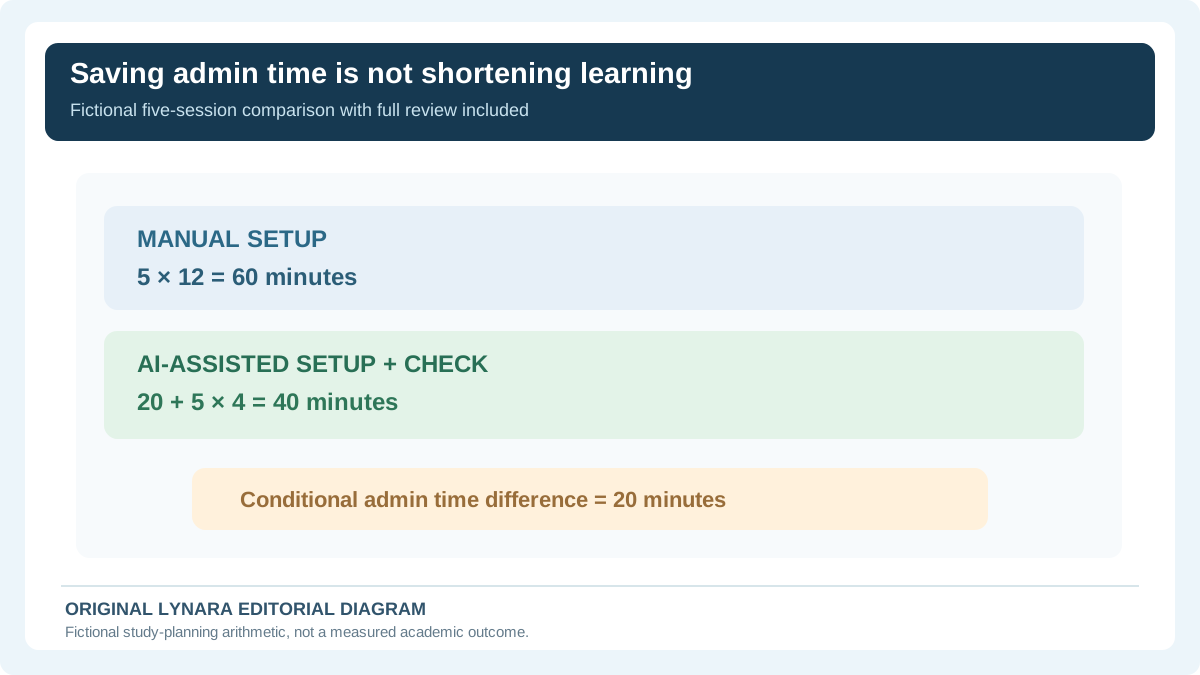
Preparing a study session can mean locating source pages, checking deadlines, selecting practice questions and arranging files. These tasks need attention, but their administrative cost can expand to fill an entire evening. A specific use for AI is creating a short preparation checklist from verified course objectives. The learner can ask for a sequence of tasks that uses material they already have, then confirm every proposed source or question is appropriate. The student still needs to carry out the actual practice. The gain comes from entering a session with a clear next action rather than redeciding the plan over and over. Imagine five study sessions, each of which previously began with twelve minutes of searching for notes and choosing work. That amounts to sixty minutes of setup across the week. If a single, carefully checked twenty-minute planning block reduces each later session's preparation to four minutes, the week's administration becomes forty minutes rather than sixty. The example saves twenty minutes on these fictional assumptions, not half of the learning time. Track the real preparation time before making a personal claim that a tool improved efficiency.
Reduce task switching and make the next action unambiguous
An attractive automatically generated timetable can still waste time if every study block requires switching between six applications and searching for another document. Keep the instructions for each block in one short place: topic, source pages, exact exercise type, estimated minutes and how the result will be checked. Use AI to draft this task card if it saves setup effort, but confirm that the referenced material exists and is allowed for the assignment. The goal is a practical workflow the student can begin without another round of planning. For a hypothetical session of sixty minutes, reserve ten for reading the current objective and finding a verified example, thirty-five for uninterrupted independent practice, ten for checking the results and five for noting the next task. That adds to sixty. If the checking reveals more work than the plan allowed, update the next session instead of pretending the original schedule was successful. Time saved by fewer transitions does not demonstrate mastery by itself; it simply protects the limited time reserved for genuine practice. The detailed retrieval methods are covered in our active-recall article.
Summaries can help, but they need a source boundary
AI summaries are attractive because they turn a long document into short notes, but they can omit an exception, distort a definition or overemphasize a minor point. For course material, start with a permitted, reliable source and record the boundaries: chapters, learning objectives and teacher instructions. Ask for a table of key terms and relationships, then spot-check it against the original. Do not accept invented citations or missing conditions merely because the layout looks polished. A strong workflow retains a link between each claim and its source. If the assistant identifies an important formula, find the formula in your notes and confirm variable definitions. If it proposes likely exam questions, remember that it does not know a private test paper. Use those questions as practice, not as a prediction of what will appear. The administrative time saved by summarization is only valuable if mistakes are caught before they become incorrect flashcards and then incorrect exam answers.
Turn repeated planning into one reusable weekly task queue
Students can lose time repeatedly copying the same deadlines, assembling similar practice prompts or locating where they left off yesterday. A useful administrative tool is a weekly task queue with four fields: what needs doing, source or location, estimated time and completion state. AI can suggest an initial order from the student's own list, but the student should check deadlines and estimate realistic effort. A task queue should contain only work that genuinely exists; a model that invents a reading assignment is not helping. At the end of each session, update the next action in a sentence rather than recreating the entire schedule. If a reading was finished but its questions were not attempted, the next action should be the questions, not another summary of the same document. Preserve one list of unfinished tasks instead of scattering several conflicting AI plans across conversations. This approach can reduce duplicative administrative work without replacing the specialist practice methods explained in our separate exam and active-recall guides. It also makes it easier to replan when a class timetable changes, because the outstanding work is visible.
Account for fatigue and unavailable dates
A timetable that fills every available minute is fragile. Students may have work shifts, sports, family obligations or lower-energy evenings. If the plan assigns two difficult hours after a day when only twenty minutes is feasible, the inevitable missed session can create stress and destroy the rest of the schedule. Put high-priority work on days when concentration is realistically available, and keep some buffer. AI can help reorganize the calendar, but it must be given the real constraints rather than a fictional unlimited schedule. In the seven-hour example, missing a sixty-minute session leaves 360 completed planned minutes if nothing is rescheduled. The choice is then explicit: find a genuine extra hour, redistribute the remaining sessions or accept a reduced scope. Do not claim seven hours were studied because they appeared on the calendar. A shorter plan that is actually completed is more useful than an impressive automatically generated timetable that never matches daily life.
Measure time saved without inventing a learning-effect percentage
If the objective is studying faster, measure the actual time spent on setup, searching, copying notes and resolving scheduling confusion. Compare a typical week without a new workflow with a week that uses it, while accounting for the time needed to inspect and correct AI suggestions. For instance, suppose manual administration took twelve minutes before each of five sessions, or sixty minutes weekly. A new AI-supported process requires twenty minutes of initial verification plus four minutes of preparation for each session, totaling forty minutes. That is an illustrative twenty-minute reduction in administrative time, not a measured claim about exam scores. A student may discover that verifying AI-generated notes takes longer than preparing notes manually. In that situation, stop using the feature or limit it to a narrower task. Track the number of completed assignments and quality of independent work separately from time spent; a faster schedule is not valuable if essential tasks are left unfinished. Do not apply a percentage from an AI product advertisement to your own learning without appropriate evidence. The right result is a repeatable process that leaves more usable time for the actual assessment material.
A practical stopping rule for each session
End a study session when the assigned practice objective has been met and independently checked, or when attention has fallen enough that further time would be unproductive. For example, the goal might be to solve four different linear equations without hints and explain the error in one earlier question. Once those tasks are done, writing more decorative notes may add little value. A student can then use a short recap prompt to prepare the next session's starting question, while leaving the actual answer hidden. For learning research and responsible use, UNESCO's AI competency framework for students emphasizes critical judgment and ethical application. The framework does not prescribe a seven-hour weekly schedule; the numbers in this article are deliberately illustrative. The aim is a repeatable workflow that reduces time spent organizing, prioritizes weak concepts and retains independent retrieval. Less time spent studying only counts as progress when the student can still do the work when the assistant is not there.
Use the seven-hour budget as a real decision, not a rigid algorithm
Start with eight short practice questions selected from the actual course, two each on fractions, linear equations, graphs and probability. In this fictional example, the student answers four of eight correctly: two fraction items, one equation item, zero graph items and one probability item. That is 4 ÷ 8 = 50% of a small baseline, not a dependable final-exam prediction. Because no graph question was answered correctly, graphs may deserve first attention. But a two-question sample per topic has substantial uncertainty, so the learner should inspect errors and try more than one new graph problem before declaring a lasting weakness.
| Activity | Minutes | Proof of completed learning activity |
|---|---|---|
| Baseline and setup | 45 | Eight attempts and a written list of errors |
| Weak-topic practice | 150 | Worked problems with independent answers |
| Mixed retrieval | 90 | Unseen questions attempted before hints |
| Error-log corrections | 60 | Each repeated error mapped to a next task |
| Timed practice | 45 | Time and correctness recorded separately |
| Final recall and planning | 30 | One-minute summary and next-session questions |
| Total | 420 | Seven hours excluding any separately scheduled breaks |
Plan those minutes around real commitments. If a sixty-minute session becomes impossible and no other time is available, the week has only 360 completed minutes. Protect the most necessary independent practice before trimming decorative note formatting. Moving a block to another day is acceptable only if that day truly has capacity. Do not ask the model to mark a missed session complete because it has already written a polished plan.
Measure the administrative change without mislabeling it a study result
Separate the minutes spent selecting and organizing work from the minutes spent actually recalling or solving. A fictional student previously spent twelve minutes on manual setup before each of five sessions: 5 × 12 = 60 minutes. An AI-supported planning process has an initial twenty-minute review and four minutes of preparation before each of five sessions: 20 + 5 × 4 = 40 minutes. The difference is 20 minutes of administration, subject to whether the plan is valid and whether repair work was counted. It is not a twenty-minute reduction in the learning required to understand the same material.
A good exit check is an unseen question solved without the assistant. If AI produced ten questions but three contain incorrect answers, correct or discard them before studying. Do not count automated output volume as progress. In the active recall guide we separate independent answers from hint-assisted answers; use the same distinction here. The UNESCO AI competency framework supports critical judgment and responsible use, not a claim that AI can reduce required learning to a fixed number of hours.
Editorial context
The sample study minutes and practice schedules are hypothetical planning exercises, not measured improvements in grades or recall. To judge a real change, compare your own baseline with later closed-book practice on equivalent material; track mistakes and time spent checking AI output. School rules and source verification still apply. Our editorial policy describes how illustrative outcomes are labeled.