Paraphrasing vs. Plagiarism: Examples and Citation Checks
Learn the difference between changing words, understanding a source and giving appropriate credit.
Paraphrasing and plagiarism are different questions
Paraphrasing means explaining another person's ideas in your own writing while preserving their meaning and crediting the original work. Plagiarism involves presenting another person's words, ideas or contributions as your own contrary to applicable academic standards. A student can paraphrase correctly and cite the source, or can change several words while still improperly taking the idea without attribution. Neither a similarity-score threshold nor a piece of AI-generated text decides whether scholarly credit was given properly. Purdue OWL's paraphrasing guidance explains why independently restating essential meaning and documenting the source go together.
A citation cannot rescue a near-copy
Adding a citation to a sentence is necessary for borrowed ideas, but the citation alone may not excuse copying distinctive original wording without quotation marks. Suppose a source says, hypothetically, “The midnight buses reduced the distance between work and possibility.” If a student writes “The nighttime buses decreased the distance between employment and opportunity” with only a citation, the unusual structure remains suspiciously close to the original. If that exact phrasing matters, quote it within the rules of the assignment; otherwise explain the underlying finding naturally in the context of your own question and cite the evidence.
Read, set aside, then explain
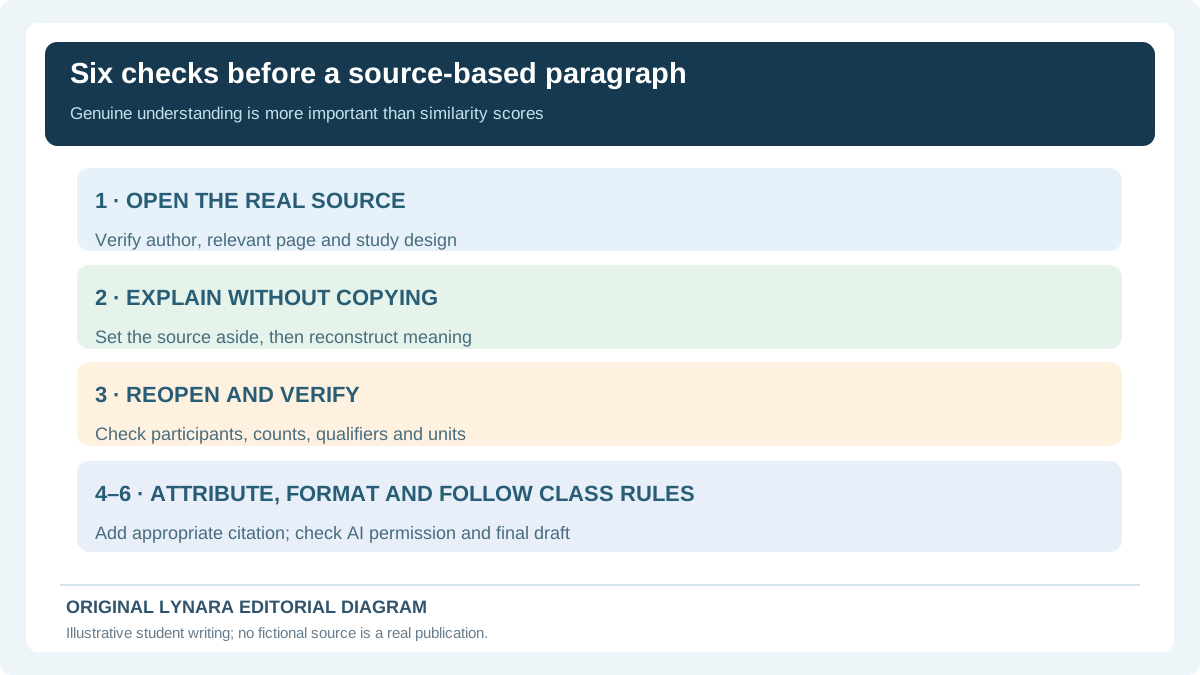
A useful process is to read the original carefully, understand the finding and its limitations, close the source temporarily and write an explanation for a different reader. Reopen the paper and verify that your version has not changed the numbers, population, confidence or direction of the claim. Purdue OWL recommends this type of deliberate comprehension step, rather than swapping a few synonyms. If you cannot explain the result without staring at a sentence, revisit the paper's methods and vocabulary before attempting the paraphrase.
Original example: a specific result becomes a careful sentence
Imagine a fictional education paper reporting that, among 80 volunteers in one class, an optional practice worksheet was associated with a higher average quiz score. A careful paraphrase could say, “In a single-class study of 80 volunteers, participants who chose the extra worksheet had higher average quiz scores; the observational design does not show whether the worksheet caused the difference (Hypothetical Author, 2026).” Both the authorship and year here are illustrative and are not a real source. The rewritten sentence keeps the sample, result and causal limitation while giving the writer a different explanatory structure.
Why synonym substitution fails
Replacing “participants” with “subjects” and “increase” with “rise” may leave the original syntax and argument intact. It can also make meaning less accurate. Technical phrases like confidence interval or randomized trial should not be replaced with near-synonyms that distort the study design. The goal is not lexical distance for its own sake; it is understanding and transparent credit. A paraphrase may be shorter or longer than the source as long as it represents the relevant content faithfully and has the attribution the assignment requires.
Quotation is appropriate when exact language matters
Use a direct quotation when a precise definition, legal language, historically significant formulation or distinctive passage is the object of analysis. Quotation marks and a correct reference tell the reader which words came from the source. Your own essay still needs interpretation: do not string together several quotations and expect them to become an argument. Check the required format for page or paragraph numbers and any rules for block quotations. Purdue OWL's teaching comparison distinguishes summary, paraphrase and direct quotation.
Summarizing compresses scope, not accuracy
A summary selects the main points of a larger source, such as the question, method, central findings and principal limitation. A paraphrase usually restates a more specific part in similar detail, though length is not a strict definition. Both require credit for borrowed research. An entire report about several study methods might be summarized in a paragraph, while one result needs a careful paraphrase with the actual sample and units. Do not state that a source “proved” something when it only reported an association.
Match references to claims, not to paragraphs by habit
If one paragraph draws three findings from three studies, readers need to understand which source supports each. Placing a single reference at the end may be unclear. Use the convention required by your instructor or publication style, and ensure that every study named appears accurately in the reference list. Our Citation Generators can format metadata supplied by the student, while the AI Claim Verification Tracker can store a manual list of claims to check against original works. Neither makes false metadata correct.
Citation style and plagiarism risk are separate
APA, MLA, Chicago and other systems have different punctuation, author-date or notes conventions. Poor punctuation is not automatically deliberate plagiarism, and perfect style does not prove that an author truly read the cited work. The essential task is honest representation of the source and an attribution a reader can follow. Check the instructor's policy for paraphrasing, collaborative work, translation, common knowledge and permitted AI assistance. These policies can vary by course and institution.
What to do with AI-generated paraphrases
If an AI system rewrites a paragraph, it may subtly change who participated, what was measured or whether a result was statistically supported. Never paste a generated paraphrase straight into an assignment and assume that it is an accurate representation. Compare every claim with the real source. Do not ask a model to invent an author, DOI or page number. If a class disallows AI-written text, using a paraphraser can breach the class rule even when the resulting sentence contains a citation. When AI use is allowed, disclose its role exactly as required.
How to compare two draft versions
A writer may want to see whether an edited paragraph actually changed its structure. Our Essay Revision Comparison Tool compares two user-provided versions for textual changes; it does not calculate a plagiarism verdict or infer authorship. Use that output to audit your revision decisions, then separately reread the original source to verify meaning and attribution. Large changes do not prove honesty, and small changes do not automatically mean misconduct. Evidence of understanding and traceable references matter.
A practical checking routine
For every borrowed passage, write the source identifier, key claim, important numbers, method or qualifier, your independent wording and the location where the evidence was found. Mark direct quotes clearly. Compare your draft against the source after the initial write. Note whether the source is verified and whether it actually supports the inference you make. Save accurate bibliography details, and ask the instructor when uncertain about common knowledge or unusual source types. Our AI detector limitations guide explains why model-generated scores should not replace this source-based process.
Better writing rather than a trick to lower similarity
Students sometimes ask how many words they must change to escape a plagiarism check. No universal number makes a passage original, and trying to game a score misses the academic objective. Work from the underlying idea, state it accurately in a genuinely appropriate voice, and credit the source. If a source contains an important technical definition, quoting with a reference may be more ethical than forcing awkward synonyms. The result should help a reader verify and understand the research—not merely make copied words look unfamiliar.
Three versions of the same fictional source: compare the evidence
For a fair exercise, start from an invented source sentence: “After weekly practice sessions, twelve of the twenty fictional students reported that they felt more prepared, although quiz scores were not measured.” There is no published study behind this demonstration. In a real paper, the attribution would have to lead to a verified source rather than a made-up title.
| Draft type | Fictional example | What is wrong or right? |
|---|---|---|
| Patchwriting | After weekly training sessions, twelve of twenty students stated they felt better prepared, but test scores were not measured. | Most original sentence structure remains; synonym replacement is not an independent explanation. It also omits attribution. |
| Overstatement | Weekly practice improved exam results for most students. | The source reports self-perceived preparation, not exam performance or a demonstrated causal effect. |
| Faithful attributed paraphrase | In the fictional classroom example, 12 of 20 participants said weekly practice helped them feel ready, but the exercise contained no measured quiz outcomes (invented teaching source). | It expresses the actual result and limit in different explanatory wording and visibly identifies the source as invented. |
When using a real study, replace the placeholder with a reference you have personally verified. George Mason University's Writing Center explains why patchwriting, including word-by-word synonym substitution, remains an inadequate paraphrase. Their examples help students distinguish meaningful restatement from superficially changed text.
When should I quote, paraphrase or summarize?
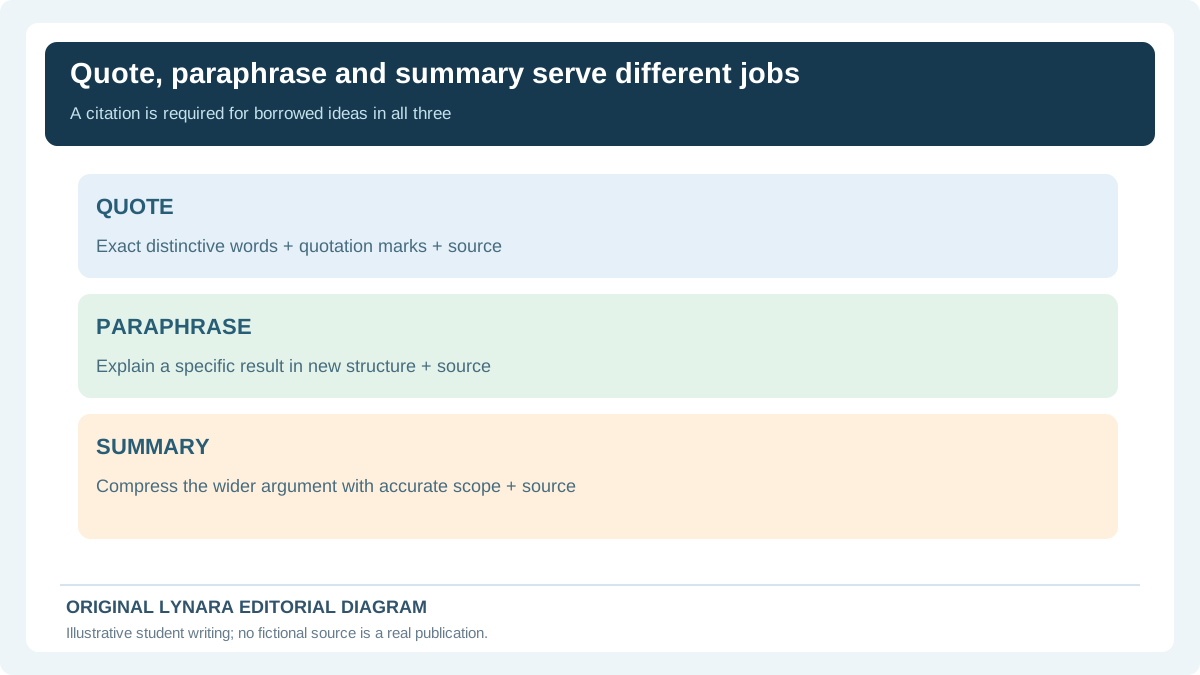
Quote when the exact original phrasing is important to the argument and your instructor allows direct quotations. Paraphrase when the particular finding or reasoning matters but the author's wording is not the focus. Summarize when a larger argument or section can be accurately condensed into its essential claims. Every borrowed finding still needs appropriate attribution unless it is genuinely common knowledge under the relevant rules.
Before submitting, pair the rewritten sentence with the original source and check the sample size, units, causal strength and quotation marks. Use the claim-verification tracker to record remaining source checks and our citation generators to format verified bibliographic data. Changing text solely to satisfy a similarity score is not a substitute for ethical source use.
A claim-preservation worksheet with an auditable numerical example
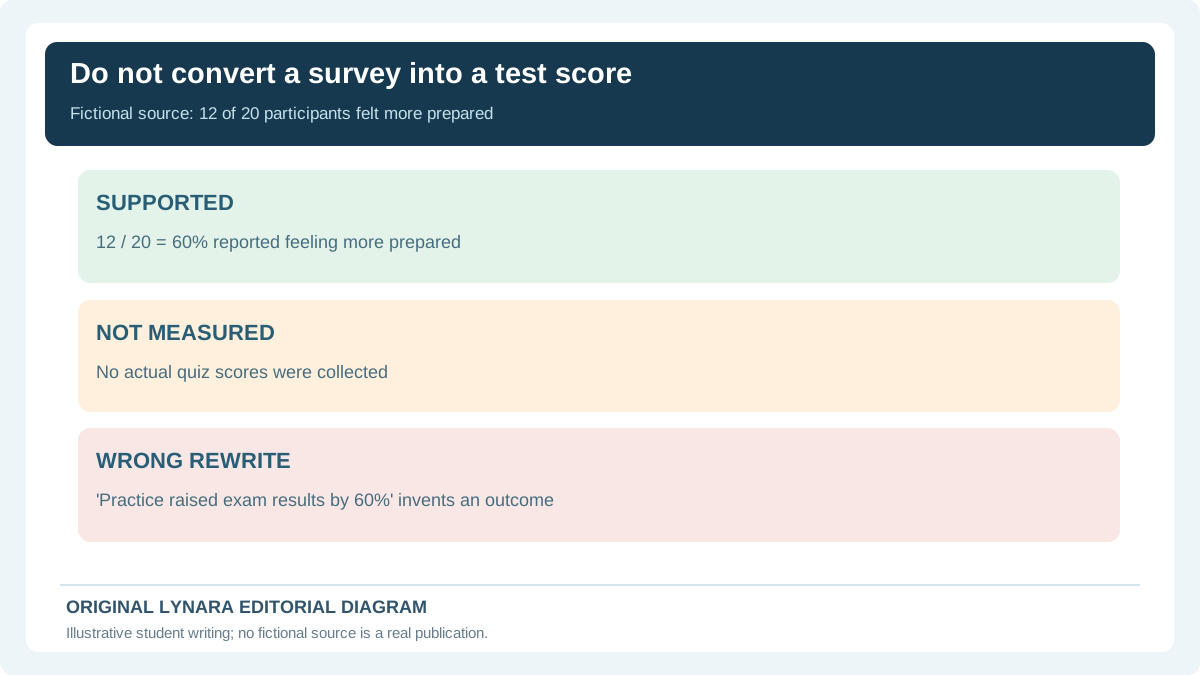
Consider only the invented teaching sentence already in this article: twelve of twenty fictional students said they felt better prepared after weekly practice, but no quiz results were measured. The ratio 12 ÷ 20 = 60% refers to self-reported confidence among the participants, not a 60% gain in exam marks, not a treatment effect and not a result that can be generalized to another school. If an assistant writes that practice raised student scores, it has substituted a new outcome, even when the English sounds polished and the bibliography appears plausible.
| Source element | What the writer must preserve | Common unsafe rewrite |
|---|---|---|
| Who | 20 fictional participants in one exercise | All students everywhere |
| What was observed | 12 said they felt more prepared | 12 showed higher scores |
| What was not measured | No examination or quiz results | Practice increased grades by 60% |
| Attribution | Identify this as an invented teaching source | Invent a journal author and DOI |
The George Mason University Writing Center's paraphrasing guidance distinguishes independent explanation from patchwriting that only replaces individual words. Purdue OWL likewise describes reading, setting the original aside and checking the new wording for faithful meaning. None of these approaches is an invitation to hide a source or defeat a similarity checker.
For real work, build the worksheet with the actual article's author, publication year, document location and precise supporting passage. Verify the paper is real before putting a citation in the draft. Preserve important technical terms when they are the established names of methods or measurements; forcing novel synonyms can make a scientifically accurate sentence wrong. When particular distinctive wording is central to the analysis, use a correctly attributed quotation instead of claiming it is your original phrasing.
The student's own critical contribution should be visible: explain why the result matters, how it relates to the assignment's question and what the reported design cannot conclude. A citation can support a factual sentence, but it cannot make a distorted interpretation accurate. Keep genuine draft history and use the Essay Revision Comparison Tool to inspect changes, not to claim that any number of substitutions proves non-plagiarism. Consult the instructor if quoting, common knowledge, AI editing or required citation style is unclear.