AI Writing Detector Accuracy: False Positives and Fair Review
Learn what an AI score can indicate, what it cannot prove and how to document genuine academic work.
An AI score is not a finding of misconduct
Students searching for “is this AI detector accurate?” deserve a more useful answer than a promise of a magic percentage. An AI-writing detector estimates patterns associated with AI-generated text according to a particular model and its training data. It does not know a student's intent, coursework rules or how a paragraph was created. Turnitin's guide to its AI Writing Report expressly says its tool may misidentify human, AI-generated and AI-paraphrased text and must not be the sole basis for adverse decisions. That limitation matters even if the score looks precise.
October 2026: the detector model changed again
Turnitin's official release notes dated October 14, 2026 describe an update to its English-language AI-writing model intended to improve detection while minimizing false positives. The provider says previously generated reports are not retroactively recalculated; an existing submission would need resubmission to obtain a report from the new model. This is a vendor statement about a software release, not an independent measurement of accuracy. When citing detector performance, always state the model release date, language, document type, tested sample and methodology. A current score or the percentage of qualifying text is not an established probability of student misconduct.
False positives and false negatives are different
A false positive means human-authored text is incorrectly flagged as likely AI-generated. A false negative means AI-written material is not identified by the detector. Both are possible and their rates depend on the test collection, language, length, genre and model version. A published vendor measurement from a particular laboratory does not guarantee the same performance on your short homework reflection, translated essay or edited draft. The fact that two detectors disagree is also not proof either is lying. They may model different patterns and use different classifications.
Why the 20 percent threshold is misunderstood
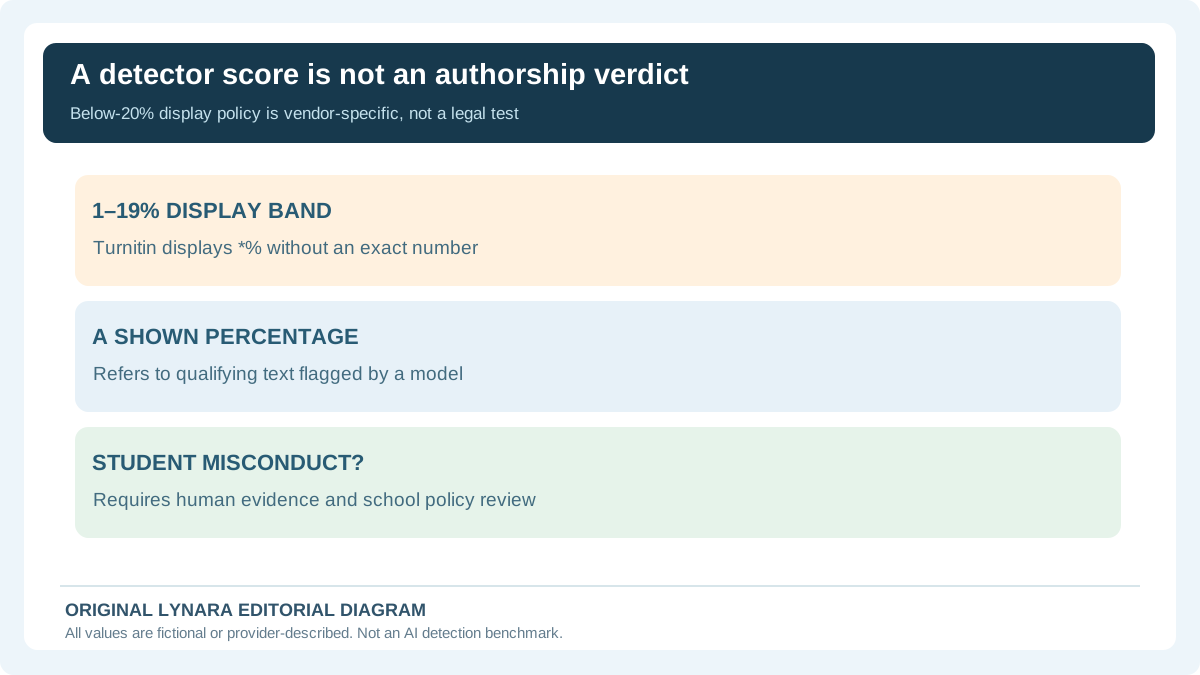
Turnitin's release notes explain that scores below 20% are not surfaced as ordinary percentages in its AI Writing Report, because low-range results have particular false-positive concerns. This is a vendor-specific interface and model policy, not a universal academic threshold for proving misconduct. A reported 21% is not a probability that a student cheated, and 0% does not certify human authorship. Models and display rules can change as providers update their systems; check the dated product guidance used by your institution.
The assignment policy matters more than a detector
Schools vary widely in whether they allow AI for brainstorming, feedback, grammar, translation, drafting or none of these. Read the actual course and institution policy. A student may use a permitted writing aid while a generic model finds the resulting text unusual; conversely, someone may violate a course's specific authorship policy without generating an obvious detector signal. Evaluate the issue against documented requirements, original assignment conditions and other evidence, not an assumed universal definition of acceptable AI use.
Document a genuine writing process
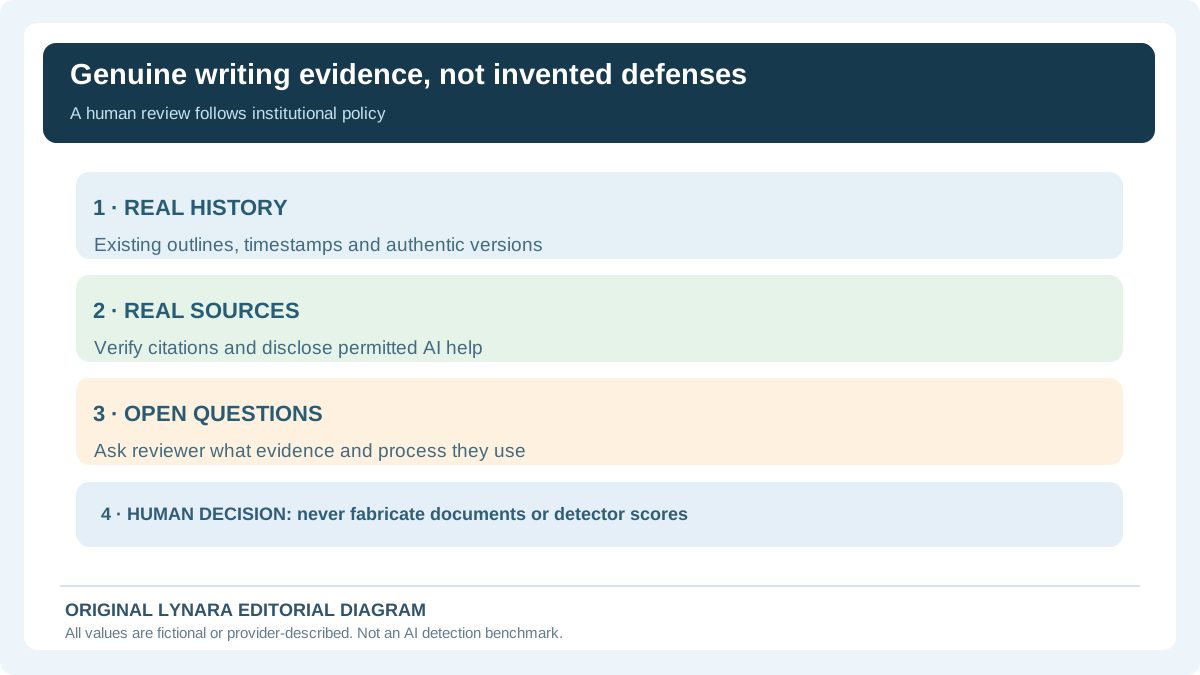
If an assignment requires original writing, retain the research notes and dated outlines from real work. Version history, draft comments, source records and feedback may help explain how a final paper developed, where the policy permits such records. These artifacts must be authentic: do not generate fake timestamps or fabricate old drafts to manufacture an alibi. Our Essay Revision Comparison Tool can help a student compare two actual versions to identify added and removed passages; it cannot certify who wrote them or prove academic integrity. Copying an output into a version history afterward does not make it authentic evidence.
Check factual accuracy separately
An essay can be written by a human and contain incorrect citations, fabricated numbers or misunderstood sources. Another piece of writing can involve a permitted AI tool yet accurately attribute every claim. These are distinct questions. Use the AI Claim Verification Tracker to record individual claims, source links and whether the original evidence has been checked. The tracker records the student's declared status; it cannot independently authenticate research. For references, use our citation tools only after verifying actual source metadata.
What to do when a detector flags an essay
First preserve the current assignment and any genuine previous versions; avoid making destructive edits just because an automated report was alarming. Read the school's policy and the actual written notice, including whether the score is a screening indicator rather than a formal allegation. Ask the instructor or relevant office what evidence and review process are used. If asked, describe real working steps and offer genuine outline drafts or tracked changes where appropriate. Do not claim the algorithm is always right or always wrong. A reasonable process considers the totality of circumstances.
Try the false-positive base-rate calculator
Open our AI Detector False Positive Scenario Calculator to adjust the fictional share of generated submissions, assumed detection sensitivity and false-positive rate. Its output is an expected count of human and generated texts among flagged submissions, not a probability of cheating for a student. If a real institution reports a percentage of qualifying passages instead of the fraction of whole submissions flagged, do not substitute that number into this probability scenario. The educational model makes the denominators visible; it does not benchmark Turnitin or any other brand.
A worked numerical explanation
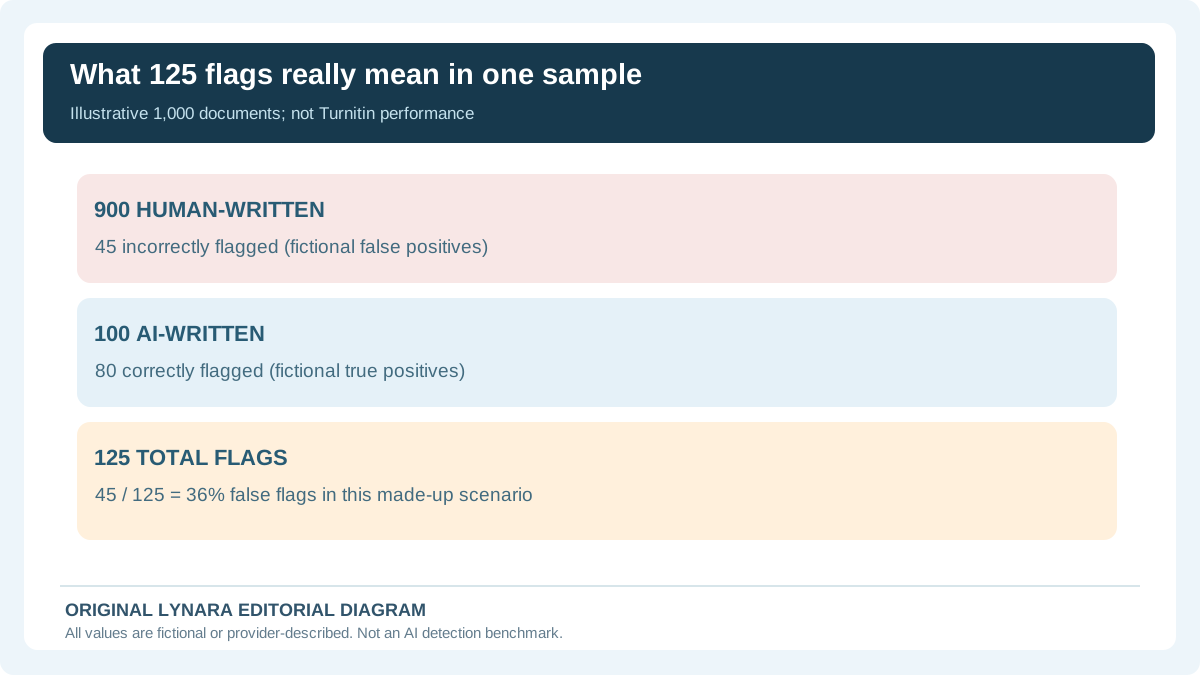
Suppose a hypothetical detector were tested on 1,000 writing samples, 900 written by humans and 100 actually AI-generated. Imagine it incorrectly flags 45 human samples and correctly flags 80 AI samples. Among 125 flagged samples, 45 are false positives; 45/125 equals 36% of flags in this fictional test. That is not a real-world statistic for Turnitin or any other provider. The point is that sensitivity, false-positive rate and the underlying proportion of AI samples all influence what a flag means. A “95% accurate” marketing claim alone does not answer the probability of misconduct for an individual student.
Do not rewrite solely to fool a model
Online tutorials sometimes suggest inserting awkward phrasing, random errors or synonyms to “humanize” text. Such methods do not improve the evidence, reasoning or clarity of an academic paper. They can damage a legitimate student's work and may break explicit course rules. The better academic task is to address the actual rubric: make claims supported by real sources, write in your own way and be able to explain your reasoning. If a class permits AI assistance, disclose it as the instructor requests; if it does not, do the work without prohibited assistance.
Short writing, languages and changed models
Detector behavior can depend on the text type. A short bullet list, formula-heavy lab report or highly standardized professional description may provide less distinctive linguistic evidence than a longer essay. Language and model support also vary. Turnitin has published dated changes to its Spanish-language detection and other capabilities. It would be misleading to make a single undated claim that every tool is equally reliable for every learner. Before interpreting any score, verify whether the tool supports the language, assignment format and word count.
Distinguish the plagiarism checker from AI detection
A text-similarity system compares strings against existing material; it does not directly determine intent or authorship. An AI-writing detector uses a different model. Neither answer substitutes for accurate quotation marks, citations and the institution's academic-integrity rules. See Paraphrasing Versus Plagiarism for how to keep borrowed ideas attributed correctly. A student could receive a low similarity score while presenting someone else's ideas without attribution, or a high similarity score because of legitimate quotations and references. Raw indicators need interpretation.
A grounded checklist to finish with
Ask what your instructor allows; read the detector provider's current documentation; distinguish a risk signal from a confirmed outcome; retain only genuine drafting artifacts; verify the factual claims and original citations; and respond through the school's documented review process if needed. Our revision comparison tool, claim tracker and reference tools support transparent coursework without pretending to diagnose authorship. The objective is better evidence and fair interpretation, not another number claiming to know who wrote a paragraph.
Evidence review table: what to bring to a fair conversation
A detector flag is a prompt to examine evidence, not an instruction to manufacture a defense. If a school requests an explanation, keep the records that genuinely exist and follow its established process. The table separates useful evidence from claims that the evidence cannot establish.
| Record | What it may help establish | What it cannot prove alone |
|---|---|---|
| Dated outlines and source notes | How ideas and references developed. | Who typed every final sentence. |
| Authentic document version history | The sequence of revisions in that document. | That every outside tool was or was not used. |
| Course policy and permitted-tool disclosure | Which uses were allowed and what was reported. | Whether a detector score is accurate. |
Do not backdate files, fabricate screenshots or upload private coursework to unapproved third-party “AI detectors.” If the institution permits an explanation, describe your real drafting and checking process and request a human review. The local revision comparison tool can help inspect two existing drafts; it does not certify authorship or overturn an institutional decision.
Interpret a flag using the number of false alarms, not a marketing accuracy claim
Consider a fictional review set with 1,000 documents: 900 written by people and 100 generated by AI. Suppose a detector flags 45 of the human documents incorrectly and correctly identifies 80 of the AI documents. There would be 125 flagged submissions, 45 of them incorrectly flagged, so 45 ÷ 125 = 36% of the flags in this one invented set would be false positives. The underlying human false-positive rate is a different quantity: 45 ÷ 900 = 5%. The hypothetical sensitivity is 80 ÷ 100 = 80%. These figures are made up to teach conditional probability; none is a reported performance figure for Turnitin or any other provider.
The mix of documents being reviewed affects what the flagged group contains. A vendor's testing result on one selected set of documents cannot establish the probability of misconduct for an individual essay. A score that highlights 'likely AI-written' text is also not a probability that a particular student violated an assignment rule. The correct questions are what material qualified for detection, which language and model version were used, what the institution permits, and what other authentic evidence exists.
Read model dates, reporting bands and school policy separately
Turnitin's October 14, 2026 release notes describe an English model update and explicitly state that earlier reports are not recalculated retroactively. An old score and a newly generated report may therefore have been produced using different model releases. Turnitin also documents the special asterisk display for detected AI writing below 20%—the 1–19% band does not show an exact number or text highlights. That is a reporting policy, not a universal threshold that proves wrongdoing at 20% or 21%.
The provider's official report guide acknowledges that its detector can misclassify human and AI-written text and cautions against using the output as the sole basis for adverse action. Its review guidance describes a percentage as one data point to discuss alongside other information. None of these documents guarantees the experience of a particular learner.
For a real concern, preserve genuine pre-existing outlines, notes and revision records if permitted. Review the writing-assistance rules for that particular course, disclose actual permitted tool use accurately, and request the documented human review process. The student should not try to defeat a detector by intentionally degrading writing, create artificial edit histories, or upload private coursework to extra services that the school has not approved. The worksheet recovered from the earlier editorial branch explains what genuine artifacts may support and what they cannot prove on their own.