AI Product Descriptions: Verify Every SKU and Claim
Make a product page clearer without promising a single feature your supplier has not actually documented.
Start with your evidence, then the draft
Use Lynara's AI Claim Verification Tracker to log claims from a draft against source records. For deciding whether to automate this kind of work at all, open the AI Workflow Suitability Checker. Neither tool fetches supplier specifications or certifies product claims automatically; the merchant remains responsible for checking its own data.
The expensive mistake hidden inside polished copy
An ecommerce product description can sound convincing and still be wrong. A model may expand “stainless finish” into “solid stainless steel,” change a 12-ounce capacity into 16 ounces or invent dishwasher safety because similar products have it. A reader may never notice the wording originated from an AI assistant. They will simply expect the item they buy to have the listed feature. Returns, complaints and lost trust can follow even when the sentence was written with good intentions.
The problem is not that AI can never help. Drafting repetitive catalog language is a plausible use case for a small team that has hundreds of reliable records but limited editorial time. The problem arises when a language model is treated as the product database. The NIST Generative AI Profile identifies the risk of confident but false generated information. A product listing needs a control that catches that failure before the text reaches a customer.
Build a source-of-truth record for each SKU
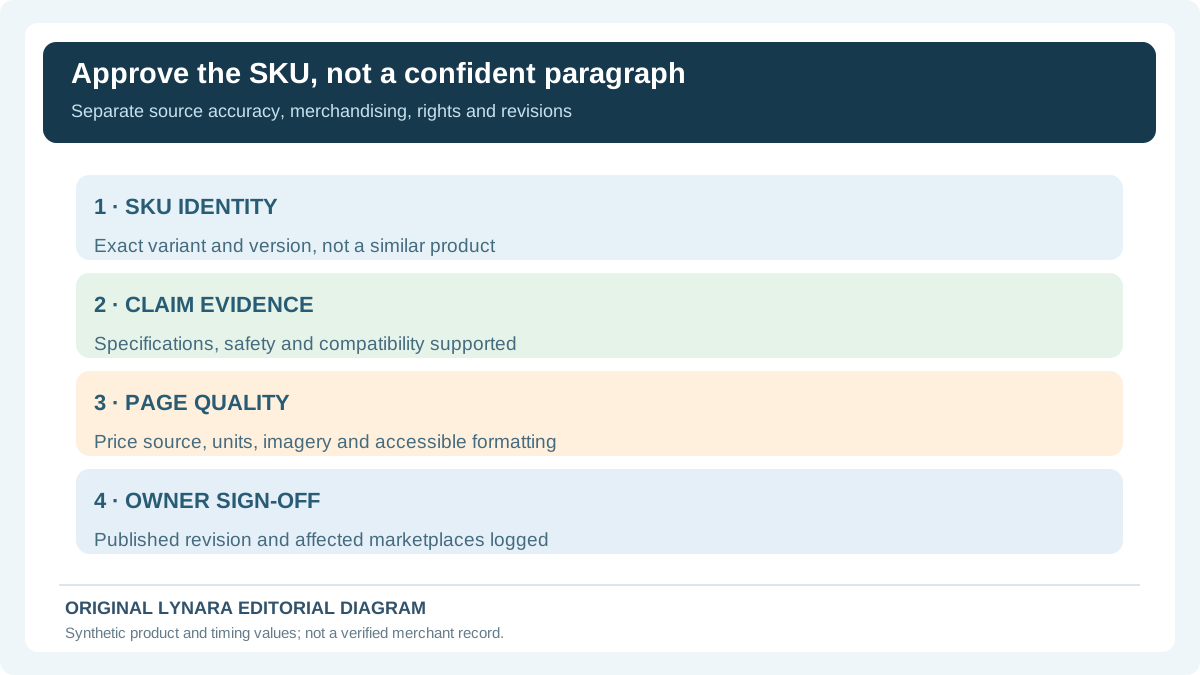
Before prompting, choose the authoritative record for a specific SKU: a supplier specification sheet, confirmed packaging information, approved manufacturer content or a verified internal product information system. Record the exact variant. A blue item and a green item can have different packaging or availability; a newer revision may have a different component or warranty. Keep a source date and a person responsible for resolving discrepancies. If the manufacturer changed a detail, a draft from last month can become inaccurate even when it was originally checked.
For each product, use fields such as internal SKU, brand, model, variant, material, dimensions, weight, capacity, included accessories, stated compatibility, care instructions, country-of-origin claim if documented, safety notes and verified warranty terms. Some fields may intentionally remain unknown. Unknown is a valid data state; it should not be converted into “probably yes.” GS1 US discusses the importance of grounding generative AI in trustworthy product data to reduce inaccurate outputs. The quality of the product record matters more than the cleverness of the prompt.
A fictional product example you can audit
Imagine a small shop sells a ceramic mug under the fictional SKU MUG-042. Its verified record says: ceramic material; 12 US fluid ounces; slate-blue color; one mug included; dimensions taken from its current supplier sheet. The record does not state whether the mug is microwave-safe, dishwasher-safe or suitable for use outdoors. An AI draft says: Enjoy your 16-ounce microwave-safe mug, crafted from premium porcelain and dishwasher-safe for effortless cleanup. That sentence is not a stylistic improvement. It introduces four potentially consequential facts not supported by the record.
Rewrite the core facts first: A slate-blue ceramic mug with a 12-ounce capacity, sold individually. If the supplier's source includes the dimensions, add them accurately and with units. For care instructions, either obtain an authoritative answer or omit the claim. Avoid substituting unsupported adjectives such as “premium,” “unbreakable” or “lifetime guarantee” for genuine information. This is a teaching example using an imaginary item, not a listing for an actual product.
Prompt the model to stay inside the source
A bounded drafting instruction might say: Write a concise ecommerce description in plain US English using only the verified attributes below. Do not infer certifications, care instructions, performance, origin, compatibility, safety, materials or warranty terms. If a requested attribute is not present, leave it out and list it separately under “needs verification.” Produce one factual short description, three supported bullet points and a claim-to-source checklist. Attach the authorized product record, not a jumble of supplier marketing copy and customer messages.
Specify the exact variant and audience. A compact product page for a home-office buyer may emphasize verified dimensions and what is included; a spare-parts listing may require precise compatibility evidence. Never ask the system to “make it sound more premium” without guardrails. The model may use language that carries implied claims even when it does not invent an explicit number. Keep a reviewer in the loop who understands the product category and can reject attractive but unsupported wording.
Audit every claim, not just the obvious numbers
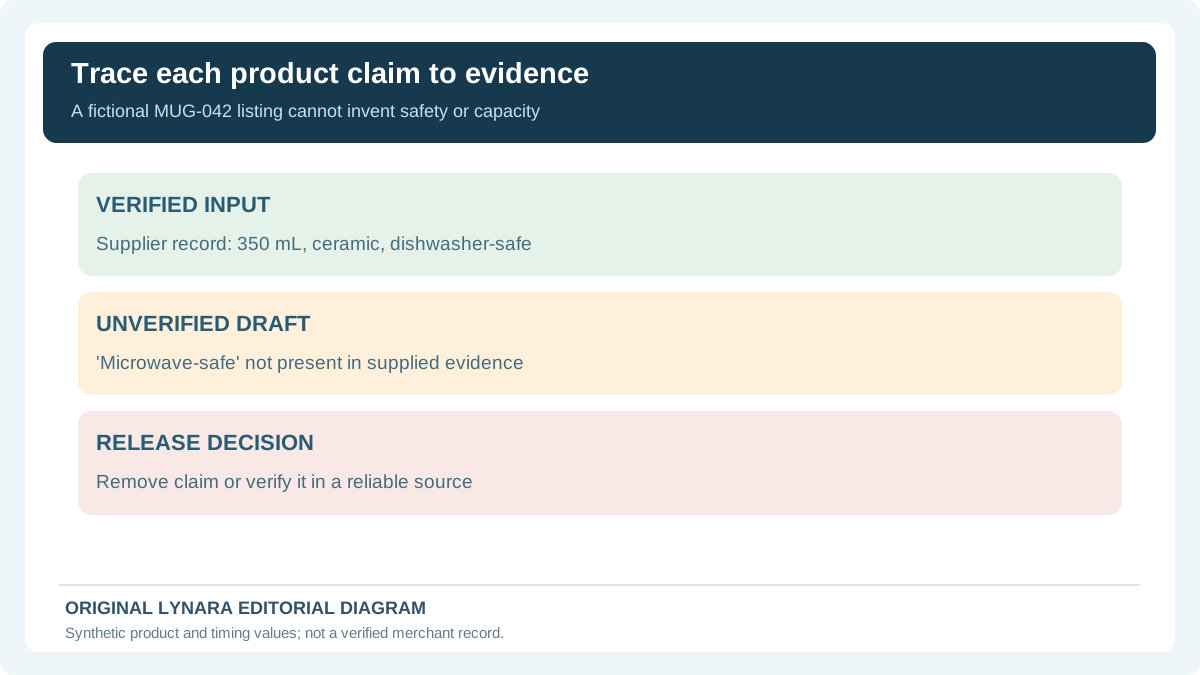
Break a draft into testable statements. For MUG-042, “ceramic” and “12 ounces” can be matched to the approved sheet. “Microwave-safe,” “dishwasher-safe” and “porcelain” cannot be verified from the hypothetical record. “Indestructible” would be an even stronger unsupported promise. Use a simple claim table: statement, source field or document, exact evidence, status, owner and correction. Give each statement a status such as supported, contradicted or unverified; do not mark it supported merely because another retail site uses similar wording.
Our AI Claim Verification Tracker can help organize this manual check. It is not connected to an external product-information service. When a claim is missing evidence, remove it or hold the listing. If the supplier document contradicts another source, identify which is authoritative for the specific SKU and revision. If a claim depends on testing, certification or a warranty, obtain the supporting documentation appropriate to the statement rather than trusting a model's confidence.
Advertising language has real consequences
A small business is still responsible for its marketing claims. The US Federal Trade Commission's advertising guidance emphasizes truthfulness, avoiding deception and having evidence for promotional claims. Rules can be more specific for certain product categories, markets or types of claims. This page is not legal advice and does not decide whether any particular listing is compliant. It explains why an editorial review needs more than correct spelling.
Special caution is appropriate for health, safety, environmental, origin and performance claims. “Made in USA,” “hypoallergenic,” “waterproof” and “clinically proven” can each convey something a customer relies on. Do not ask a general-purpose model to create or validate such claims from vague supplier notes. Verify what the statement actually means, whether the evidence covers the precise item, and whether the wording is appropriate for the intended selling context. When the evidence is incomplete, the honest choice is to avoid the claim.
Separate a good description from a complete catalog entry
A product page contains more than a paragraph. It may need a clear product title, accurate variant selector, measurements, available colors, included components, care instructions, price, shipping and returns links, images and accessibility labels. AI can help editors organize verified information, but it does not replace a working inventory or pricing system. Never let a generated paragraph invent current stock, delivery dates or discount periods. Those belong to systems that actually know the current state.
Photographs and diagrams need the same discipline. A generated lifestyle image might be attractive but show a handle, button, size or accessory the real product does not have. Do not use an artificial image as evidence of a product feature. If you need visual inspiration, distinguish concept images from accurate product photography and ensure the final presentation does not mislead. The goal is to make purchasing easier, not to create a fictional version of the item.
Test the workflow on a small mixed batch
Do not begin with the entire catalog. Choose a pilot that contains simple products, multiple variants and at least one item with uncertain specifications. Have a human write down the expected allowed claims before generating any text. Compare every draft with that list. Measure how many claims need correction, how long verification takes, whether information is omitted and whether the reviewer finds the result clearer than the current page. A system that performs well on ten nearly identical T-shirts may not perform well on complex electronics or regulated products.
For example, consider an imaginary pilot of 20 descriptions. Suppose reviewers find unsupported claims in four drafts. That is four of 20, or 20 percent of this invented sample, not an observed error rate of any actual AI service. Count the severity as well as frequency: a wrong shade name and a false electrical safety claim should not be treated as equally serious. Document the examples, update the instructions and retest. If errors remain difficult to catch, the right decision may be to stop using generative drafting for that category.
Count review time before calling it a saving
Imagine 40 listings. A fully manual process takes an illustrative 14 minutes per listing, or 560 minutes. An AI-assisted process needs 60 minutes to prepare source records and prompts, two minutes of generation per listing, and ten minutes of human verification per listing. Its total is 60 + (40 × 2) + (40 × 10) = 540 minutes. That saves only 20 minutes under these assumptions. If the real review takes 12 minutes per item instead, the assisted process becomes 620 minutes and is slower than manual work. These numbers are arithmetic examples, not productivity benchmarks.
The Business AI ROI Calculator can help evaluate editable cost assumptions. Include revisions, source preparation, quality-control checks and any provider fees instead of comparing raw draft speed alone. A reliable product description may reduce confusion, but this article cannot promise increased conversions or fewer returns. Those outcomes require actual store measurements and a fair comparison to existing pages.
Maintain accuracy after publication
Assign an owner to each catalog category and keep the approved source version with the published text. Trigger a new check when the supplier revises a specification, a product variant is added, a warranty changes or customer complaints reveal confusion. Avoid stamping “verified” onto every product permanently. A good review date reflects an actual check, not a scheduled automation that might have failed. Maintain a record of changes so the team can identify why a claim appeared and who approved it.
When a problem is reported, pause or correct the affected claim promptly according to the business's process. Search for that same unsupported attribute across other SKUs; a prompt mistake may have spread the error. If automated content goes to multiple marketplaces, update every active listing rather than only the website. A small, accurate catalog is more useful to buyers than thousands of confident descriptions with untraceable facts. That is the business case for source-checked AI: bounded assistance with evidence and accountability.
Make the evidence record useful when a seller changes a specification
A seller using a fictional SKU MUG-042 receives one supplier document showing a 350 mL ceramic mug marked dishwasher-safe. A draft assistant suggests 'microwave-safe, unbreakable and keeps drinks warm for six hours.' Those three extra claims are not supported by the document. Do not hide unsupported claims in adjectives or rely on the model's confidence. A release record should identify the exact SKU and variant, the date and edition of the supplier source, the approved wording, who checked it and what to do when the supplier updates its catalog.
| Draft claim | Evidence available | Decision |
|---|---|---|
| 350 mL capacity | Current supplier sheet for MUG-042 | Use with correct units |
| Ceramic body | Product material field for exact variant | Use with source reference |
| Microwave-safe | No documented appliance-use claim | HOLD: remove until verified |
| Unbreakable | No valid absolute performance evidence | REMOVE unsupported guarantee |
The FTC's advertising substantiation policy requires adequate support for objective claims, including reasonable interpretations implied by wording. That principle is particularly important for safety, compatibility, performance and warranty promises, where the consequence of a false statement may exceed a routine cosmetic error. FTC guidance does not certify a product merely because a merchant lists a supplier document; assess whether the actual evidence is adequate for the claim in context.
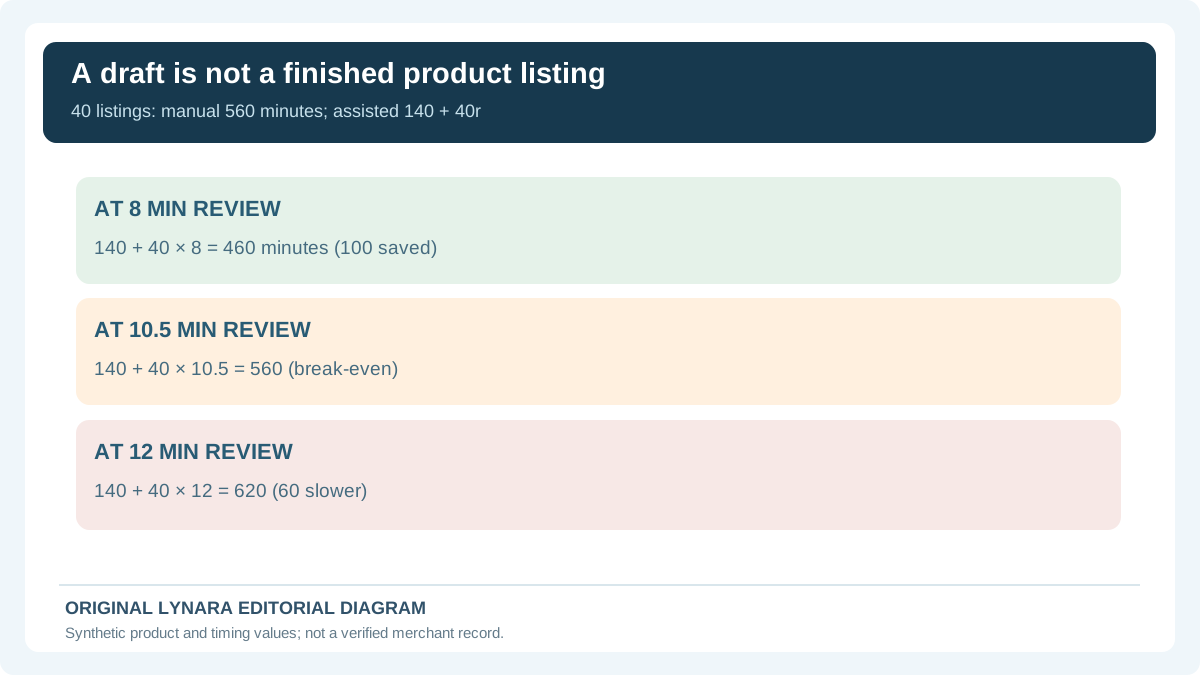
For a 40-listing batch, retain the prewritten break-even worksheet already in this article: 14 manual minutes each total 560. An assisted workflow costs 60 minutes setup and two drafting minutes per listing, or 140 before checking. At eight review minutes each the workflow costs 460, saving 100 minutes; at 10.5 minutes it costs 560 and breaks even; at 12 minutes it costs 620, or one hour more than manual. This exercise measures reviewer capacity under hypothetical assumptions, not conversion uplift, truthfulness or a verified vendor benchmark.
When a source changes, search other SKUs and marketplaces for repeated unsupported words rather than fixing only the current page. For a live store, send sensitive safety or regulatory statements to a qualified reviewer. A smaller list of truthful products is preferable to mass-produced descriptions that imply nonexistent certifications or incompatible device support. The Claim Verification Tracker can hold the evidence trail; it cannot itself authenticate a supplier or approve marketing claims.
Editorial method
MUG-042, the audit outcomes and all timing examples are fictional educational scenarios. No AI vendor or merchant workflow has been independently benchmarked by Lynara in this article. Source documents must be verified for each real product. See our methodology for our distinction between tool calculations, assumptions and independent evidence.
Find the break-even review time before scaling
The fictional 40-listing example above has 560 minutes of manual work and 140 minutes of AI setup plus drafting (60 + 40 × 2). If each assisted listing needs r minutes of human verification, total time is 140 + 40r. To be faster than the manual baseline, review must take less than 10.5 minutes per listing. That is a mathematical threshold, not a recommendation to rush or skip checks.
| Review per listing | Assisted total | Difference from 560-minute manual baseline |
|---|---|---|
| 8 minutes | 460 minutes | 100 minutes saved |
| 10 minutes | 540 minutes | 20 minutes saved |
| 10.5 minutes | 560 minutes | Break-even |
| 12 minutes | 620 minutes | 60 minutes slower |
Record actual preparation, rework and reviewer time in the Business AI ROI Calculator before expanding a pilot. A listing with an unverified safety, compatibility or warranty claim must stay on hold even when review time exceeds the break-even point. The calculation tests efficiency, not truthfulness or compliance.