College Essay Outline Examples: Build a Strong Argument
An outline should help you see what's missing before you spend an evening writing paragraphs you'll have to move. Start with the claim, then decide what evidence each part needs.
An essay outline is a reasoning map, not just headings
Students searching for a college essay outline often find the familiar introduction, three body paragraphs and conclusion. That format can work for a short assignment, but a longer analytical essay needs a structure that follows its argument. Begin with the question you must answer and a working thesis that another thoughtful reader might dispute. Then list the evidence necessary to persuade that reader. Harvard College's essay-organization guidance recommends breaking a thesis into the points needed to support it, rather than forcing evidence into a fixed paragraph count.
Read the rubric before choosing the outline
A compare-and-contrast prompt, a research argument, a literary close reading and a personal reflection do not share one ideal structure. Record the task verb: analyze, evaluate, compare, explain, defend or reflect. Note the required sources, word count, submission format, thesis expectations and special restrictions on AI use. The outline should solve the assignment actually set. For length planning, our Essay Word Budget Calculator helps allocate words among sections using user-selected assumptions; it does not generate evidence or determine what your instructor requires.
Build a claim that can guide the order
A weak thesis such as “Online learning is important” offers little direction because most readers could agree without examining evidence. A more focused hypothetical thesis might be, “For first-year students, short self-check quizzes may support exam preparation when paired with targeted feedback, but quiz frequency alone does not address poor access to teaching support.” This is an arguable educational question, not a research finding. The outline should separately consider practice, feedback and access; it should not assert that actual studies support a specific improvement without checking them.
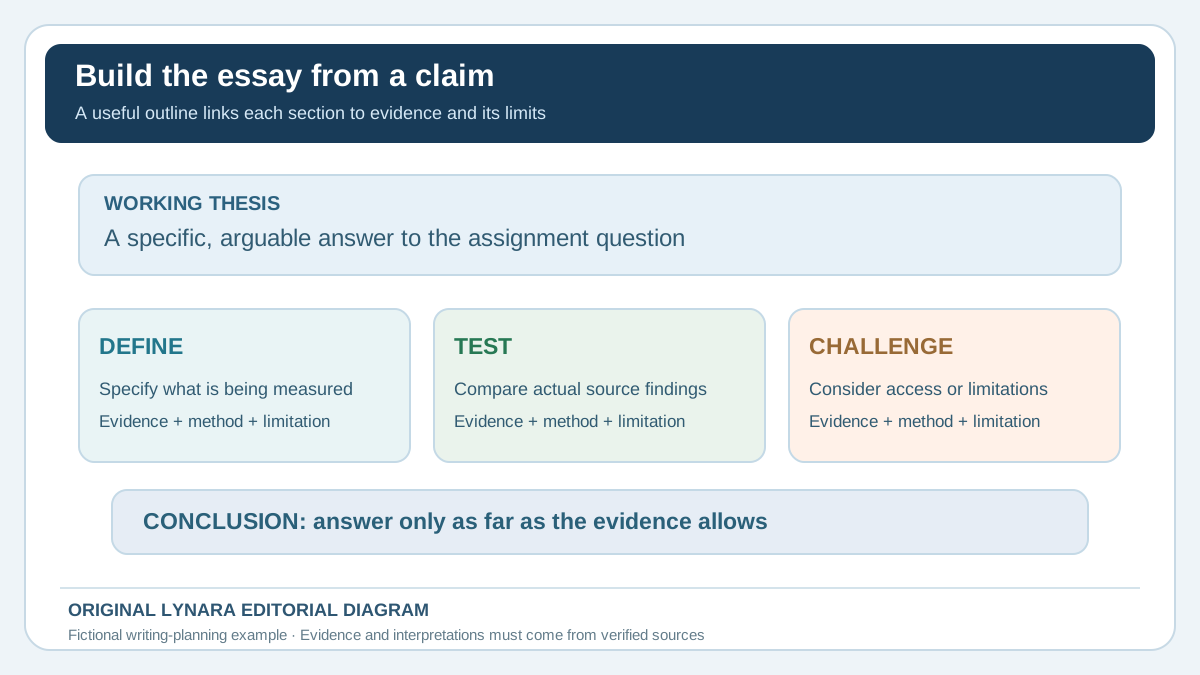
Worked outline: research essay about feedback
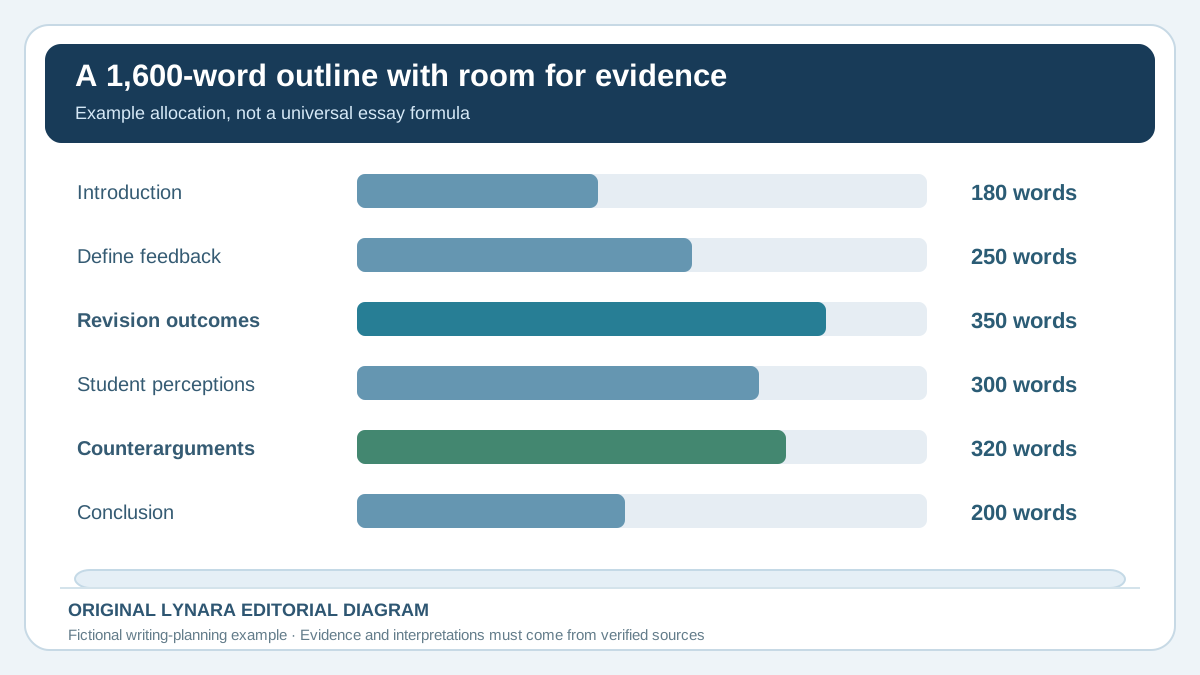
Imagine a 1,600-word hypothetical assignment assessing whether automated formative feedback helps first-year writing students. One possible structure is a 180-word introduction establishing the research question and limits; a 250-word section explaining types of feedback and their measurement; a 350-word section comparing evidence about revision quality; a 300-word section on student perception; a 320-word section discussing counterarguments and access concerns; and a 200-word conclusion. Those add to 1,600 words. They are budgeting assumptions, not a universally good length. Check them against the actual rubric with the Word Budget Calculator.
Turn the sample research essay into a usable evidence plan
The 1,600-word example above gives you section lengths, but numbers alone won't tell you whether the argument works. Here is a compact planning sheet for the fictional question about automated feedback. None of the sample entries asserts that a real study found a particular effect.
| Section's job | Evidence to find | Question to test before drafting |
|---|---|---|
| Define feedback | Actual course context and a verified definition of the intervention. | Are the studies measuring comments, automated scoring or revision suggestions? |
| Compare revision outcomes | Methods and results from original research measuring student revisions. | Is improved writing quality measured, or only student satisfaction? |
| Test the counterargument | Evidence on access, error rates or dependency, where available. | Would this objection narrow the thesis? |
| Reach a limited conclusion | Strengths and limitations already covered in the body. | Am I claiming more than the evidence allows? |
Try writing a one-sentence answer in the final column for each section before drafting. An empty evidence cell is a signal to return to your sources, not an invitation to make a citation up. If your rubric weights source evaluation heavily, give more time and space to methods and limitations even if a template suggests equal paragraph lengths.
Stop or revise the outline when the evidence does not fit
Use a short go, revise or pause decision before drafting. Go when every central section has at least one real source with a known method and a clear reason that the evidence supports the claim. Revise when sources measure a related but different outcome: a student satisfaction survey cannot, by itself, prove an improvement in evaluated writing quality. Pause when you cannot access the original study, the prompt prohibits outside sources, or the required evidence has not been collected. A polished heading does not make a missing finding real.
For the fictional automated-feedback example, record the study identifier, research design, number and type of participants, measure of revision quality, main limitation and the exact sentence you intend to write. If two studies measure different outcomes, keep that distinction in the outline rather than averaging their conclusions. Mark an unsupported idea “evidence needed” until it can be checked, and use the evidence matrix to compare methods. This decision gate is especially important if AI helped you brainstorm claims: never ask the tool to fabricate citations or fill an empty study-results cell.
Then apply a final rubric-to-outline check: match each required learning objective to a planned section, verify that planned evidence actually answers it, and confirm that your counterargument receives genuine treatment. If the rubric asks for a close reading of assigned passages only, a broad research essay with outside scholarship may violate the task even if it is otherwise coherent. The instructor's instructions take precedence over this example.
Give every section a job
A section title such as “Evidence” does not tell you what the paragraph will prove. Instead, draft a purpose statement: “Compare studies that measure actual revisions, not just how much participants liked feedback.” Under it, list the source, method, result and limitation that bear on the point. Another section might distinguish measurable writing quality from self-reported confidence. This prevents an outline from becoming a pile of quotations. If you do not yet have a source for a critical claim, write “evidence needed” rather than inventing a citation.
Plan counterarguments before you draft
A credible essay should consider what a careful opponent would say about its central claim. Harvard's counterargument guide suggests viewing objections as alternative answers or missing evidence, not an obligatory sentence inserted at the end. In our fictional essay, an objection might be that automated feedback reduces independent revision skill. A measured response would require evidence about long-term learning, not the unsupported assertion that the concern is false. A counterargument may legitimately narrow or change the thesis.
Outline by comparison, not by source
A common literature-based outline has one paragraph per author. This structure is easy to write but often fails to synthesize. A better thematic plan might compare participants, methods, outcomes and evidence limitations across several studies in each section. Use our Literature Review Evidence Matrix Builder to organize real sources and see when you lack a method or limitation. The worksheet cannot authenticate papers and should not be used to generate fictional findings. Keep source verification distinct from deciding paragraph order.
A second example: a close-reading essay
Suppose an assignment asks how a recurring image changes meaning over the course of a short story. The outline could begin with the image's first appearance and the narrator's perspective, then analyze the contrast at a turning point, then show how later details complicate the reader's initial interpretation. Each body section needs a specific passage and close analysis, not merely a chapter summary. The conclusion should explain what this reading changes about the larger question. A thematic literature-review outline would not automatically fit this task.
What the introduction needs to accomplish
An introduction gives the reader context, stakes, question and a workable central claim. It should not become a dictionary of broad concepts before arriving at the actual topic. If the essay analyzes one study, identify the relevant issue and scope. If it compares multiple papers, explain the dimension of comparison. The thesis may change as you examine evidence; use a working thesis early and revise it honestly when research complicates the original idea. Do not promise a claim that the sources cannot support.
Evidence and analysis are not synonyms
A quotation, chart or statistic provides material; analysis explains how that material addresses the essay's claim and why the reader should trust the inference. Your outline can include two separate lines under each planned paragraph: “evidence” and “interpretation.” If the interpretation merely repeats the quotation in different words, it may need deeper reasoning. If the evidence line is empty, research is unfinished. The AI Claim Verification Tracker can help record which generated or tentative claims still need original source support.
Reverse outline an existing draft
Students often discover the real structure after writing a rough draft. To reverse outline, summarize the central claim of each existing paragraph in one sentence. Place those claims in order, then inspect gaps, duplication and abrupt changes. If two sections make the same point, decide whether to merge or give them different roles. If the conclusion introduces new evidence, move it earlier or adjust the structure. Harvard's essay-organization materials recommend reverse outlining as one possible way to check logic and sequence.
Fix a real structure problem with a reverse outline
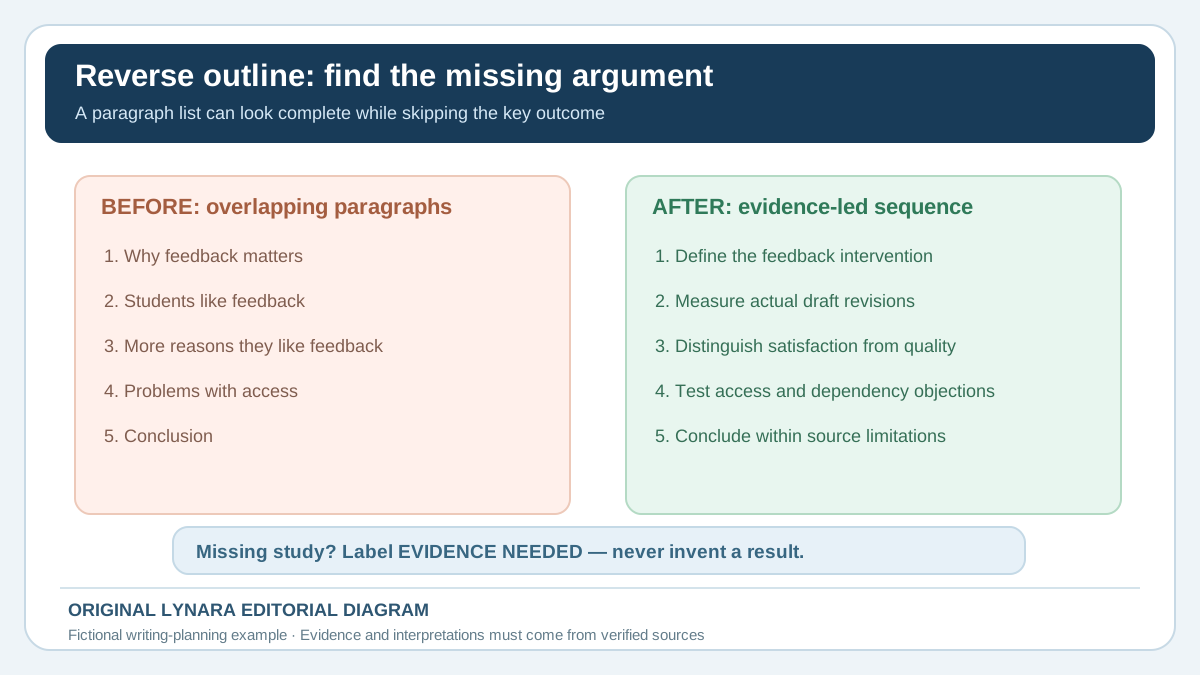
Imagine a draft whose paragraph notes say: “1: why feedback matters; 2: students like feedback; 3: more reasons students like feedback; 4: problems with access; 5: conclusion.” The second and third paragraphs overlap, and nothing evaluates whether revision quality improved. The fix is not merely renaming headings. Merge the overlapping material, reserve a paragraph for verified outcome measures and use the access discussion to qualify the thesis. If the sources never measured revision quality, change the question or limit the claim—don't pretend the missing evidence is there.
For a quick test, cover your paragraph text and read only each one-sentence summary aloud. Does the sequence tell a logical story? Could you explain why paragraph three must follow paragraph two? That exercise takes minutes and often exposes repetition more clearly than rereading the full draft. Use your own draft and sources; the Evidence Matrix can help identify whether two paragraphs rely on the same unsupported claim.
Revision checklist before submitting
Ask whether every section answers some part of the prompt, every paragraph connects back to the thesis and all empirical claims have genuine sources. Confirm that counterarguments are treated fairly, quotations are accurate and the conclusion follows from the evidence. Use the word-budget calculator to diagnose overlong background or a rushed analysis section, not to force every paragraph to the same length. An outline is successful when you can explain why each part is present and why the next part follows—not merely when it has Roman numerals.
Compare a weak outline with an evidence-driven one
For the fictional first-year feedback essay, a weak outline might read “Introduction; Advantages; Disadvantages; Conclusion.” Those labels do not tell the writer what to research, how the sources relate or where a counterargument changes the thesis. An evidence-driven outline could instead read: “Define feedback and the measured learning outcome; compare studies reporting actual draft revisions; distinguish students' stated confidence from graded writing quality; review access and dependency objections; draw a conclusion limited to what the studies can show.”
When using that structure, mark each subsection with a claim, the original source it relies on, a methodological limitation, and a sentence explaining how the section advances the thesis. You should not insert an invented author or numerical effect merely to fill the evidence cell. A missing reference means the reading stage is unfinished, not that the outline has failed.
The Literature Review Evidence Matrix makes this comparison more concrete: enter verified studies and label the different outcomes and methods before selecting a paragraph order. Then use the Essay Word Budget Calculator to assign space to those sections. Giving the longest section to the most substantial evidence is often more defensible than forcing every paragraph to use exactly the same number of words.